



Protection Of Algorithmically Designed Public Installations And Digital Sculptures
I. Legal Framework for Protection
1. Copyright Protection
Copyright protects:
The source code of the algorithm (as a literary work),
The audiovisual output (if sufficiently original),
The overall sculptural form (as artistic work),
3D digital models and renderings.
However:
Copyright protects expression, not ideas or mathematical methods.
Pure algorithms as abstract procedures are not protected — only their coded expression.
2. Patent Protection
If the installation involves:
Novel technical processes,
New interactive systems,
Innovative data-processing mechanisms,
it may qualify for a utility patent (if it meets novelty, inventive step, and industrial applicability requirements).
In the U.S., software patents are limited by the Supreme Court decision in Alice Corp. v. CLS Bank International, which restricts patents on abstract ideas implemented via computers.
3. Moral Rights (Important for Public Installations)
Public sculptures and installations are often protected by moral rights laws.
In the United States, the Visual Artists Rights Act (VARA) protects:
Right of attribution,
Right of integrity (preventing distortion or destruction).
4. Design Rights
In some jurisdictions:
Registered design protection may protect the ornamental form.
EU unregistered community design rights can protect short-term aesthetic originality.
5. Contractual and Licensing Protection
Because algorithmic installations are often commissioned:
Licensing agreements determine ownership.
Public-private contracts define reproduction rights.
Code escrow agreements may govern maintenance.
II. Important Case Laws (Detailed Discussion)
Below are more than five key cases relevant to algorithmic installations and digital sculpture protection.
1. Alice Corp. v. CLS Bank International
Issue:
Whether implementing an abstract idea on a computer makes it patentable.
Relevance:
Algorithmic public installations often rely on software processes.
Decision:
The U.S. Supreme Court held:
Abstract ideas are not patentable.
Merely implementing them on a computer does not make them patentable.
There must be an "inventive concept" beyond the abstract idea.
Application:
If a digital sculpture uses:
Mathematical pattern generation,
Data transformation,
Environmental sensors,
the underlying algorithm may not be patentable unless it improves computer functionality or introduces a technical innovation.
2. Feist Publications, Inc. v. Rural Telephone Service Co.
Issue:
Whether factual compilations are protected by copyright.
Principle:
Originality requires:
Independent creation,
Minimal creativity.
Relevance to Algorithmic Works:
If a sculpture is generated purely from:
Raw environmental data,
Automatically processed inputs,
Without human creative input,
then protection may be limited.
This case establishes that:
Mechanical or automated output without creative authorship may lack copyright protection.
3. Bridgeman Art Library v. Corel Corp.
Issue:
Whether exact photographic reproductions of public domain artworks are protected.
Holding:
Slavish reproductions lacking creativity are not protected.
Application:
If an algorithm merely replicates:
Pre-existing sculptural forms,
Public domain architecture,
Standard geometric patterns,
without creative variation, protection may fail.
This case highlights the threshold of creativity.
4. Meshwerks, Inc. v. Toyota Motor Sales U.S.A., Inc.
Issue:
Whether digital 3D wireframe models of Toyota cars were copyrightable.
Holding:
The court denied protection because:
The models were exact digital copies,
No creative deviation was added.
Relevance:
If a digital sculpture is:
Purely a digital scan,
An exact real-world replication,
it may not qualify for copyright.
However, if algorithmic distortion, abstraction, or creative transformation occurs, protection strengthens.
5. Massachusetts Museum of Contemporary Art Foundation, Inc. v. Büchel
Issue:
Whether unfinished installation art is protected under moral rights (VARA).
Facts:
Artist Christoph Büchel created a massive installation.
The museum modified and displayed it against his wishes.
Holding:
The court ruled that:
VARA protects installation art,
Even unfinished works may qualify,
Artists can prevent distortion or premature display.
Relevance:
Algorithmically generated public installations:
Often involve complex software configurations,
May evolve over time.
Artists retain moral rights over:
Modification of the code,
Alteration of interactive parameters,
Removal or destruction.
6. Carter v. Helmsley-Spear, Inc.
Issue:
Whether lobby sculpture artists could prevent removal under VARA.
Holding:
The court held:
VARA protects works of recognized stature,
But employment status affects ownership.
Application:
If an algorithmic installation is commissioned:
Was the artist an employee or independent contractor?
Was there a written waiver of moral rights?
This case shows the importance of contract drafting.
7. Kelley v. Chicago Park District
Issue:
Whether a living garden installation was protected by copyright.
Holding:
The court ruled it was not copyrightable because:
It was a living, changing organism,
Not fixed in a tangible medium.
Relevance:
Many algorithmic installations are:
Dynamic,
Continuously changing,
Generative.
The court emphasized fixation requirement.
If the work constantly changes and lacks stable form, copyright issues arise.
However:
The code itself is fixed.
The sculptural framework may be fixed.
Individual generated frames may be protected.
8. Star Athletica, L.L.C. v. Varsity Brands, Inc.
Issue:
When artistic features of useful articles are copyrightable.
Holding:
If artistic features:
Can be conceptually separated,
And exist independently of utility,
they are protected.
Application:
If an installation:
Also serves architectural or functional purposes,
Includes lighting, seating, or shelter,
the artistic algorithmic patterns may still be protected if separable from utility.
III. Key Legal Challenges for Algorithmic Public Art
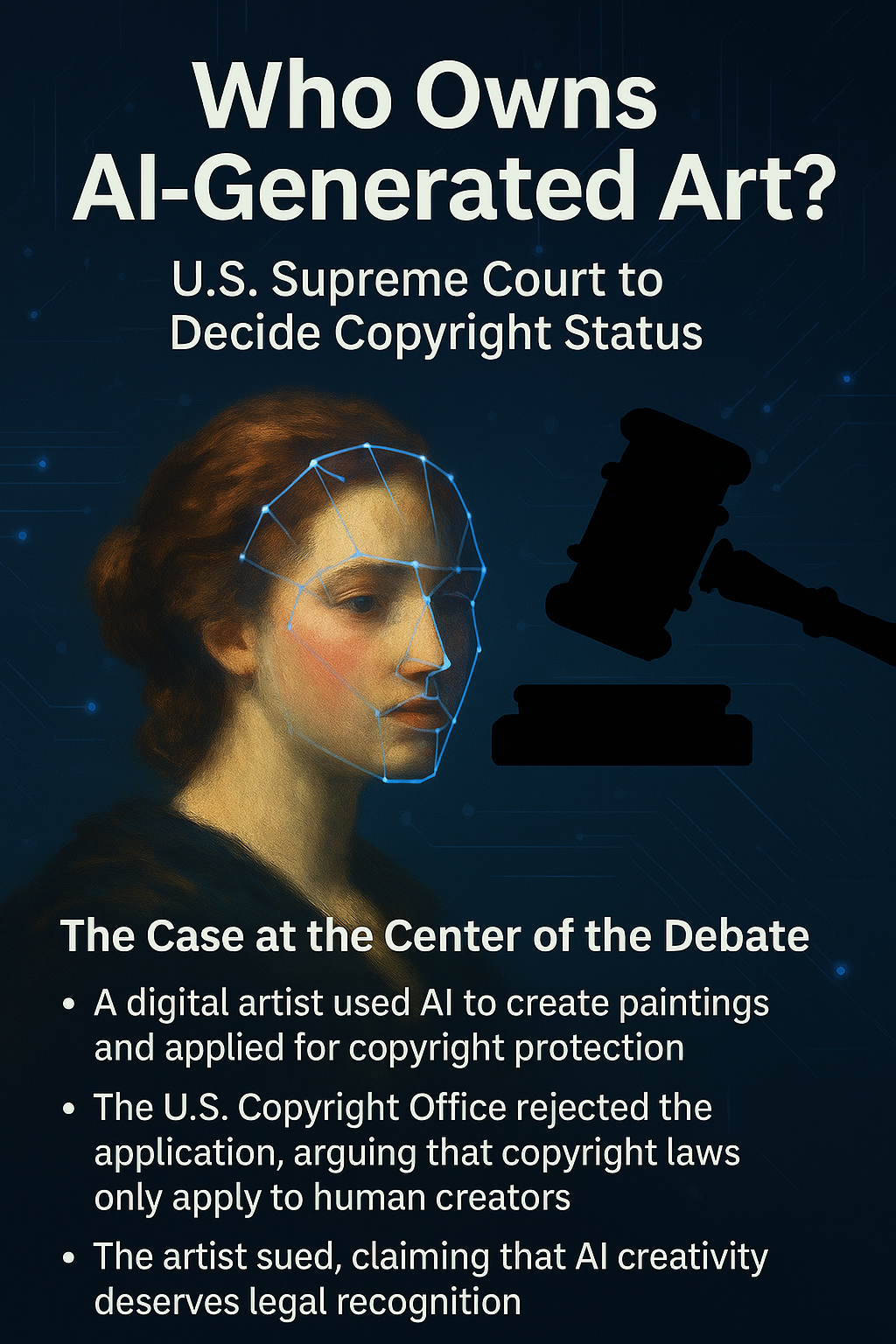
1. Authorship
Is the artist the coder?
Is the AI system the author?
Is the commissioning body a joint author?
Most jurisdictions require human authorship.
2. AI-Generated Variability
If the algorithm:
Produces new outputs every second,
Adapts to environmental data,
who owns each generated version?
Courts generally protect:
The underlying program,
Not necessarily every unpredictable output.
3. Public Space Complications
Public installations face:
Government modification,
Urban redevelopment,
Vandalism,
Site relocation.
Moral rights and contract law become crucial.
4. Destruction and Removal
If a city removes a digital sculpture:
VARA may apply (U.S.).
European moral rights laws may be stronger.
IV. Comparative Position
United States:
Strong copyright.
Limited moral rights.
Restrictive software patentability (post-Alice).
European Union:
Strong moral rights.
Design rights protection.
Broader database rights (relevant to generative systems).
V. Conclusion
Algorithmically designed public installations and digital sculptures are protected through a multi-layered legal approach:
Copyright protects code and expressive output.
Patent law protects technical innovations (with limits).
Moral rights protect integrity of public art.
Design rights protect ornamental form.
Contract law determines ownership in commissioned works.
The case laws discussed above demonstrate that protection depends on:
Originality,
Fixation,
Human authorship,
Creative deviation,
Conceptual separability,
And technical innovation beyond abstract ideas.
As generative and AI-based public art expands, courts will increasingly refine doctrines of authorship, originality, and integrity in relation to computational creativity.
RELATED Blog



comments