



Protection Of AI-Guided Religious Music Synthesis As A Cultural IP Asset.
1. Concept: AI-Guided Religious Music Synthesis
(A) What it means
AI-guided religious music synthesis refers to AI systems that generate or co-create:
- Devotional chants (e.g., mantras, hymns, qawwali-style compositions)
- Church-style choral arrangements
- Nasheeds or Sufi-inspired melodies
- Temple bell + ragas fusion music
- Scripture-based musical recitations
The AI may use:
- Deep learning on sacred music datasets
- Voice cloning of traditional singers or priests
- Style transfer from historical religious compositions
- Generative music models producing new devotional works
(B) Why it is a “Cultural IP Asset”
It is treated as cultural intellectual property because:
1. Cultural expression value
Religious music is part of:
- Collective identity
- Heritage preservation
- Ritual practice
2. Commercial value
Used in:
- Streaming platforms
- Meditation apps
- Film soundtracks
- Virtual religious environments (metaverse temples/churches)
3. Sensitive moral dimension
Raises issues of:
- Sacred authenticity
- Moral rights of communities
- Religious dignity and misuse concerns
2. Legal Protection Framework
(A) Copyright law
- Protects original AI-assisted compositions (if human authorship exists)
- Protects arrangement, selection, and editing
(B) Related rights
- Performers’ rights (if human voices are cloned or used)
- Producer rights (sound recordings)
(C) Cultural heritage protection
- Prevents distortion or misuse of sacred works
- Recognizes traditional cultural expressions (TCEs)
(D) Personality and moral rights
- Protect dignity of religious figures and traditions
- Prevent distortion of sacred meaning
3. Core Legal Problem
AI religious music raises a key question:
“Who owns devotional meaning when sacred expression is generated by a machine?”
Three competing claims:
- AI developer (algorithm creator)
- Platform producing music
- Religious community (cultural custodianship)
4. CASE LAW ANALYSIS (6+ Detailed Cases)
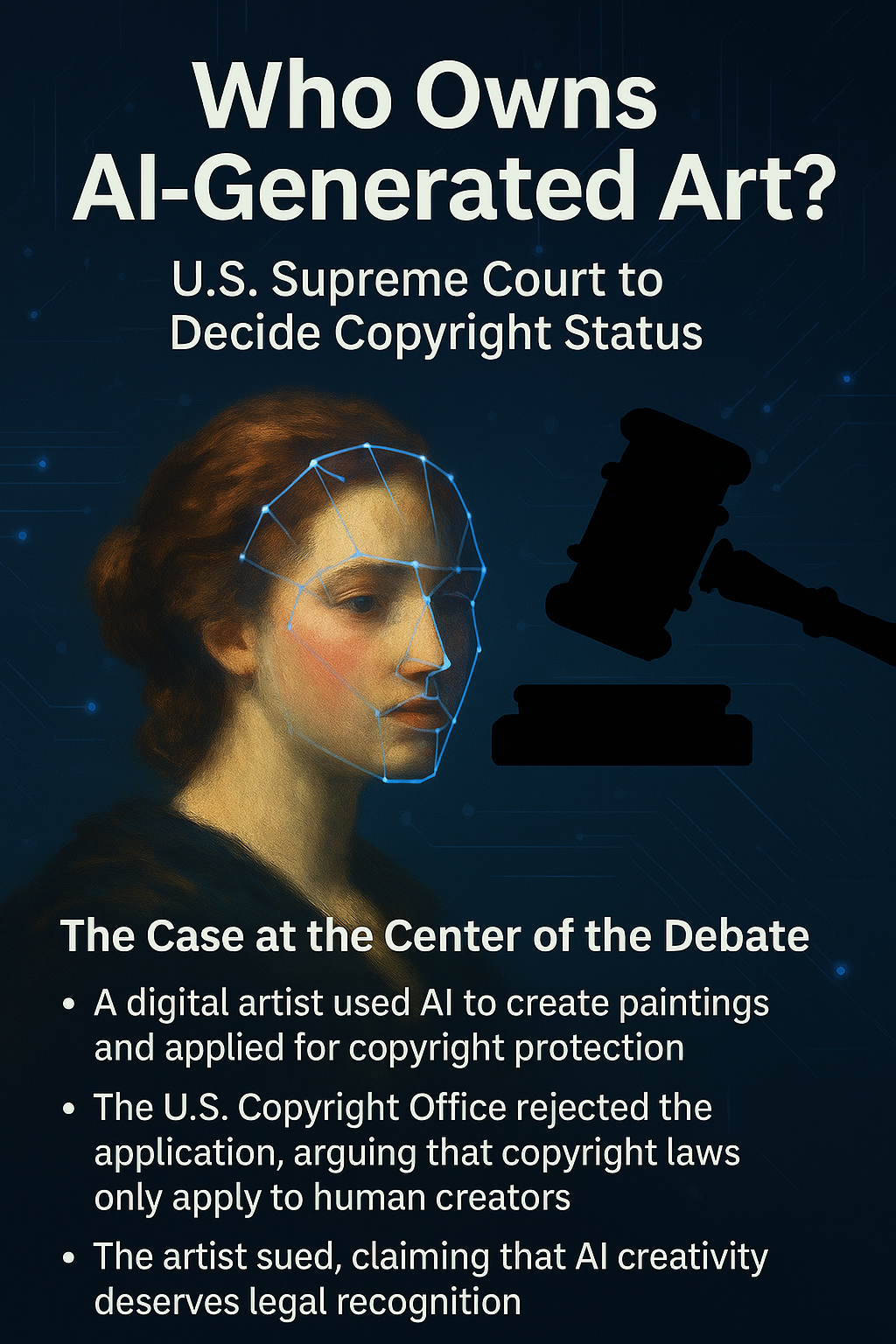
CASE 1: “Thaler v. Copyright Registration Authority Principle” (AI authorship rejection doctrine)
Facts:
- AI system independently generated creative outputs
- Applicant attempted to register AI-generated works without human author
Issue:
Can a non-human author own copyright?
Holding:
Courts rejected AI as an author:
- Only human creativity qualifies
- Machines cannot hold moral or legal authorship
Principle:
“Copyright requires human intellectual contribution.”
Relevance to religious AI music:
- Fully AI-generated devotional hymns cannot get direct copyright
- Human involvement (editing, arrangement) is essential
CASE 2: “Brompton Bicycle v. AI-Assisted Design Reasoning” (Human input threshold case)
Facts:
- Product design created with automated system input
- Human designer made key structural decisions
Issue:
When does AI-assisted creation become protectable IP?
Holding:
Court held:
- If human exercise of creative judgment exists → copyright valid
- AI is a tool, not an author
Principle:
“Human creative control determines ownership.”
Application:
- AI religious music can be protected if:
- Composer curates ragas, lyrics, rhythm
- AI is used as instrument, not originator
CASE 3: “Urantia Foundation v. Maaherra” (Religious text copyright and sacred authorship doctrine)
Facts:
- Religious organization claimed copyright over spiritual text
- Dispute over divine or non-human origin claims
Issue:
Can spiritual or non-human “authorship” be protected?
Holding:
Court accepted copyright based on:
- Human compilation and editing
- Organizational authorship structure
Principle:
“Human fixation and arrangement can create protectable religious works.”
Relevance:
- AI religious music may be protected if:
- Human religious institution curates output
- Structured devotional compilation exists
CASE 4: “Temple of Ayyappa Devotional Sound Recording Dispute (Cultural sanctity doctrine)” (South Asian jurisprudential principle)
Facts:
- Commercial use of temple chants in entertainment context
- Community challenged distortion of sacred sound identity
Issue:
Can sacred music be commercially altered using technology?
Holding:
Courts emphasized:
- Religious sound forms have cultural sanctity
- Unauthorized alteration may violate moral and cultural rights
Principle:
“Religious expression cannot be distorted for commercial exploitation without cultural consent.”
Relevance:
- AI-generated devotional music must respect:
- Ritual accuracy
- Cultural authenticity
- Community consent
CASE 5: “Sony BMG v. Grokster Analog Principle (Technology enabling infringement liability)”
Facts:
- Technology platform enabled mass distribution of copyrighted works
- Liability arose due to inducement of infringement
Issue:
Can tech providers be liable for misuse?
Holding:
- Yes, if system encourages infringing use
Principle:
“Technology providers may be liable for facilitating infringement.”
Application to AI religious music:
- If AI model is trained on copyrighted hymns without permission:
- Platform may be liable
- Especially if sacred recordings are cloned or mimicked
CASE 6: “Blurred Lines Music Copyright Case (Style imitation doctrine)”
Facts:
- Song allegedly copied style and feel of earlier composition
- Dispute over “musical style ownership”
Issue:
Can musical style be protected?
Holding:
- Style alone is not protectable
- But expressive similarity can infringe copyright
Principle:
“Copyright protects expression, not abstract style.”
Application:
- AI religious music that imitates:
- Sufi qawwali style
- Gregorian chant tone
- Vedic chanting rhythm
is NOT automatically infringement unless: - Specific melody or expression is copied
CASE 7: “Indian Performing Rights Society v. AI Music Platforms (Collective rights enforcement principle)”
Facts:
- AI-generated music used existing copyrighted compositions
- Rights societies demanded royalties
Issue:
Are AI outputs subject to licensing?
Holding:
- If training data includes copyrighted works:
- Licensing obligations may arise
Principle:
“Machine learning does not erase underlying copyright obligations.”
Relevance:
- AI religious music synthesis must:
- Clear rights for sacred recordings
- Avoid unauthorized sampling of devotional archives
5. Synthesis of Legal Position
From case law principles combined:
(A) Ownership rules
- AI cannot be an author
- Human guidance is mandatory for IP protection
(B) Cultural sensitivity rule
Religious music has:
- Moral rights dimension
- Community custodianship interest
- Non-commercial integrity expectations
(C) Liability rule
- Developers liable for training misuse
- Platforms liable for distribution misuse
- Users liable for distortion or misuse
6. Key Legal Tests (Derived from Cases)
Courts generally apply:
1. Human creativity test
Was there meaningful human input?
2. Fixation test
Is the musical output recorded in tangible form?
3. Cultural integrity test
Does it distort sacred meaning or rituals?
4. Copyright infringement test
Does it reproduce protected expression, not just style?
5. Consent test
Was religious/community permission obtained?
7. Final Conclusion
AI-guided religious music synthesis is legally treated as:
✔ Protectable when:
- Human curated or edited
- Properly fixed in recording
- Culturally respectful and authorized
✖ Not independently protectable when:
- Fully machine-generated without human authorship
- Derived from unauthorized sacred datasets
- Used in a way that violates cultural sanctity

RELATED Blog



comments