



Patent Law Challenges In Quantum-Enhanced AI Data Analysis And Prediction Models.
🔹 1. Key Patent Law Challenges in Quantum-Enhanced AI
1. Patent Eligibility (Abstract Idea Problem)
Most jurisdictions (especially the U.S.) exclude:
- Abstract ideas
- Mathematical formulas
- Algorithms
Quantum-AI models often rely on:
- Quantum circuits (mathematical constructs)
- Optimization algorithms
- Statistical prediction methods
👉 The challenge: Are these technical inventions or just abstract computations?
2. Inventorship (AI + Quantum Autonomy)
Quantum-enhanced AI systems may:
- Self-optimize
- Generate new predictive models autonomously
This raises:
- Who is the inventor? The human? The AI?
3. Enablement & Disclosure
Quantum systems are:
- Highly complex
- Not easily reproducible
Patent law requires:
- Sufficient disclosure so a skilled person can replicate the invention
👉 Problem: Quantum-AI models may be:
- Too complex to fully explain
- Dependent on specialized quantum hardware
4. Non-Obviousness
Quantum + AI often combines known fields:
- Quantum computing
- Machine learning
Patent offices ask:
👉 Is the combination obvious to a skilled person?
5. Data & Training Issues
QAI models depend heavily on:
- Training datasets
- Optimization processes
But:
- Data itself is usually not patentable
- Training methods may be considered abstract
🔹 2. Important Case Laws (Detailed)
1. Alice Corp. v. CLS Bank International
Facts:
Alice Corp. patented a computerized financial trading system using intermediated settlement.
Issue:
Is implementing an abstract idea on a computer patentable?
Judgment:
The Supreme Court of the United States ruled:
- Merely applying an abstract idea on a generic computer is NOT patentable.
Two-Step Test (Alice Test):
- Is the claim directed to an abstract idea?
- Does it include an “inventive concept” beyond that idea?
Relevance to Quantum-AI:
- Quantum-enhanced prediction models may be seen as:
- Mathematical models (abstract)
- Unless tied to:
- Specific quantum hardware improvements
- Technical implementation
👉 Most QAI patents risk rejection under Alice.
2. Diamond v. Diehr
Facts:
Patent involved curing rubber using a mathematical equation (Arrhenius equation) implemented in a computer-controlled process.
Judgment:
The Court allowed the patent because:
- It improved an industrial process
- The algorithm was applied in a physical transformation
Key Principle:
👉 Mathematical formulas CAN be patented if applied in a technical process
Relevance to Quantum-AI:
- If QAI is used in:
- Drug discovery
- Material science
- Climate modeling
👉 It becomes more patentable when tied to real-world technical effects
3. Gottschalk v. Benson
Facts:
Patent claim covered a method for converting binary-coded decimal numbers into pure binary.
Judgment:
Rejected because:
- It was purely a mathematical algorithm
- Would preempt all uses of the method
Key Principle:
👉 Pure algorithms are NOT patentable
Relevance to Quantum-AI:
- Quantum algorithms (e.g., optimization routines) risk being:
- Considered mathematical abstractions
- Without hardware linkage → rejection likely
4. Parker v. Flook
Facts:
Patent for updating alarm limits in catalytic conversion processes using a formula.
Judgment:
Rejected because:
- Only novelty was the mathematical formula
- No inventive application beyond it
Principle:
👉 Adding a formula to a conventional process is NOT enough
Relevance:
- QAI models that:
- Improve prediction mathematically
- But don’t change system architecture
👉 May fail under this reasoning
5. Association for Molecular Pathology v. Myriad Genetics
Facts:
Myriad patented isolated human genes.
Judgment:
- Natural DNA → NOT patentable
- Synthetic DNA → patentable
Principle:
👉 Discoveries ≠ inventions
Relevance to Quantum-AI:
- Data patterns discovered by QAI:
- Not patentable
- But:
- Novel quantum processing methods may be
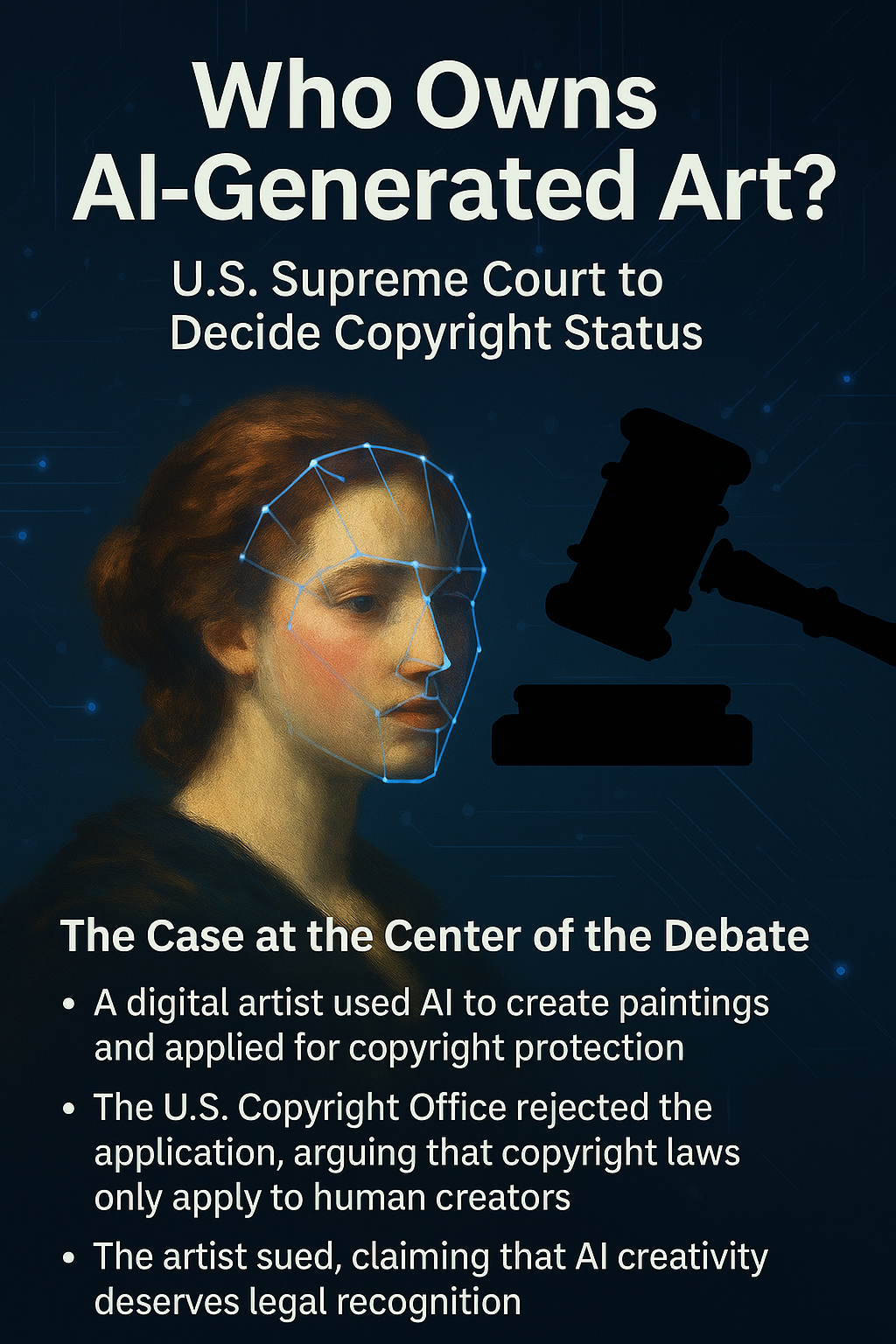
6. Thaler v. Vidal
Facts:
Stephen Thaler listed an AI system (DABUS) as the inventor.
Issue:
Can AI be an inventor?
Judgment:
- Only humans can be inventors under U.S. law
Principle:
👉 AI cannot legally own inventorship
Relevance:
- Quantum-AI systems generating models:
- Cannot be inventors
- Human involvement must be shown
7. McRO Inc. v. Bandai Namco Games America Inc.
Facts:
Patent covered automated lip-sync animation using rules.
Judgment:
Patent upheld because:
- It improved computer functionality
- Not merely abstract
Principle:
👉 Software is patentable if it improves technology
Relevance:
- QAI systems that:
- Improve quantum circuit efficiency
- Optimize qubit usage
👉 More likely to be patentable
8. Enfish LLC v. Microsoft Corp.
Facts:
Patent involved a self-referential database model.
Judgment:
Allowed because:
- It improved computer architecture itself
Principle:
👉 Improvements to internal computer functioning are patentable
Relevance:
- Quantum-AI innovations in:
- Quantum memory structures
- Hybrid classical-quantum architectures
👉 Strong patent eligibility
🔹 3. Synthesis: How Courts Would Treat Quantum-AI Models
Likely Patentable:
- Quantum-enhanced AI tied to:
- Hardware improvements
- Physical processes
- Efficiency gains in computing
Likely Rejected:
- Pure:
- Prediction models
- Mathematical optimizations
- Data analysis methods
🔹 4. Emerging Legal Trends
- Shift toward technical effect requirement
- Stricter scrutiny of AI-generated inventions
- Focus on hardware + software integration
- Global inconsistency (USPTO vs EPO vs India)
🔹 5. Conclusion
Quantum-enhanced AI sits at the intersection of three problematic patent domains:
- Software patents
- AI-generated inventions
- Quantum algorithms
From the case laws above, a clear pattern emerges:
👉 Courts favor:
- Practical application
- Technical improvement
- Human inventorship
👉 Courts reject:
- Abstract models
- Pure algorithms
- Data-driven discoveries
RELATED Blog



comments