



IP Governance Around AI-Driven Traffic Decongestion Simulation Models.
🚦 1) Core IP Issues for AI‑Driven Traffic Simulation Models
AI traffic systems typically combine:
Proprietary algorithms (machine learning architectures for traffic prediction)
Training data (traffic sensor data, maps, vehicle flow logs)
Simulation outputs (predictive outputs which may be monetized or licensed)
The IP governance issues arise around who owns what, what is protected, and what legal rights others have when AI systems use, generate, or build on existing IP.
Key IP frameworks implicated include:
Patent law – for protecting innovative AI architectures, data processing pipelines, technical contributions beyond abstract algorithms.
Copyright law – for training data, underlying source code, and potentially the outputs of AI models.
Trade secrets – for datasets and proprietary model parameters.
Licensing & contracts – for controlling use of data and models by third parties.
🧠 2) Patent‑Related Governance and Case Law
Case 1 — Thaler v. Commissioner of Patents (DABUS)
Jurisdiction: Australia, U.S., U.K., others
Issue: Can an AI system itself be named as an inventor for patent rights?
Details: Stephen Thaler sought patents naming his AI DABUS as the sole inventor. Courts generally rejected this, holding that only natural persons count as inventors under patent statutes. In Australia the result was briefly different but ultimately overruled. This sets precedent globally that AI cannot (yet) hold patent rights — the human operator must be inventor.
Relevance: In traffic models, if a simulation technique was generated largely by AI, current IP systems will still require a human inventor to be listed. This affects who owns and can enforce patents.
Case 2 — Enfish, LLC v. Microsoft Corp. (U.S.)
Jurisdiction: United States (Federal Circuit, 2016)
Issue: Patent eligibility of software innovations that are not “abstract ideas.”
Details: The Federal Circuit upheld the patent eligibility of self‑referential database architecture developed by Enfish — addressing whether software claims were mere abstract ideas. This case became significant in software and AI patent challenges by clarifying how courts interpret technical improvements versus abstract algorithms.
Relevance: Traffic simulation models are software‑driven technical systems. Establishing technical contribution beyond abstract math/algorithms will be vital for patent protection.
Case 3 — Comprehensive Technologies Int’l v. Software Artisans (U.S.)
Jurisdiction: United States (Fourth Circuit)
Issue: Trade secret misappropriation in software systems.
Details: The court ruled that trade secret misappropriation claims require more than circumstantial evidence and clarified tests for software copyright and trade secret disputes.
Relevance: AI traffic models often rely on proprietary traffic data. This case highlights how courts examine misappropriation vs legitimate use, important when datasets are licensed or shared among vendors.
📚 3) Copyright and Training Data Case Law
Traffic systems often involve datasets aggregated from public and licensed sources — raising contentious copyright questions when used to train AI prediction models.
Case 4 — Thomson Reuters v. Ross Intelligence (Ross AI)
Jurisdiction: U.S. District Court
Issue: Use of proprietary content to train competing AI.
Details: Westlaw sued competitor Ross Intelligence for training a legal research AI on Westlaw headnotes. The court rejected fair use because Ross built a competitive product using proprietary content and this directly competed with Westlaw’s services.
Relevance: For traffic simulation, using a competitor’s proprietary traffic dataset without permission to train or enhance your model could be infringing — especially if the model competes commercially.
Case 5 — Copyright Lawsuits Against Generative AI Training (Meta & Anthropic)
Example: Meta was sued by 13 authors alleging unauthorized use of book texts to train Meta’s Llama AI. A U.S. federal judge dismissed the claims partly on fair use grounds — but stressed this wasn’t approval of the underlying data practices.
Relevance: Although not specific to traffic models, the principles apply to AI training on copyrighted sources. For traffic simulation, sensors or municipal data collected under license may have contractual or copyright conditions governing reuse.
Case 6 — Andersen v. Stability AI / Getty Images v. Stability AI
Jurisdictions: U.S.
Issue: AI models trained on large visual databases without license.
This ongoing litigation involves artists and Getty Images alleging that Stability AI trained on copyrighted images without authorization and created works reproducing copyrighted traits.
Relevance: Even for non‑visual traffic data, the scraping and reuse of proprietary datasets for model training raises similar infringement questions — particularly for datasets not in public domain.
🔐 4) Trade Secret & Data Use Governance
Case 7 — Figma Data Use Lawsuit
Jurisdiction: U.S. District Court (N.D. Cal.)
Issue: Alleged misuse of customer data to train Figma AI tools without consent.
Details: Users claim their proprietary designs and IP were used to train Figma’s AI without permission — a form of trade secret misappropriation and contract breach.
Relevance: Municipal traffic data, private sensor logs, or contractual data shared by partners can have trade secret protection. Unauthorized training or derivative use may trigger liability.
🧩 5) Licensing, Contracts, and Model Outputs
Two important governance questions arise for AI simulation models:
(a) Who owns model outputs?
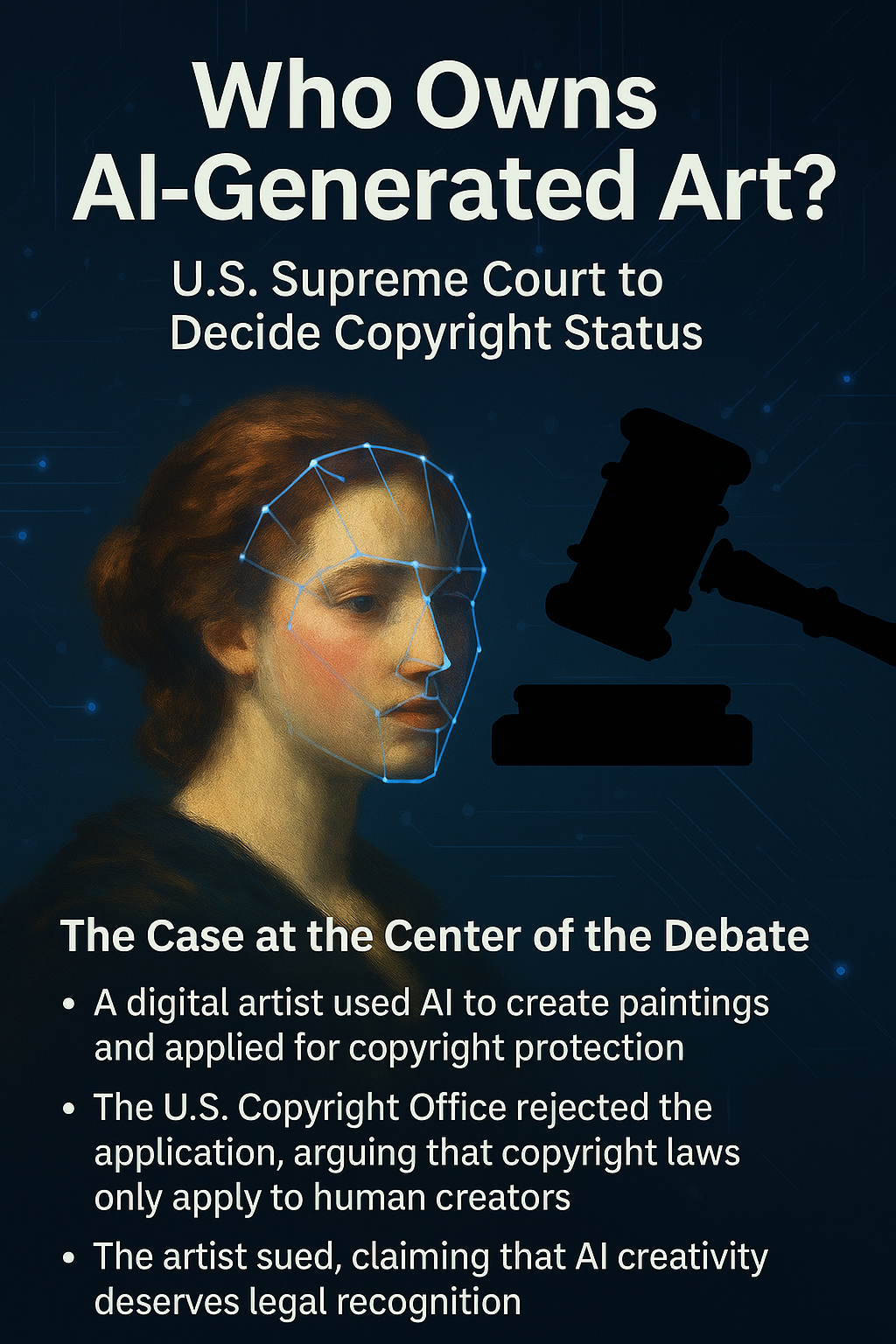
Even if training data is proprietary, the legal status of AI‑generated outputs (predicted traffic patterns, optimized routing plans) remains unsettled. Some jurisdictions hold that purely machine‑generated works lack copyright unless there’s human contribution.
(b) What does licensing permit?
Companies often require AI model licenses governing how models and training data can be used, shared, and commercialized. But courts question how enforceable these licenses are when they purport rights over model weights or generated outputs that might not be copyrightable. (Scholars argue many such terms could be unenforceable).
🧠 6) Specific Concerns for Traffic Decongestion AI Systems
Traffic simulation models uniquely involve:
Sensitive dataset governance
Traffic point data may derive from private vehicles or user devices → subject to privacy and contractual restrictions.
Improper use can lead to trade secret or contractual breach claims.
Patentability challenges
Transportation simulation models often involve complex tech stacks. Courts will analyze if the innovation is a technical contribution rather than abstract math.
Data licensing
Licensing terms must explicitly allow use in AI training.
Competing firms cannot use datasets without clear permissions — as Ross Intelligence shows.
⚖️ 7) Policy and Future Directions
Even where direct case law is still developing, several trends are emerging:
📍 Fair use doctrine is contested
Courts are split on how fair use applies to AI training — some rulings accept it narrowly, others reject it when there’s direct competition.
📍 Inventorship is human‑centric
AI cannot currently be an inventor under most patent regimes, affecting ownership structures of AI‑generated innovations.
📍 Licensing regimes evolving
Many jurisdictions are considering AI‑specific IP reforms to require data licensing and training royalties — especially for training on proprietary datasets.
📌 Summary of Principles for Traffic‑AI IP Governance
| IP Domain | Key Issue | Governance Requirement |
|---|---|---|
| Patent | Patent eligibility & AI inventorship | Must show human contribution and technical innovation |
| Copyright | Training data use | Use licensed or public data; fair use narrow & contested |
| Trade Secret | Proprietary datasets | Protect via contracts and strict access controls |
| Licensing | Model & output rights | Clear licensing needed; enforceability uncertain |
RELATED Blog



comments