



IP Concerns In Smart Toll Collection Algorithms
1. Patentability of Smart Toll Collection Algorithms
Smart toll systems rely on algorithms that perform tasks such as:
vehicle identification using RFID or camera recognition
automated billing and transaction processing
real-time traffic management
fraud detection and toll evasion monitoring.
Patent protection is often sought for technical innovations in toll collection systems. However, courts frequently examine whether such algorithms are abstract ideas or patentable technological inventions.
Case Law
1. Alice Corp v. CLS Bank International
Facts
Alice Corporation owned patents for a computerized financial settlement system that reduced settlement risk between financial institutions.
Legal Issue
Whether implementing a financial transaction method on a computer makes it patentable.
Judgment
The US Supreme Court held that simply implementing an abstract idea using a computer does not make it patent-eligible.
Two-Step Test Introduced
Determine whether the claim involves an abstract idea.
Determine whether the invention adds an inventive concept transforming the idea into a patent-eligible application.
Relevance to Smart Toll Systems
Many toll algorithms involve:
electronic payment processing
automated billing methods.
If a patent claim merely covers collecting toll payments electronically, it may be considered an abstract business method and rejected. However, if the invention includes:
unique vehicle detection technology
specialized traffic sensor integration
automated infrastructure control
it may qualify as a patentable technological improvement.
2. Copyright Protection for Toll Collection Software
The software that operates toll booths, payment gateways, and vehicle detection systems is protected under copyright law.
However, copyright protects expression of code, not ideas or algorithms themselves.
Case Law
2. Computer Associates International v. Altai Inc.
Facts
Computer Associates accused Altai of copying portions of its computer program used for system compatibility.
Issue
How courts should determine copyright infringement in computer programs.
Court Decision
The court created the Abstraction–Filtration–Comparison Test.
Three Steps
Abstraction – identify different layers of software (algorithms, modules, source code).
Filtration – remove elements that are not copyrightable (ideas, efficiency-driven structures).
Comparison – compare remaining protected elements to determine infringement.
Application to Smart Toll Algorithms
If a company develops a toll collection platform and another company copies its:
source code
database architecture
user interface
courts will use this test to determine infringement.
However, general toll processing algorithms cannot be copyrighted.
3. Trade Secret Protection of Toll Algorithms
Companies often protect their toll collection algorithms as trade secrets rather than patents.
Trade secrets may include:
vehicle recognition algorithms
dynamic toll pricing models
fraud detection algorithms
traffic prediction systems.
Case Law
3. Waymo LLC v. Uber Technologies Inc.
Facts
A former Waymo engineer downloaded thousands of confidential files related to autonomous vehicle technology before joining Uber.
Legal Issue
Whether Uber used Waymo’s confidential trade secrets.
Outcome
The case settled with Uber agreeing to provide equity compensation worth about $245 million and confirm that Waymo’s trade secrets were not incorporated in its technology.
Importance for Smart Toll Systems
If an engineer working on a smart toll algorithm leaves a company and shares:
proprietary vehicle recognition models
toll optimization algorithms
fraud detection software
with another company, it could result in trade secret misappropriation litigation similar to the Waymo dispute.
4. Patent Eligibility of Computer Implemented Inventions
Smart toll systems often combine hardware sensors with software algorithms. Courts must determine whether the invention represents a genuine technological improvement.
Case Law
4. Diamond v. Diehr
Facts
The case involved a process for curing rubber using a computer program that calculated the curing time.
Legal Issue
Whether a computer-implemented process could be patented.
Judgment
The US Supreme Court ruled that the invention was patentable because it involved a physical industrial process controlled by a computer.
Key Principle
A mathematical formula can be patented if it is applied in a technological process.
Application to Smart Toll Systems
A toll algorithm controlling:
barrier gates
vehicle detection sensors
automated payment infrastructure
may be patentable because it forms part of a physical transportation management system.
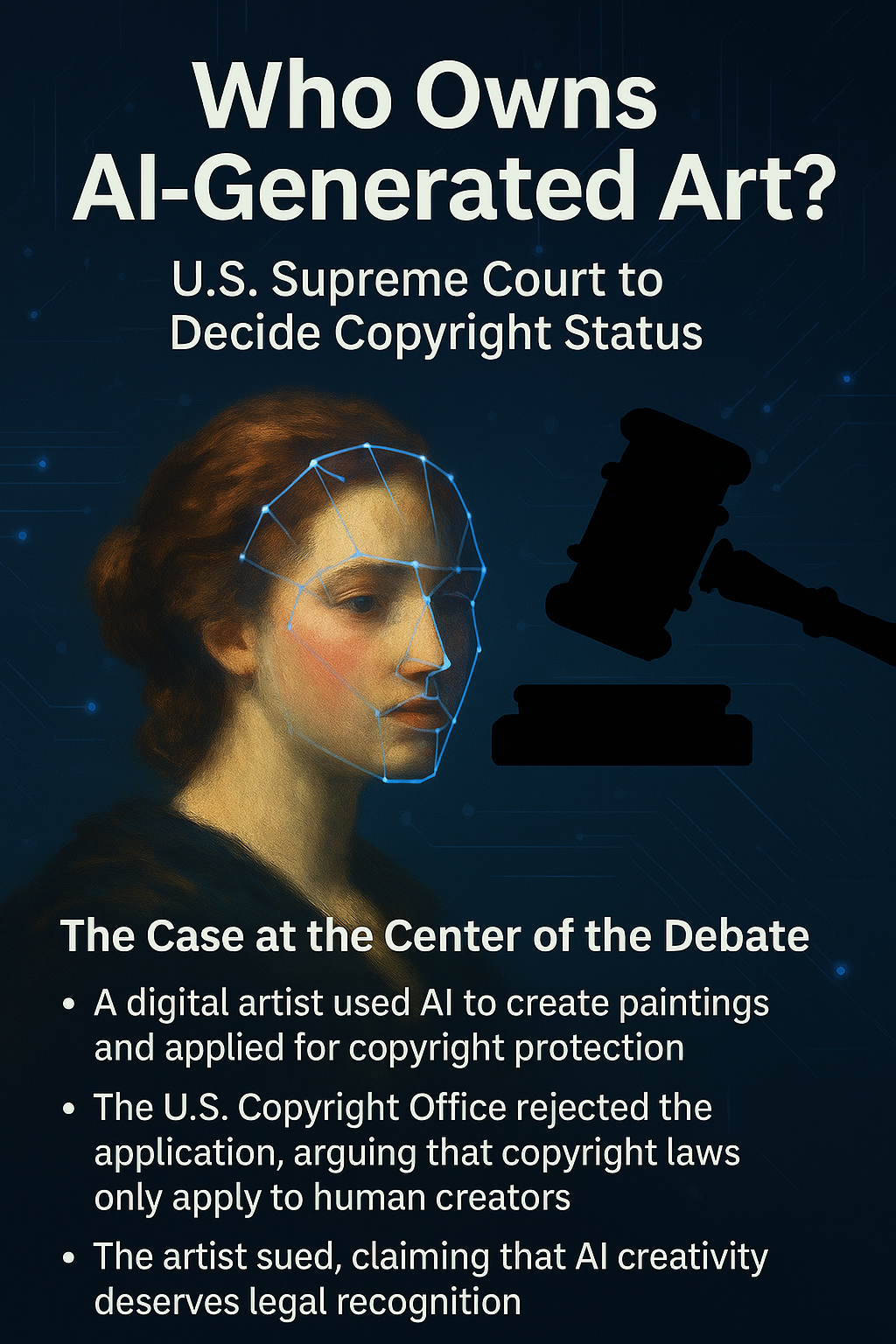
5. Copyright Ownership and Non-Human Creators
AI-driven toll systems may generate outputs such as:
traffic prediction reports
toll optimization models
dynamic pricing structures.
This raises questions about ownership of AI-generated outputs.
Case Law
5. Naruto v. Slater
Facts
A monkey named Naruto accidentally took photographs using a camera owned by photographer David Slater.
Legal Issue
Whether a non-human entity could own copyright.
Judgment
The court ruled that only humans can be authors under copyright law.
Relevance to Smart Toll Systems
If an AI system independently generates a new toll optimization model, the AI itself cannot own copyright.
Ownership will belong to:
the software developer
the company operating the system
or the employer under employment contracts.
6. Database Protection and Data Ownership
Smart toll systems generate enormous amounts of data, including:
vehicle movement patterns
toll payment records
traffic congestion statistics.
Ownership of this data is an important IP issue.
Case Law
6. British Horseracing Board v. William Hill
Facts
William Hill used racing data from the British Horseracing Board database for betting services.
Legal Issue
Whether the use of data constituted infringement of database rights.
Judgment
The court held that database protection applies when there is substantial investment in collecting and verifying data.
Application to Smart Toll Systems
A toll authority investing heavily in collecting traffic data may claim database protection.
However:
raw traffic data itself may not be protected
only the database structure and investment in data collection receive protection.
7. AI Inventorship and Patent Ownership
Smart toll systems may involve AI-assisted invention, raising questions about who should be recognized as the inventor.
Case Law
7. Thaler v. Comptroller-General of Patents
Facts
Stephen Thaler attempted to list an AI system called DABUS as the inventor of certain patent applications.
Issue
Whether an AI system can be legally recognized as an inventor.
Judgment
The UK Supreme Court held that only natural persons can be inventors under patent law.
Relevance to Smart Toll Algorithms
If an AI system autonomously develops:
a new vehicle recognition algorithm
dynamic toll pricing mechanism
the patent must still name a human inventor, such as the system developer or researcher.
8. Additional IP Concerns in Smart Toll Systems
1. Algorithm Transparency
Governments may require disclosure of toll algorithms to ensure fairness, which can conflict with trade secret protection.
2. Interoperability
Different toll systems must communicate across regions. Proprietary algorithms can limit interoperability.
3. Public Infrastructure vs Private IP
Since toll roads are public infrastructure, excessive IP control may limit government access to essential technologies.
4. Licensing Issues
Private technology providers often license toll software to governments under strict IP agreements.
9. Conclusion
Smart toll collection algorithms involve complex interactions between software, AI models, sensor technology, and transportation infrastructure. As a result, several intellectual property concerns arise, including:
patent eligibility of algorithms
copyright protection of software
ownership of AI-generated outputs
trade secret protection of proprietary algorithms
database rights in traffic data.
Important judicial decisions such as Alice Corp v. CLS Bank International, Computer Associates International v. Altai Inc., Waymo LLC v. Uber Technologies Inc., Diamond v. Diehr, British Horseracing Board v. William Hill, Naruto v. Slater, and Thaler v. Comptroller-General of Patents demonstrate how courts address legal challenges involving software, AI, data ownership, and inventorship.
These rulings collectively shape the legal framework governing AI-based toll collection technologies, balancing innovation incentives with public infrastructure needs.
RELATED Blog



comments