



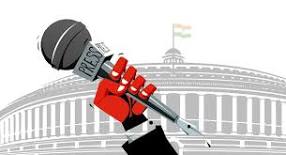
Press Freedom.
1. Meaning of Press Freedom
Freedom of the press refers to the right to publish information, opinions, and ideas without undue interference from the State. It is a cornerstone of democracy because it ensures:
- Free flow of information
- Accountability of government
- Public participation in governance
In India, press freedom is not separately mentioned in the Constitution but is derived from:
- Article 19(1)(a) – Freedom of speech and expression
- Subject to Article 19(2) – Reasonable restrictions
2. Scope of Press Freedom
Press freedom includes:
- Right to publish and circulate
- Right to criticize government policies
- Right to access information (linked with Right to Information)
- Right to editorial independence
However, it is not absolute and can be restricted on grounds such as:
- National security
- Public order
- Defamation
- Contempt of court
- Morality and decency
3. Importance in Democracy
A free press acts as:
- Watchdog – Keeps check on government power
- Public educator – Spreads awareness
- Platform for debate – Encourages diverse opinions
Without press freedom, democracy becomes weak and unaccountable.
4. Key Case Laws (At least 6)
(1) Romesh Thappar v. State of Madras (1950)
- One of the earliest cases on press freedom.
- Supreme Court struck down a ban on a journal.
- Held that freedom of circulation is part of freedom of speech.
- Established that restrictions must fall strictly within Article 19(2).
(2) Brij Bhushan v. State of Delhi (1950)
- Concerned pre-censorship of a newspaper.
- Court held pre-censorship unconstitutional.
- Emphasized that prior restraint is a serious violation of press freedom.
(3) Sakal Papers Ltd. v. Union of India (1962)
- Government tried to regulate number of pages in newspapers.
- Supreme Court struck it down.
- Held that economic restrictions affecting circulation violate press freedom.
(4) Bennett Coleman & Co. v. Union of India (1973)
- Newsprint policy restricted quantity of paper.
- Court held that such restrictions indirectly limit press freedom.
- Recognized that freedom of press includes freedom of quantity and circulation.
(5) Indian Express Newspapers v. Union of India (1985)
- Concerned import duty on newsprint.
- Court held that excessive taxation can burden press freedom.
- Established that press needs special consideration due to its role in democracy.
(6) Secretary, Ministry of I&B v. Cricket Association of Bengal (1995)
- Recognized right to broadcast as part of freedom of speech.
- Held that airwaves are public property and should be used for public good.
- Expanded press freedom into electronic media.
(7) Sahara India Real Estate Corp. v. SEBI (2012)
- Dealt with media reporting during ongoing trials.
- Court allowed postponement orders in certain cases.
- Balanced press freedom with fair trial rights.
(8) Shreya Singhal v. Union of India (2015)
- Struck down Section 66A of IT Act.
- Protected online speech and digital media.
- Reinforced that vague restrictions violate freedom of expression.
5. Doctrine of Reasonable Restrictions
Under Article 19(2), press freedom can be restricted only if:
- The restriction is reasonable
- It falls under specified grounds
- It is proportionate and not excessive
Courts apply tests like:
- Proportionality
- Clear and present danger
- Direct and proximate nexus
6. Types of Restrictions on Press
(A) Prior Restraint
- Government censorship before publication
- Generally disfavored by courts
(B) Post-publication Liability
- Defamation, contempt, sedition laws
(C) Economic Control
- Taxes, licensing, or resource restrictions
7. Challenges to Press Freedom Today
- Fake news and misinformation
- Government pressure and censorship
- Corporate ownership and bias
- Threats to journalists
- Digital regulation issues
8. Key Principles Summarized
- Press freedom is part of Article 19(1)(a)
- Includes publication, circulation, and expression
- Not absolute; subject to reasonable restrictions
- Courts strongly protect against:
- Censorship
- Indirect restrictions
- Balance required with:
- Fair trial
- National security
9. Conclusion
Press freedom is essential for a functioning democracy. The judiciary in India has consistently expanded and protected this freedom, ensuring that restrictions remain reasonable, proportionate, and justified. At the same time, it balances press freedom with other societal interests like justice, order, and security.

RELATED Blog







comments