



Six Capitals Model Application.
Six Capitals Model – Application
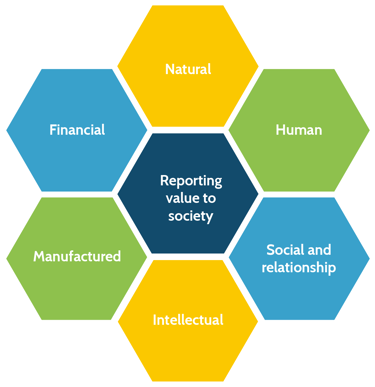
The Six Capitals Model is a core framework of International Integrated Reporting Council under the International <IR> Framework. It is used in integrated reporting to explain how organizations create value over time by managing multiple forms of capital—not just financial resources.
1. The Six Capitals Explained

4
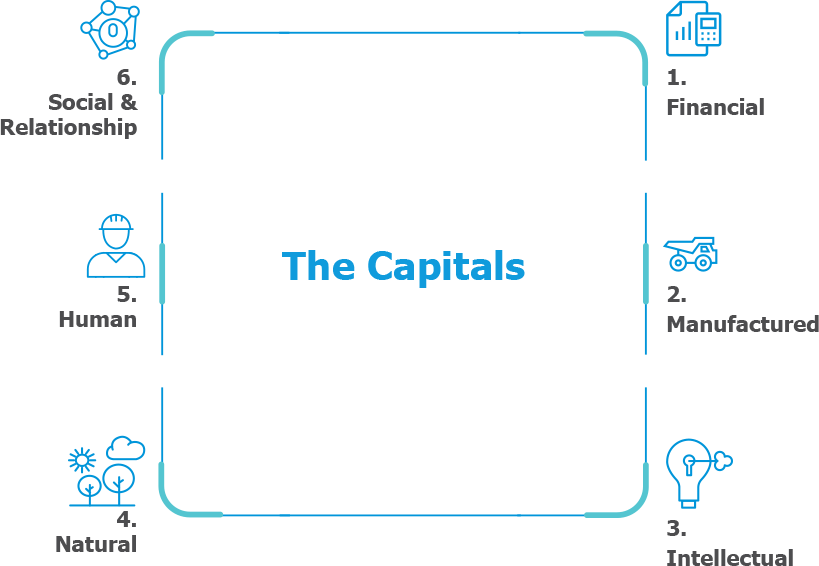
The model identifies six types of capital:
| Capital Type | Description |
|---|---|
| Financial Capital | Funds available (equity, debt, cash) |
| Manufactured Capital | Physical assets (plants, equipment, infrastructure) |
| Intellectual Capital | Intangibles (IP, patents, systems, brand) |
| Human Capital | Skills, experience, workforce capability |
| Social & Relationship Capital | Stakeholder relationships, trust, networks |
| Natural Capital | Environmental resources (land, water, biodiversity) |
2. Core Idea of the Model
Organizations:
- Use inputs from the six capitals
- Transform them through business activities
- Create outputs and outcomes
- Affect the capitals positively or negatively
👉 Focus: Long-term value creation, not just short-term profits
3. Practical Application of the Six Capitals Model
(a) Corporate Reporting (Integrated Reporting)
Companies use the model to:
- Explain value creation processes
- Link financial performance with:
- ESG factors
- Sustainability outcomes
Example:
- Investment in employee training → improves human capital → leads to better productivity → increases financial capital
(b) Strategic Decision-Making
Boards apply the model to:
- Evaluate trade-offs between capitals
- Avoid decisions that:
- Increase profits but damage environment or reputation
Example:
- Cutting environmental compliance costs may boost short-term profits but harm natural capital and social capital
(c) Risk Management
Helps identify:
- Environmental risks
- Reputational risks
- Human resource risks
👉 Encourages holistic risk assessment beyond financial metrics
(d) ESG and Sustainability Governance
The model aligns with:
- ESG (Environmental, Social, Governance) frameworks
- Corporate social responsibility (CSR)
(e) Stakeholder Engagement
Companies assess:
- Impact on employees, customers, communities
- Trust and reputation (social capital)
(f) Performance Measurement
Moves beyond:
- Profit-only metrics
To include:
- Employee well-being
- Innovation
- Environmental sustainability
4. Judicial Recognition and Case Laws
While the Six Capitals Model itself is not directly codified in case law, courts have increasingly recognized principles aligned with multi-capital value creation and stakeholder governance.
1. Dodge v. Ford Motor Co.
- Emphasized:
- Profit maximization for shareholders
- Represents traditional financial capital focus
2. Revlon, Inc. v. MacAndrews & Forbes Holdings, Inc.
- Held:
- Directors must maximize shareholder value in sale context
- Highlights dominance of financial capital
3. eBay Domestic Holdings, Inc. v. Newmark
- Reinforced:
- Profit-oriented corporate purpose
- Limits purely social objectives
4. Burwell v. Hobby Lobby Stores, Inc.
- Recognized:
- Non-financial values (religious beliefs) in corporate decisions
- Reflects human and social capital considerations
5. Vedanta Resources plc v. Lungowe
- Held:
- Parent companies may be liable for environmental harm
- Emphasizes natural capital accountability
6. Chandler v. Cape plc
- Recognized:
- Duty toward employee safety
- Highlights human capital protection
7. People & Environment v. Shell
- Ordered:
- Emission reductions
- Strong focus on natural capital and sustainability
5. Integration with Corporate Governance
The Six Capitals Model influences:
- Board duties
- Broader consideration of stakeholder interests
- Disclosure obligations
- Transparency in ESG reporting
- Executive decision-making
- Balancing short-term vs long-term value
6. Advantages of the Model
- Holistic understanding of value creation
- Encourages sustainable business practices
- Improves transparency and accountability
- Aligns business with societal expectations
7. Criticisms
- Lack of standardized measurement metrics
- Subjectivity in assessing non-financial capitals
- Potential conflict with shareholder primacy doctrines
- Implementation complexity
8. Practical Illustration
A manufacturing company:
- Invests in cleaner technology
- ↓ Natural capital damage
- ↑ Social trust
- ↑ Long-term financial performance
👉 Demonstrates interdependence of capitals
9. Conclusion
The Six Capitals Model represents a paradigm shift from narrow financial reporting to holistic value creation. While traditional case law emphasizes shareholder primacy, modern judicial trends increasingly recognize environmental, social, and human considerations, aligning closely with the model. Its application is now central to integrated reporting, ESG governance, and sustainable corporate strategy.

RELATED Blog

comments