



Restorative Justice Worldwide
Restorative Justice: Overview
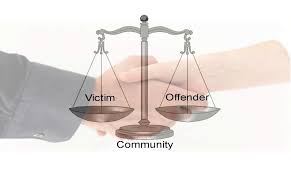
Restorative Justice (RJ) is an approach to justice focusing on repairing the harm caused by criminal behavior through cooperative processes involving victims, offenders, and the community. Unlike traditional punitive justice, which emphasizes punishment, RJ seeks healing, accountability, and reconciliation.
Core principles include:
Victim involvement: Giving victims a voice and opportunity to express the impact of the crime.
Offender accountability: Encouraging offenders to take responsibility and make amends.
Community engagement: Involving the community in the healing process and reintegration of offenders.
Dialogue and negotiation: Facilitated meetings or conferences aimed at consensus on repair and restitution.
Restorative justice is increasingly adopted worldwide in various forms, such as victim-offender mediation, family group conferencing, and circles.
Case 1: R v. Cloutier (Canada, 2009)
Issue: Application of restorative justice in sentencing.
Facts: The defendant, charged with assault, participated in a restorative justice program involving victim-offender mediation.
Holding: The Canadian court recognized the victim-offender mediation process and accepted the outcomes as part of the sentencing considerations, including the offender’s apology and agreement to make reparations.
Significance: This case illustrates how Canadian courts integrate restorative justice outcomes into sentencing, acknowledging the value of repairing harm and victim participation as part of justice.
Case 2: New South Wales v. Mitchell (Australia, 2013)
Issue: Use of restorative justice conferencing as an alternative to trial.
Facts: The defendant, charged with property offenses, took part in a restorative justice conference involving the victim and community representatives.
Holding: The court endorsed the use of restorative justice conferencing to resolve the matter, leading to the withdrawal of charges upon fulfillment of agreed conditions.
Significance: This case reflects Australia's legal framework supporting restorative justice conferences, showing how they can serve as effective alternatives to formal prosecution and foster community healing.
Case 3: Gacaca Courts (Rwanda, post-1994 Genocide)
Issue: Community-based restorative justice for genocide crimes.
Context: After the 1994 genocide, Rwanda established Gacaca courts — traditional community tribunals focused on truth-telling, confession, and reconciliation between victims and perpetrators.
Outcome: The courts helped process thousands of cases, emphasizing community restoration over punishment, with offenders required to confess and compensate victims.
Significance: Gacaca courts are a large-scale example of restorative justice principles applied in post-conflict societies to promote healing and social cohesion, rather than only retribution.
Case 4: S v. Makwanyane (South Africa, 1995)
Issue: Abolition of the death penalty and promotion of restorative justice.
Facts: The Constitutional Court of South Africa considered the constitutionality of the death penalty.
Holding: The court struck down the death penalty, emphasizing human dignity, rehabilitation, and restorative approaches as foundations of the new justice system.
Significance: This landmark case paved the way for South Africa to adopt restorative justice measures within its criminal justice system, prioritizing restoration over retribution.
Case 5: United States v. Diversion Programs (U.S., 2000s)
Issue: Incorporation of restorative justice diversion programs.
Context: Various U.S. states implemented diversion programs where eligible offenders engage in mediation and restitution, avoiding traditional prosecution.
Outcome: Courts accepted restorative justice programs as legitimate alternatives, with demonstrated benefits including reduced recidivism and improved victim satisfaction.
Significance: Shows how the U.S. legal system is gradually embracing restorative justice in limited but growing forms, particularly for juvenile and minor offenses.
Summary
Restorative justice encourages healing, accountability, and community involvement worldwide.
Countries like Canada and Australia integrate victim-offender mediation and conferencing into legal processes.
Rwanda’s Gacaca courts exemplify large-scale restorative justice in post-conflict recovery.
South Africa’s Constitutional Court supports restorative justice principles through human dignity and rehabilitation.
RELATED Blog









comments