



Reform Of Irish Copyright Law In Light Of Generative Ai Text Synthesis.
1. Introduction: Irish Copyright Law and Generative AI
Copyright law in Ireland is governed primarily by the Copyright and Related Rights Act 2000 (CRRA 2000). It protects:
Literary works: books, articles, computer code
Artistic works: paintings, illustrations
Musical works: compositions
Films, broadcasts, and typographical arrangements
Generative AI and Copyright Challenges
Generative AI (like ChatGPT) creates text, code, or other creative works based on large datasets, often including copyrighted materials. This raises novel challenges:
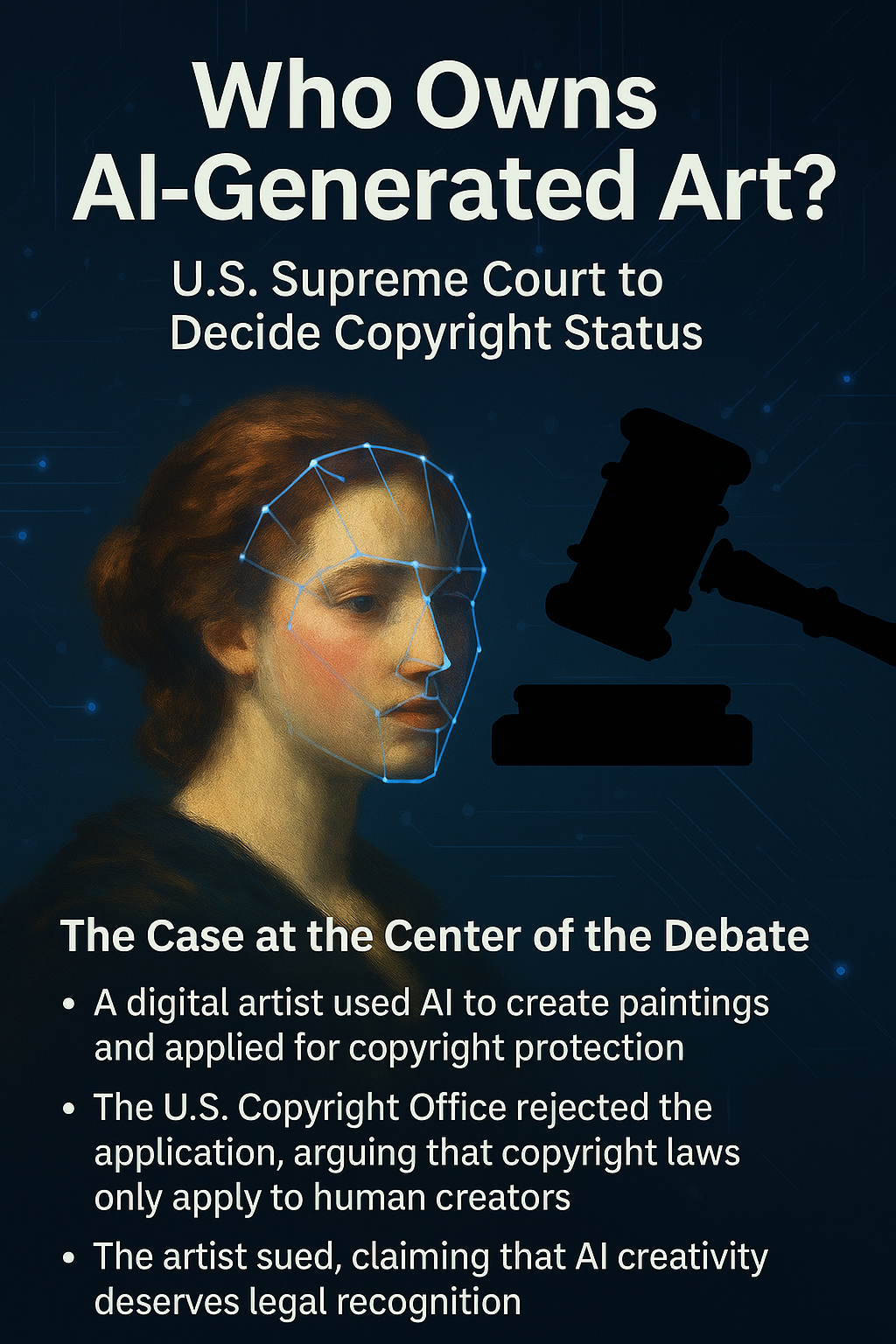
Authorship: Who owns AI-generated text—the AI, the programmer, or the user?
Infringement: Does training on copyrighted material without permission constitute infringement?
Reform needs: Updating laws to clarify protection, liability, and licensing.
2. Irish Copyright Law: Key Principles Relevant to AI
Originality Requirement: Section 9 CRRA 2000 – copyright protects original works created by human authors.
Authorship: Section 11 – author is the natural person who created the work.
Economic Rights: Reproduction, adaptation, distribution.
Exceptions: Fair dealing for research, criticism, reporting, and education.
Problem: AI challenges the “natural person” concept—can AI be an author? Current law does not explicitly recognize AI as a copyright holder.
3. Need for Reform in the Context of AI
Clarify Ownership:
Who owns AI-generated text—the developer, user, or nobody?
Consider introducing “AI-assisted works” copyright provisions.
Training Dataset Licensing:
Current law does not explicitly address using copyrighted works for training AI.
Potential reform: require licensing or fair use exceptions.
Liability Rules:
If AI reproduces copyrighted material verbatim, who is liable?
Reform could impose joint liability on developers and users.
International Alignment:
EU AI Act, Directive on Copyright in the Digital Single Market, and WIPO consultations may influence Irish reform.
4. Relevant Case Laws
Even though Irish courts have limited AI-specific cases, several copyright and computer-generated works cases provide guiding principles. Here are six detailed cases:
Case 1: CJEU – Infopaq International A/S v. Danske Dagblades Forening (2009)
Court: Court of Justice of the European Union
Issue: Whether digitally extracted snippets from newspapers infringe copyright.
Relevance to AI:
AI often extracts text fragments for training.
Court ruled that even short extracts can infringe if they contain original expression.
Impact: Irish law (aligned with EU law) suggests AI training on copyrighted text without permission may infringe.
Case 2: SAS Institute Inc. v. World Programming Ltd (UK Supreme Court, 2013)
Issue: Whether software functionality and interface can be copied.
Relevance to AI:
AI algorithms often replicate software behavior.
Court held ideas and functionality are not copyrightable, only the specific code is.
Impact: Irish reform may distinguish copyrightable text vs. functional outputs of AI.
Case 3: Football Association Premier League Ltd v. QC Leisure (CJEU, 2011)
Issue: Broadcast content piracy.
Relevance to AI:
Shows that secondary distribution of copyrighted material (like AI-generated summaries) may require authorization.
Impact: Irish reform may need licensing frameworks for AI reproductions.
Case 4: NLA v. Meltwater (UK, 2011; ECJ guidance 2013)
Issue: News aggregator copying snippets from news websites.
Outcome: Aggregators may infringe copyright if substantial portions are reproduced.
Relevance to AI:
AI text synthesis often reproduces phrases, sentences, or summaries.
Irish law may adopt a threshold for “substantial copying” in AI training or output.
Case 5: Creation Records Ltd v. News Group Newspapers (UK, 1997)
Issue: Reproduction of lyrics and creative content.
Outcome: Courts confirmed that original expression in text is protected.
Relevance to AI:
Confirms that even short creative texts used in AI training require caution under Irish law.
Case 6: SAS v. European Union Intellectual Property Office (EUIPO) Advisory
Issue: Protection of AI-assisted works as “computer-generated” works.
Outcome:
EU guidance suggests that if no human author contributes, copyright may not subsist.
Impact: Irish reform might consider special protection for AI-generated works, perhaps granting rights to the developer or user.
5. Possible Irish Law Reforms
Definition of Authorship
Amend Section 11 CRRA 2000: Include AI-assisted works and clarify human authorship requirements.
Licensing for Training Data
Introduce rules requiring explicit permission or royalty frameworks for using copyrighted material in AI datasets.
Liability Framework
Create joint liability for developers and end-users if AI reproduces copyrighted works unlawfully.
AI Work Registration
Optional registry for AI-generated works to clarify ownership and rights.
Fair Dealing Expansion
Clarify whether AI training datasets qualify under research or educational exceptions.
6. Key Takeaways
Current Irish copyright law does not explicitly address AI-generated content.
Case law shows that substantial copying, originality, and human authorship remain central principles.
Reform is needed to:
Clarify ownership of AI-generated works
Define liability and licensing for AI training datasets
Align with EU directives and international treaties
Case precedents from EU and UK courts provide guidance for Irish lawmakers.
RELATED Blog



comments