



Protection Of AI-Assisted Legal Codification And Procedural Standardization Systems.
1. Introduction
AI-assisted legal codification and procedural standardization systems refer to artificial intelligence tools used in legal governance to:
- Draft or restructure statutes, regulations, and rules
- Standardize judicial procedures (case filing, sentencing guidelines, compliance rules)
- Harmonize legal language across jurisdictions
- Generate model codes or “smart law frameworks”
- Assist courts or governments in procedural decision-making
Examples include:
- AI drafting tax codes or regulatory frameworks
- Systems standardizing court procedures (e-filing + automated formatting rules)
- AI tools harmonizing contract law templates across agencies
- Algorithmic systems proposing sentencing or bail standards
2. Core Legal Protection Questions
These systems raise four major legal issues:
(A) Is AI-generated legal codification protectable?
- Copyright vs public domain doctrine
- Government work exclusion principles
(B) Can procedural rules be owned?
- Are laws and legal procedures copyrightable?
(C) Protection of software systems used in codification
- Algorithms, AI models, rule engines
(D) Risk of monopolization of law itself
- Can private entities “own” legal structure?
3. Key Case Law (Detailed Analysis)
Below are seven foundational cases that define the legal boundaries of protecting AI-assisted legal codification systems.
CASE 1: Baker v. Selden (1879, US Supreme Court)
Facts:
- Selden created a bookkeeping system and published explanatory books.
- Baker used similar accounting forms.
Issue:
Can copyright protect a system or method of operation?
Decision:
- Court ruled:
- Copyright protects expression, NOT the underlying system
- Methods must be protected (if at all) by patent law
Legal Principle:
“Copyright does not extend to ideas, systems, or methods of operation.”
Relevance to AI Legal Codification:
AI systems generating:
- Legal drafting frameworks
- Procedural rule systems
- Code structuring methodologies
➡ Cannot claim copyright over:
- The legal rules themselves
- The structure of a legal code
- Standard procedural logic
Key Insight:
AI can assist in codifying law, but law itself remains unownable.
CASE 2: Feist Publications v. Rural Telephone Service (1991)
Facts:
- Telephone directory was copied by another publisher.
Issue:
Are factual compilations protected?
Decision:
- No copyright in facts or mere compilations without originality.
Legal Principle:
- Requires original selection or arrangement
Relevance:
AI legal codification systems often:
- Compile statutes
- Organize regulations
- Structure case law databases
➡ Protection applies only to:
- Unique arrangement of legal data
- Not to laws or legal facts themselves
Key Insight:
Legal codification outputs are mostly functional compilations, giving them weak copyright protection.
CASE 3: Lotus Development Corp. v. Borland (1996, US Supreme Court)
Facts:
- Lotus spreadsheet menu structure was copied.
Issue:
Can a software interface or command structure be copyrighted?
Decision:
- Court held:
- Menu commands are a “method of operation”
- Not protectable under copyright
Legal Principle:
- Functional user interfaces = not copyrightable
Relevance to AI Legal Standardization:
AI systems often:
- Design procedural workflows for courts
- Standardize legal filing commands
- Create structured legal interfaces
➡ These are considered:
- Functional legal “methods of operation”
- Not creative expression
Key Insight:
Legal procedure standardization systems are functional tools, not artistic works.
CASE 4: Google LLC v. Oracle America (2021)
Facts:
- Google reused Java API structures in Android.
Issue:
Can software interface structures be copied?
Decision:
- Court ruled:
- Copying allowed under fair use
- Emphasis on innovation and interoperability
Legal Principle:
- Functional code interfaces are weakly protected
- Transformation matters
Relevance:
AI-assisted legal codification systems rely on:
- Rule engines
- Legal logic APIs
- Structured legal datasets
➡ This case supports:
- Reuse of legal algorithmic frameworks for innovation
- Interoperable legal tech systems across jurisdictions
Key Insight:
Legal AI systems must remain open enough for innovation and public governance use.
CASE 5: Sony Corp. of America v. Universal City Studios (1984 – “Betamax Case”)
Facts:
- Sony’s VCR technology enabled copying of TV broadcasts.
Issue:
Is technology enabling copying liable for infringement?
Decision:
- Court ruled:
- Technology with substantial non-infringing uses is lawful
Legal Principle:
- “Substantial non-infringing use” doctrine
Relevance to AI Legal Codification:
AI systems used in law:
- Draft statutes
- Generate procedural templates
- Standardize compliance rules
➡ Even if misused, they are protected if:
- They have legitimate governance, administrative, or legal uses
Key Insight:
AI legal systems are protected if they serve lawful institutional functions.
CASE 6: SAS Institute Inc. v. World Programming Ltd (2010, UK/EU)
Facts:
- SAS software analytics system was partially replicated by competitor.
Issue:
Can software functionality be protected?
Decision:
- Court held:
- Programming language functionality is NOT copyrightable
- Only source code expression is protected
Legal Principle:
- Functionality and programming logic are free to use
Relevance:
AI legal codification systems involve:
- Legal logic modeling
- Rule-based reasoning engines
- Procedural automation systems
➡ These functional aspects:
- Cannot be monopolized
- Must remain open for competition
Key Insight:
Legal AI architecture is largely unprotectable functional logic.
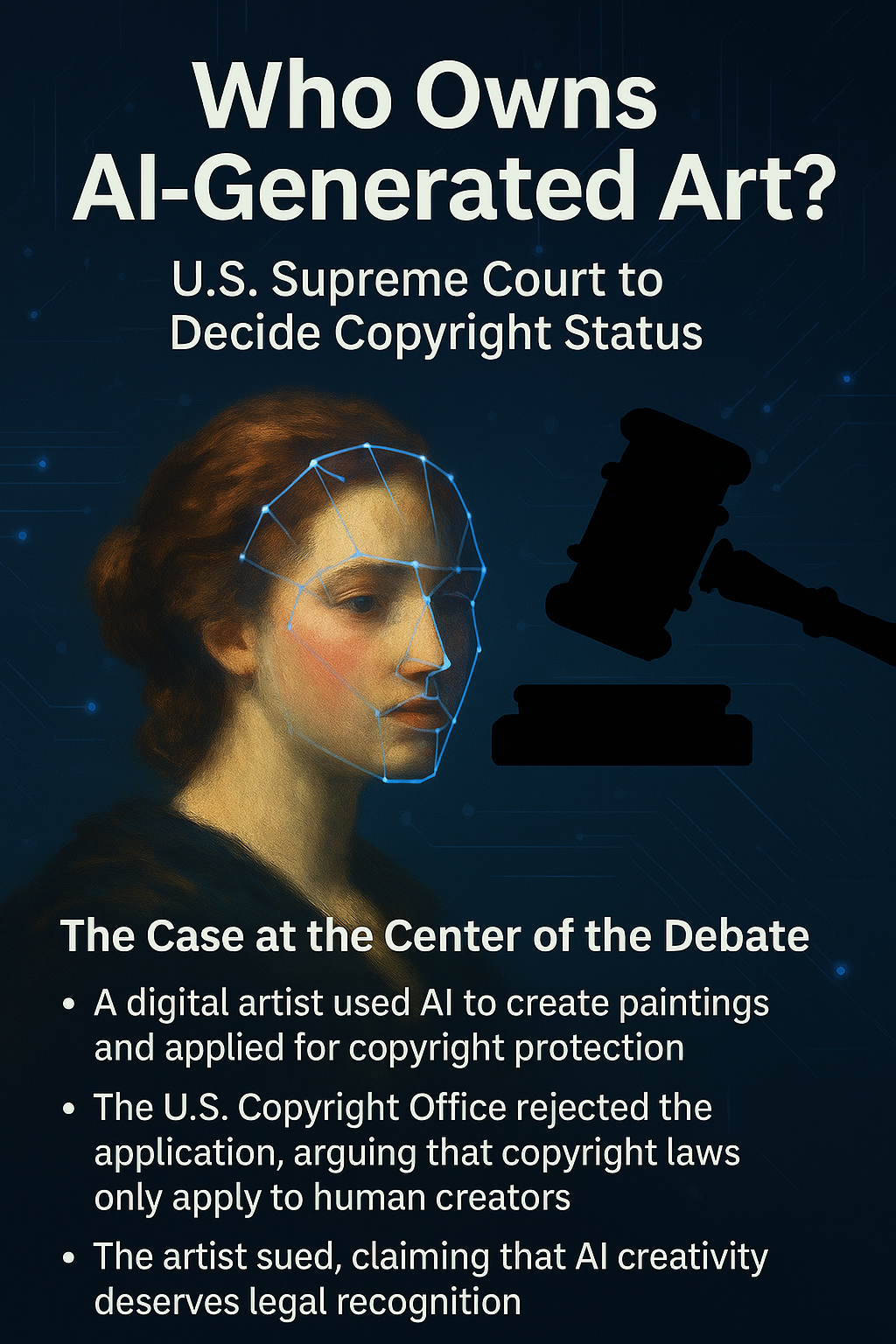
CASE 7: Thaler v. Perlmutter (2023–2024, US Copyright Office/Federal Court)
Facts:
- AI-generated artwork was submitted for copyright registration.
Issue:
Can AI alone be an author?
Decision:
- No human authorship = no copyright protection
Legal Principle:
- Human creativity is required
Relevance:
AI legal codification systems often:
- Generate draft laws
- Produce procedural codes
- Suggest legal reforms
➡ Without human input:
- Outputs are not copyrightable
- Fall into public domain or government domain
Key Insight:
Human legal oversight is essential for protection.
4. Synthesis: Legal Position on AI-Assisted Legal Codification Systems
From all cases, we derive a unified legal framework:
(A) What is NOT protected
Based on Baker, Feist, Lotus:
- Laws and statutes themselves
- Procedural legal rules
- Legal methods of operation
- Functional legal coding systems
- Governmental legal structures
➡ Law is fundamentally public domain
(B) What CAN be protected
Based on Feist, Oracle, Sony:
- Software code of AI systems
- Unique databases and legal taxonomies
- AI interface design (if creative)
- Proprietary training datasets (partially, under trade secret law)
(C) What is conditionally protected
Based on Thaler and Google v Oracle:
- AI-generated legal drafts IF:
- Human reviewed or edited them
- Significant creative contribution exists
- Procedural standardization tools IF:
- They involve original technical design
(D) What remains open/public
Based on Baker and SAS:
- Legal principles
- Codification systems of law
- Procedural rules of courts
- Standard governance frameworks
5. Application to Modern AI Legal Systems
Example 1: AI Drafting Tax Code
- Code structure itself → NOT protectable
- Software tool → protectable
- Final law text → public domain once enacted
Example 2: AI Court Procedure Standardization
- Workflow logic → not copyrightable
- Platform software → protectable
- Judicial rules → public law
Example 3: AI Regulatory Compliance Engine
- Algorithm → partly protectable as software
- Outputs → may be public if government-adopted
- Interface → limited protection possible
6. Conclusion
AI-assisted legal codification systems exist at the boundary of:
- Intellectual property law
- Public law doctrine
- Government transparency principles
- Software protection regimes
Final legal principle derived from case law:
“The law itself cannot be owned, but the tools used to structure, simulate, or assist its creation may be protected only in their expressive or technical implementation—not in their legal substance.”

RELATED Blog



comments