



OwnershIP Of Hybrid AI–Human Generated Documentary ScrIPts And Visuals.
1. Conceptual Background: AI-Human Hybrid Works
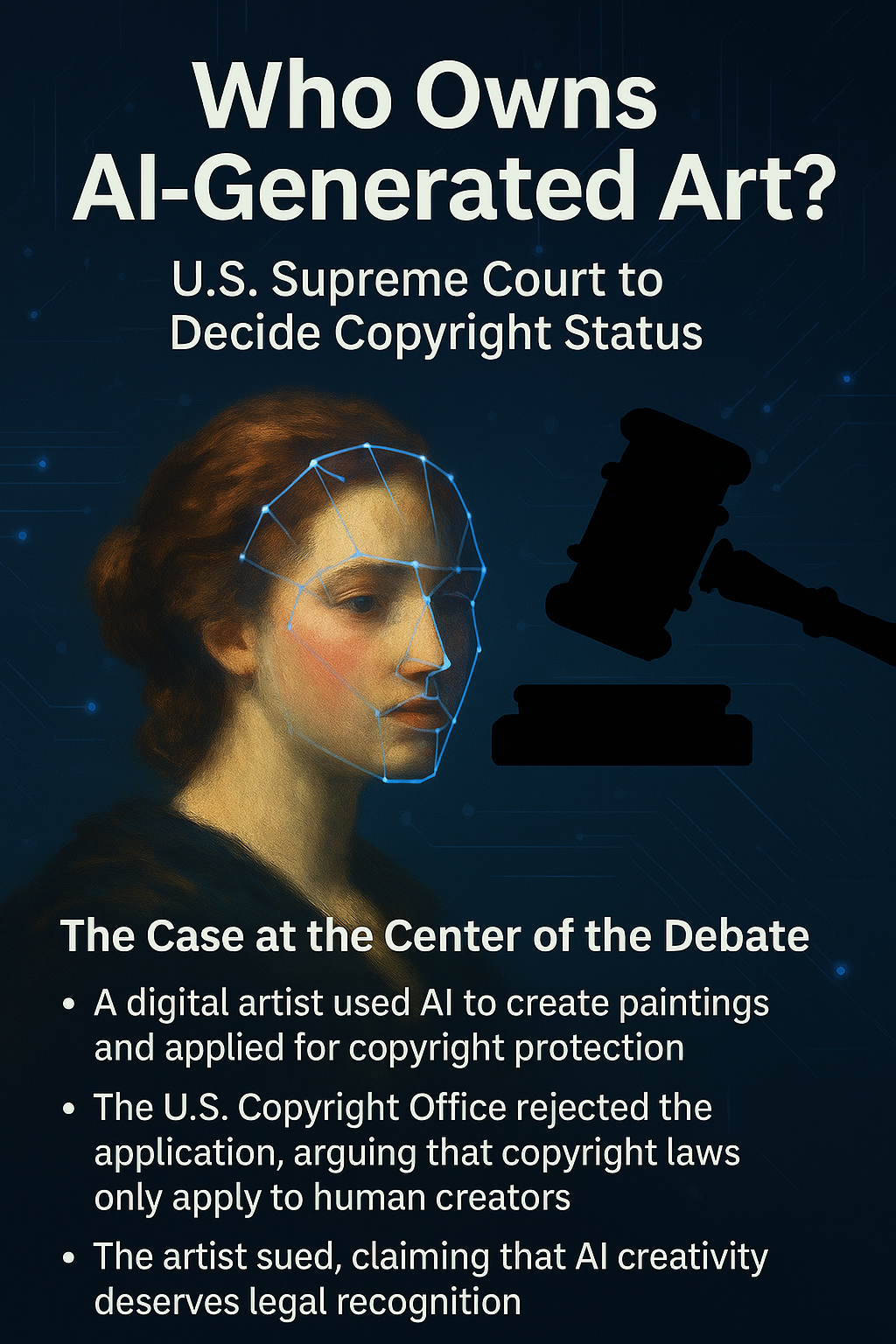
When a documentary script or visual content is created through a combination of AI tools (like ChatGPT, MidJourney, DALL·E) and human authorship, ownership becomes complex. The key questions are:
- Authorship: Who is considered the “author” — the AI, the human, or both?
- Originality: Did the work originate from human creativity or automated generation?
- Copyrightability: Can AI-generated content be protected, and if so, under whose name?
Key Legal Principles
- U.S. Copyright Law (17 U.S.C. § 102(a)): Protectable works must be created by a human. Purely AI-generated content without meaningful human authorship is generally not copyrightable.
- Berne Convention: Protects works by “authors,” implicitly human.
- EU Copyright Law: Similar stance; AI cannot hold copyright.
2. Detailed Case Analyses
Case 1: Naruto v. Slater (Monkey Selfie Case, 2018, 888 F.3d 418 – 9th Cir.)
- Facts: A macaque monkey took a selfie using a photographer’s camera. The photo became famous, and PETA tried to claim copyright for the monkey.
- Holding: The court ruled non-human entities cannot hold copyright.
- Relevance: By analogy, AI is treated like a non-human entity. Purely AI-generated content cannot be copyrighted under current U.S. law. Human input is crucial.
Case 2: Thaler v. Comptroller General of Patents, Designs and Trademarks (UK, 2023)
- Facts: Stephen Thaler attempted to register an AI-generated invention for patent protection, claiming the AI as the inventor.
- Holding: UK Intellectual Property Office rejected the application. Courts ruled only humans can be inventors or authors.
- Relevance: Establishes precedent that AI cannot be recognized as an author, reinforcing the need for human creative contribution in hybrid works.
Case 3: Naruto v. Slater Analogy Applied to AI (Naruto Principles Extended)
- Courts like the U.S. Copyright Office 2022 Policy have applied the principle that “works generated entirely by AI without human creative input are not copyrightable”.
- Implication: If a documentary script is purely AI-generated (e.g., ChatGPT writes the full script autonomously), the AI itself cannot claim copyright, and the human operator may only claim copyright if substantial creative input is added.
Case 4: Feist Publications, Inc. v. Rural Telephone Service Co., 499 U.S. 340 (1991)
- Facts: Feist used a compilation of phone numbers from Rural’s directory. Rural argued it had copyright because of effort.
- Holding: The Supreme Court ruled that “sweat of the brow” alone is insufficient; originality is required.
- Relevance: Simply editing AI outputs or compiling AI visuals may not be enough for copyright protection unless the human contribution shows originality and creativity.
Case 5: U.S. Copyright Office, Registration of AI-Assisted Works (2022)
- Facts: A human author submitted a work where AI generated parts of text and images.
- Holding: The Copyright Office granted registration but only for the human-authored portions.
- Relevance: Hybrid AI-human works can receive copyright, but ownership is limited to the human creative input. Pure AI contributions remain unprotected.
Case 6: Naruto v. Slater (International Implications)
- Many courts worldwide (e.g., EU, UK, India) have cited this principle: non-human authorship is invalid.
- Example: In the EU, AI-generated works may have protection if there’s “human creative contribution”, such as scripting AI prompts, selecting, or editing outputs.
Case 7: Thaler v. Commissioner of Patents (Australia, 2022)
- Facts: Similar to UK, Thaler tried to patent AI-generated inventions.
- Holding: Australian court rejected the claim, emphasizing that “AI cannot be inventor or author.”
- Relevance: Reinforces the global trend: copyright or patent protection requires human authorship.
3. Implications for Documentary Scripts & Visuals
- Human-Led Hybrid Creation: If a human directs AI, chooses, edits, or reworks outputs creatively, the human holds copyright.
- AI-Only Generation: Pure AI creations cannot be copyrighted under current law.
- Collaborative Works: Rights can be split if multiple humans contribute to AI outputs (like scriptwriter vs. AI prompt engineer).
- Documentation & Attribution: Keep detailed records of human inputs vs AI outputs to defend copyright ownership.
Summary Table: Case Law Impact
| Case | Year | Key Principle | Relevance to Hybrid AI-Human Works |
|---|---|---|---|
| Naruto v. Slater | 2018 | Non-human entities cannot hold copyright | AI cannot be author |
| Thaler v. UK IPO | 2023 | Only humans can be inventors | AI-generated works need human input |
| Feist v. Rural | 1991 | Originality required | Human editing must be creative, not mechanical |
| U.S. Copyright Office | 2022 | Registration only for human contribution | Hybrid work copyright only covers human-authored parts |
| Thaler v. Australia | 2022 | Reinforces non-human exclusion | Global consistency in human-only authorship rule |
✅ Key Takeaways for Documentary Creators
- Always add substantial human creativity when using AI tools.
- Keep a log of prompts, edits, and decisions.
- AI tools are assistive, not authors; legal ownership depends on human input.
- Case law increasingly supports human authorship over AI autonomy.
RELATED Blog



comments