



OwnershIP Of AI-Created Metaverse Replicas Of Uae Ministry Offices.
1. Legal Nature of AI-Created Metaverse Replicas
A “metaverse replica” of a UAE Ministry office (e.g., Ministry of Interior building rendered in VR) may involve:
- 3D architectural reproduction
- Government insignia/logos
- Interior layouts (possibly confidential)
- AI-generated textures, designs, or environments
Thus, it implicates:
(A) Copyright law
(B) Government/public authority control
(C) AI-generated works doctrine
(D) Potential national security/public law issues
2. UAE Legal Framework
(1) Copyright Law (Federal Decree-Law No. 38 of 2021)
- Protects “works” broadly (artistic, architectural, digital works)
- Ownership belongs to human author
- AI has no legal personality
👉 Key rule:
- If AI generates the metaverse replica without meaningful human creativity → no copyright
- If human designers use AI as a tool → human owns the work
Important principle:
- “Authorship is human-centric”
- Mere prompting ≠ ownership
(2) Architectural & Government Works
- Government buildings may be:
- Copyright protected (architectural drawings)
- Restricted (security-sensitive infrastructure)
👉 Therefore:
- Replicating UAE Ministry offices in metaverse may require permission
- Unauthorized reproduction may lead to:
- Copyright infringement
- Public law violations
(3) AI Output Problem
UAE law is silent on purely AI-generated works, leading to:
- Possible public domain classification if no human authorship
- Disputes between:
- AI developer
- User
- Platform
3. Ownership Scenarios in Metaverse Context
| Scenario | Ownership |
|---|---|
| Human designs replica using AI tools | Human developer owns |
| Fully AI-generated model (no human creativity) | Likely no copyright |
| Replica of government building | Requires state permission |
| Built using copyrighted blueprints | Infringement |
| AI trained on protected datasets | Possible liability |
4. Key Legal Issues
1. Lack of Human Authorship
→ No copyright protection
2. Derivative Work Problem
→ Replica = reproduction of existing building
3. Government Control
→ Ministries are not ordinary private property
4. Data & Security Concerns
→ Digital twins may expose sensitive layouts
5. IMPORTANT CASE LAWS (DETAILED)
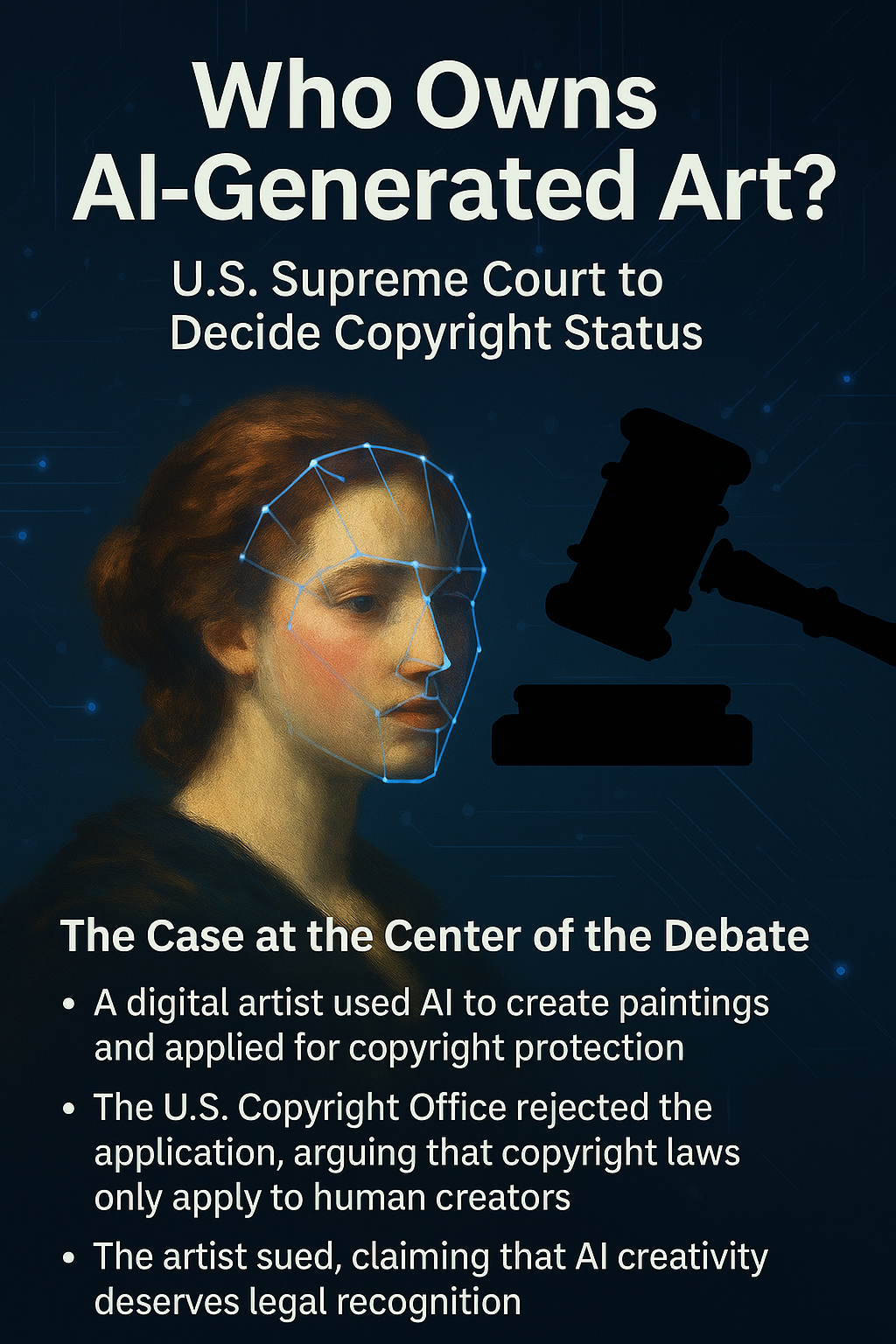
1. Thaler v. Perlmutter (USA, 2023–2025)
Facts:
- Stephen Thaler created artwork using AI
- Claimed AI as author
Issue:
Can AI be an author?
Judgment:
- Court held: Only human authors are recognized
- AI-generated work = no copyright
Principle:
- “Human authorship is a bedrock requirement”
Relevance to UAE:
- UAE follows similar human-authorship approach
- Fully AI-generated metaverse replicas → no ownership
2. Naruto v. Slater (2018, USA – Monkey Selfie Case)
Facts:
- A monkey (Naruto) took photos using a camera
- Dispute over copyright
Judgment:
- Non-human entities cannot own copyright
Principle:
- Authorship requires legal personality
Application:
- AI ≈ non-human
→ Cannot own metaverse assets
3. Feist Publications v. Rural Telephone Service (1991, USA)
Facts:
- Phone directory copied
Issue:
What qualifies as originality?
Judgment:
- Requires minimal creativity
Principle:
- Mere data or mechanical reproduction is not protected
Application:
- AI replica of ministry building:
- If purely mechanical → no protection
- If creatively modified → protectable
4. Meshwerks v. Toyota (2008, USA)
Facts:
- 3D digital models of Toyota cars created
Issue:
Are digital replicas original?
Judgment:
- Exact digital copies lack originality
Principle:
- Faithful replication ≠ creative work
Application:
- Metaverse replica of UAE Ministry:
- Exact digital twin → not protected
- Stylized/creative version → may be protected
5. Navitaire v. easyJet (2004, UK)
Facts:
- Software commands copied
Judgment:
- Functional commands not protected
Principle:
- Ideas/processes ≠ copyright
Application:
- AI prompts creating metaverse office:
- Prompts alone → no ownership
6. Infopaq International v. Danske Dagblades (CJEU, 2009)
Facts:
- Newspaper snippets copied
Judgment:
- Even small parts protected if original
Principle:
- “Author’s own intellectual creation”
Application:
- Even partial replication of ministry design:
- Could infringe if original elements copied
7. Midjourney / AI Training Lawsuits (Disney, Marvel cases)
Facts:
- AI trained on copyrighted content
- Generated derivative images
Claims:
- Direct infringement
- Secondary liability
Principle:
- Training AI on protected works may itself be infringement
Application:
- If AI trained on:
- Government blueprints
- Official designs
→ Liability may arise
6. Application to UAE Ministry Metaverse Replicas
(A) Who owns the replica?
| Situation | Ownership |
|---|---|
| Government commissions AI | Government |
| Private developer creates with creative input | Developer |
| Pure AI generation | No copyright |
| Based on copyrighted plans | Original owner |
(B) Can you legally create such replicas?
Depends on:
- Permission from UAE government
- Nature of building (public vs restricted)
- Degree of copying
⚠️ High risk if:
- Security-sensitive ministries
- Use of official logos/symbols
(C) Special UAE Restrictions
Recent policy trend:
- Restrictions on AI-generated depictions of national symbols
→ reinforces state control over digital representations
7. Key Legal Principles (Summary)
- Human authorship rule dominates UAE law
- AI cannot own property
- Exact digital replicas lack originality
- Government buildings may require authorization
- Training data can trigger liability
- Metaverse has no separate legal regime yet
8. Conclusion
Ownership of AI-created metaverse replicas of UAE Ministry offices depends on:
- Human creative involvement
- Source of data used
- Nature of replication (exact vs creative)
- Government permissions
👉 In most cases:
- Fully AI-generated replicas → no ownership
- Human-assisted creations → owned by human
- Unauthorized replicas → risk infringement or illegality
RELATED Blog



comments