



OwnershIP And Data Rights In Immersive Workplace Collaboration Platforms.
📌 I. Conceptual Framework: What Are Immersive Workplace Platforms?
Immersive workplace collaboration platforms include:
- VR meeting environments (e.g., virtual offices)
- AR-assisted design tools
- Persistent metaverse workspaces
- AI-driven collaboration environments
These platforms generate multiple categories of data:
Types of Data
- User-generated content (UGC) — documents, designs, code
- Behavioral data — gestures, eye tracking, voice
- Biometric data — facial expressions, body movement
- Platform-generated data — analytics, AI outputs
- Organizational data — workflows, internal communications
📌 II. Core Legal Issues
1. Ownership of Content
- Usually governed by contract (terms of service, employment contracts)
- Employers often claim ownership of work created in course of employment
2. Data Rights
- Governed by data protection laws (e.g., GDPR principles in EU contexts)
- Employees retain rights over personal data, especially biometric data
3. Platform Control
- Platforms may claim licenses over user-generated content
- Raises questions of data monetization and secondary use
4. Liability
- Who is liable if data is misused?
- Employer?
- Platform provider?
- Individual user?
📌 III. Key Case Laws and Judicial Developments
Case 1 — Google Spain SL v AEPD
Facts:
A Spanish individual requested removal of personal data from search engine results.
Legal Issue:
Who controls personal data — the platform or the individual?
Court Decision:
The Court of Justice of the EU held that:
- Individuals have control over personal data
- Platforms are data controllers if they process data
Relevance to Immersive Platforms:
- VR collaboration platforms collecting behavioral/biometric data act as data controllers
- Employees can demand:
- deletion
- correction
- limitation of processing
Legal Principle:
➡️ Data ownership ≠ control rights
Even if a company “owns” the platform, users retain fundamental rights over personal data
Case 2 — Barbulescu v Romania
Facts:
An employee was monitored by his employer through workplace messaging tools.
Legal Issue:
Extent of employer control over employee communications.
Court Decision:
The European Court of Human Rights ruled:
- Monitoring is allowed only if proportionate and transparent
- Employees retain privacy rights even in workplace systems
Relevance to Immersive Workspaces:
- VR/AR platforms collect far more intrusive data (voice tone, gestures, eye movement)
- Employers must:
- inform employees clearly
- justify monitoring
- limit scope
Legal Principle:
➡️ Workplace immersion does not eliminate privacy rights
Case 3 — HiQ Labs v LinkedIn
Facts:
HiQ scraped publicly available data from LinkedIn profiles.
Legal Issue:
Who controls access to data on digital platforms?
Court Decision:
The U.S. Ninth Circuit held:
- Public data scraping may not violate computer access laws
- Platforms cannot always assert absolute control over data
Relevance:
- Raises questions about:
- ownership of interaction data in immersive platforms
- third-party analytics extraction
- Suggests that:
- not all platform-held data is exclusively controlled by the platform
Legal Principle:
➡️ Platform control over data is not absolute, especially for publicly accessible or shared data
Case 4 — Naruto v Slater
Facts:
A monkey took a photograph using a camera; dispute arose over copyright ownership.
Legal Issue:
Can a non-human entity own intellectual property?
Court Decision:
The court ruled:
- Only humans can own copyright
- Non-human creators cannot hold IP rights
Relevance to Immersive Platforms:
- AI-generated outputs in VR collaboration (designs, code, simulations)
- Platform-generated content cannot own itself
Legal Principle:
➡️ Ownership must vest in:
- human users
- or organizations
—not autonomous systems
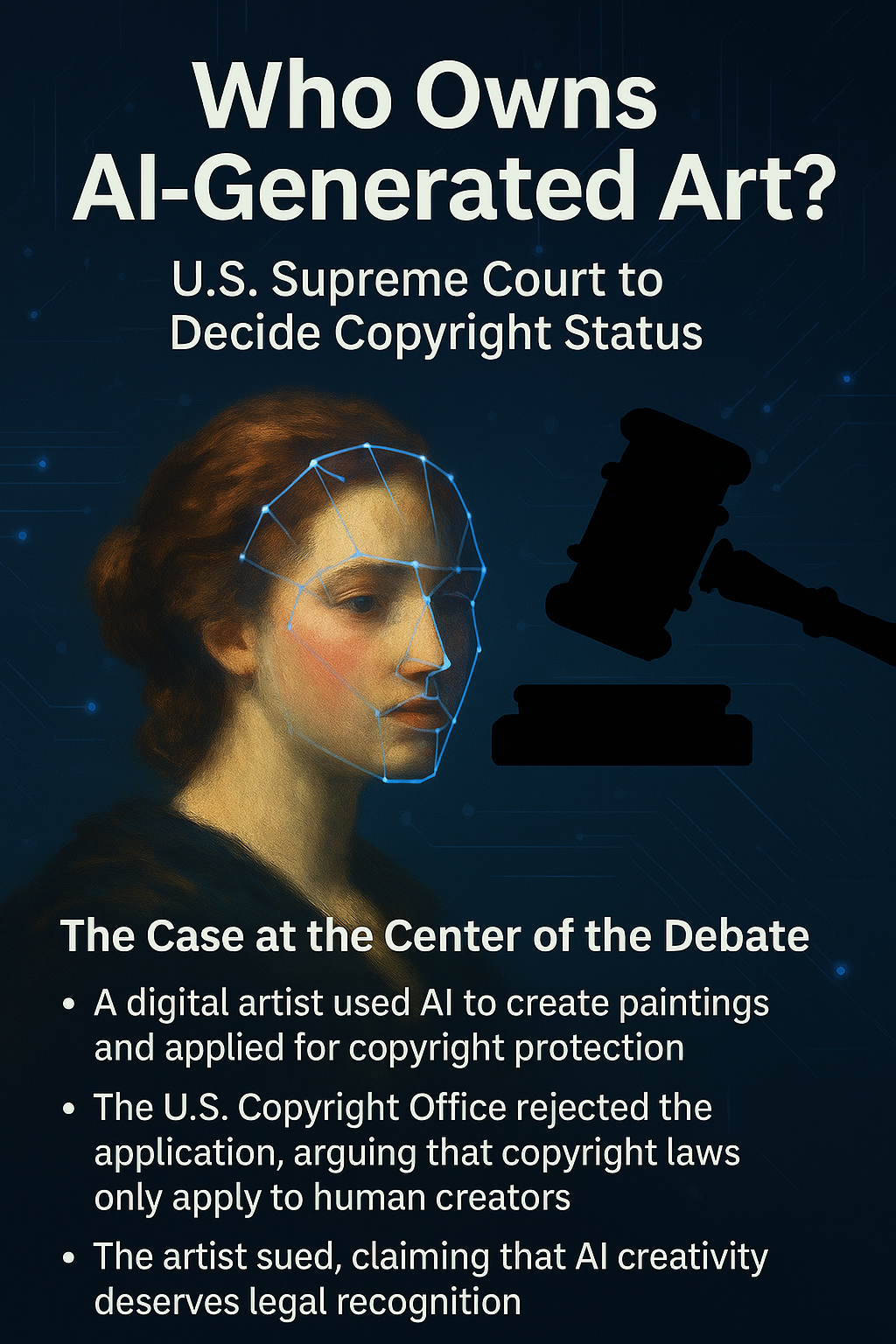
Case 5 — Thaler v Perlmutter
Facts:
An AI-generated artwork was submitted for copyright registration.
Legal Issue:
Whether AI-generated works can be copyrighted.
Court Decision:
- Rejected copyright claim
- Reinforced human authorship requirement
Relevance:
In immersive platforms:
- AI tools generate:
- virtual environments
- collaborative outputs
- Ownership depends on:
- human creative input
- contractual allocation
Legal Principle:
➡️ AI-assisted creation belongs to humans directing the process, not the system
Case 6 — Ryanair Ltd v PR Aviation BV
Facts:
PR Aviation used Ryanair’s database information without authorization.
Legal Issue:
Can database owners restrict reuse via contracts?
Court Decision:
- Contractual terms can restrict data use even if database rights don’t apply
Relevance:
- Immersive platforms rely heavily on terms of service
- Platform providers can:
- define ownership of analytics
- restrict extraction or reuse of workplace data
Legal Principle:
➡️ Contract law is central to data ownership allocation
Case 7 — Fashion ID GmbH v Verbraucherzentrale NRW
Facts:
A website embedded Facebook “Like” button collecting user data.
Legal Issue:
Who is responsible for data collection — website or platform?
Court Decision:
- Both parties were joint data controllers
Relevance:
In immersive workplace platforms:
- Employer + platform provider may be joint controllers
- Shared liability for:
- data misuse
- GDPR violations
Legal Principle:
➡️ Responsibility can be shared across ecosystem actors
📌 IV. Key Legal Principles Emerging
1. Dual Ownership Structure
- Content ownership → employer or employee (contract-based)
- Personal data rights → always remain with the individual
2. Platform vs Employer Control
- Platforms:
- control infrastructure
- may license data
- Employers:
- control work outputs
- Both may share liability
3. Biometric Data Sensitivity
- Immersive platforms process:
- eye tracking
- movement
- voice patterns
➡️ These are highly protected data categories
4. AI and Generated Content
- AI outputs:
- not independently owned
- Ownership depends on:
- human contribution
- contractual allocation
5. Contractual Dominance
Most ownership questions are resolved through:
- employment agreements
- platform terms of service
- data processing agreements
📌 V. Liability Framework
| Actor | Potential Liability |
|---|---|
| Employer | Misuse of employee data; excessive monitoring |
| Platform Provider | Data breaches; unlawful processing |
| Employee/User | Unauthorized sharing or IP infringement |
| Third Parties | Data scraping or misuse |
📌 VI. Practical Implications for Organizations
1. Draft Clear Contracts
- Define:
- ownership of outputs
- licensing rights
- data usage scope
2. Ensure Data Protection Compliance
- Transparency
- Consent (especially for biometrics)
- Data minimization
3. Limit Monitoring
- Follow proportionality principle
- Avoid excessive surveillance
4. Define AI Contribution Rules
- Clarify ownership of AI-assisted work
- Document human input
📌 VII. Conclusion
The legal status of ownership and data rights in immersive workplace collaboration platforms is shaped by a hybrid legal regime:
- Copyright law → governs creative outputs
- Data protection law → governs personal and biometric data
- Contract law → allocates ownership and usage rights
- Platform liability doctrines → define responsibility across actors
Across jurisdictions, courts consistently emphasize:
- Human control over personal data
- Human authorship for IP rights
- Shared liability in digital ecosystems
- Central role of contractual frameworks
As immersive technologies evolve, courts are likely to refine these doctrines further, especially regarding biometric data ownership and AI-generated collaborative outputs.
RELATED Blog



comments