



Legal Frameworks For AI-Assisted Collaborative Research Projects.
I. Intellectual Property Law in AI-Assisted Research
AI challenges traditional notions of authorship and ownership in research outputs, including:
Papers, simulations, or predictive models co-generated by AI
Code or algorithms developed collaboratively
Data sets and derived insights
Key legal questions:
Who owns AI-generated contributions?
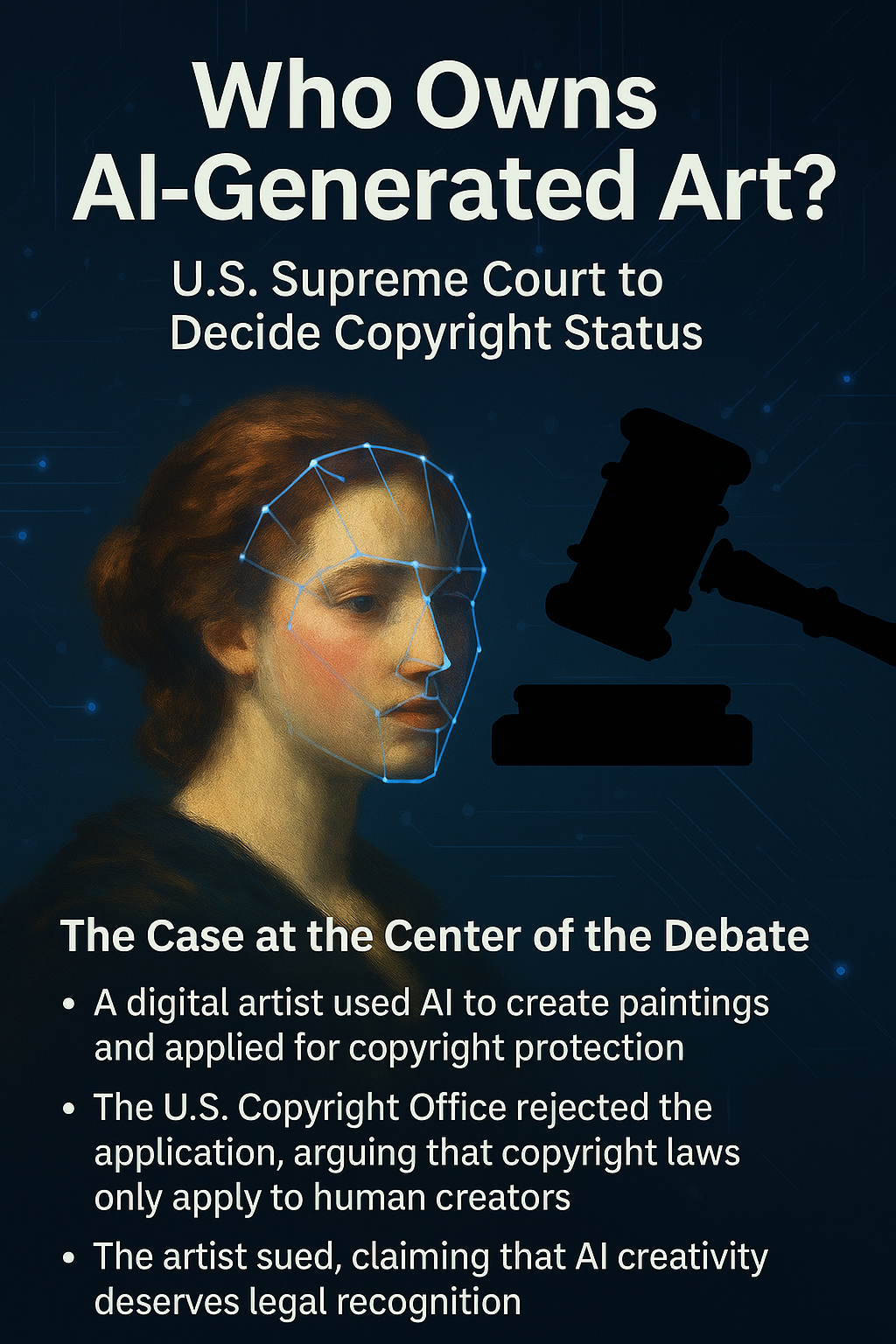
Can AI be listed as an author?
How are patent rights assigned?
Case 1 — Feist Publications, Inc. v. Rural Telephone Service Co.
Court: US Supreme Court, 1991
Issue: Whether a compilation of factual data can be copyrighted.
Holding: Copyright requires originality — mere facts are not protected.
Relevance:
AI-assisted research often generates factual datasets, analyses, or simulations.
Pure AI-generated datasets without human selection, curation, or creative input may not qualify for copyright protection.
Universities must ensure human oversight in creating, organizing, and interpreting AI-generated outputs to secure IP ownership.
Implication: Collaborative research agreements should clearly define human contribution thresholds for IP claims.
Case 2 — Burrow-Giles Lithographic Co. v. Sarony
Court: US Supreme Court, 1884
Issue: Whether a photograph is protected if it reflects the photographer’s creative conception.
Holding: Works with demonstrable intellectual input are protected.
Relevance:
AI tools act as instruments, not creators.
Researchers providing conceptual design, experiment setup, or interpretation maintain authorship rights.
AI outputs cannot claim independent authorship.
Implication: Collaborative research contracts should specify the human designer/lead responsible for creative contributions.
Case 3 — Naruto v. Slater
Court: US Court of Appeals, 9th Cir, 2018
Issue: Whether a non-human (monkey) could own copyright.
Holding: Non-human entities cannot hold copyright.
Relevance:
AI cannot be an author.
Ownership of AI-generated outputs must vest in humans or institutions.
Licensing of AI-generated content requires contracts assigning rights to researchers or organizations.
Implication: Collaborative agreements must define IP assignment clauses, especially when multiple institutions and AI tools are involved.
Case 4 — Community for Creative Non-Violence v. Reid
Court: US Supreme Court, 1989
Issue: Whether a commissioned work is a “work made for hire.”
Holding: Factors include control, compensation, and intent.
Relevance:
Collaborative AI-assisted projects often involve joint development with external partners.
Clearly defining work-for-hire relationships prevents disputes over IP ownership.
Universities must specify whether AI-generated content created by contracted researchers belongs to the institution.
Implication: Draft precise agreements regarding IP ownership and work-for-hire provisions.
Case 5 — Authors Guild v. Google, Inc.
Court: US Court of Appeals, 2nd Cir, 2015
Issue: Whether digitizing copyrighted works for searchable databases constitutes fair use.
Holding: Held to be transformative fair use.
Relevance:
AI-assisted research often uses large datasets for training or analysis.
Using copyrighted datasets requires either:
Permission from rights holders, or
Reliance on fair use/fair dealing principles if the AI usage is transformative.
Outputs derived from copyrighted sources may carry infringement risks.
Implication: Collaborative research teams must document dataset usage and licensing to avoid liability.
Case 6 — Andy Warhol Foundation v. Goldsmith
Court: US Supreme Court, 2023
Issue: Scope of transformative use in derivative works.
Holding: Commercial derivative works that substitute for the original may not qualify as fair use.
Relevance:
AI-assisted research generating derivative analyses or visualizations based on prior works may infringe if it competes commercially with original sources.
Licensing and publication must account for transformative vs. derivative distinctions.
II. Patent and Innovation Law in Collaborative AI Research
AI-assisted projects may also produce patentable inventions, e.g., drug targets, algorithms, or device designs.
Case 7 — Thaler v. USPTO (DABUS case)
Court: US Patent and Trademark Office / Federal Circuit, 2022
Issue: Whether an AI can be listed as an inventor.
Holding: AI cannot be an inventor; only natural persons qualify.
Relevance:
Patent filings from AI-assisted research must name human inventors.
AI is a tool, not a legal inventor, even if it autonomously generates inventive concepts.
Collaborative teams must ensure clear attribution and ownership among human inventors.
Case 8 — Naruto v. Slater (Patent Analogy)
While the original case dealt with copyright, the principle extends to patents:
Only humans can hold inventorship rights.
Institutional ownership requires assignment agreements among collaborating entities.
III. Data Protection & Privacy Law
Collaborative research often involves sensitive data (medical, social, genomic). AI analysis may process personal data.
Case 9 — Carpenter v. United States
Court: US Supreme Court, 2018
Issue: Privacy in digital tracking data.
Holding: Individuals have a reasonable expectation of privacy.
Relevance:
AI-assisted research processing identifiable data must comply with privacy regulations (e.g., GDPR in Europe, HIPAA in the US).
Institutions must implement data anonymization, informed consent, and governance mechanisms.
Case 10 — Sorrell v. IMS Health Inc.
Court: US Supreme Court, 2011
Issue: Regulation of data mining and sale of prescription info.
Holding: Data use restrictions implicate First Amendment rights.
Relevance:
AI-assisted collaborative projects analyzing sensitive datasets for research may encounter legal limits on commercialization.
Clear agreements on data use, publication, and IP rights are necessary.
IV. Liability and Ethical Oversight
AI-generated outputs may mislead, create errors, or bias research results.
Case 11 — Donoghue v. Stevenson
Court: UK House of Lords, 1932
Issue: Duty of care to prevent foreseeable harm.
Relevance:
Collaborative research teams owe a duty to ensure AI-assisted outputs are accurate and ethically validated.
Incorrect AI predictions leading to harm (e.g., in clinical trials) can trigger negligence claims.
Case 12 — Goss v. Lopez
Court: US Supreme Court, 1975
Issue: Due process rights in disciplinary actions.
Relevance:
If AI-assisted research outputs affect student evaluation, employment, or authorship credit, human oversight is required.
Transparency and appeal processes are essential.
V. Collaborative Research Agreements
Key legal frameworks for AI-assisted research:
IP Assignment & Authorship Clauses
Specify who owns AI-generated outputs.
Define human contribution thresholds.
Data Use & Licensing Provisions
Address copyright, database rights, and fair use.
Ensure compliance with GDPR/other privacy regulations.
Patent Ownership & Inventorship
Identify human inventors.
Assign rights among institutions and companies.
Liability & Ethics
Define responsibility for AI errors.
Include ethical review obligations.
Publication & Credit
AI as a tool vs. human authorship.
Guidelines on acknowledgment.
VI. Practical Recommendations
Document human creative input in AI-assisted analysis or model design.
Assign IP rights explicitly in collaboration agreements.
Ensure ethical oversight for AI outputs with potential societal impact.
Secure dataset licenses or rely on fair use carefully.
Define clear inventorship for patentable AI-generated inventions.
Implement transparency and human review for decisions impacting careers or funding.
VII. Conclusion
AI-assisted collaborative research intersects multiple legal domains:
Copyright — human authorship required; AI is a tool.
Patent law — only humans may be inventors.
Data protection — strict compliance with GDPR, HIPAA, or local regulations.
Liability — duty of care extends to AI outputs.
Contracts — critical for assigning IP, inventorship, and rights to outputs.
Case law trends emphasize:
AI cannot independently own IP rights.
Human contribution must be documented for copyright or patent claims.
Ethical, contractual, and regulatory compliance is essential for collaborative AI projects.

RELATED Blog



comments