



Ipr In Ip Portfolio Management Of AI-Generated Creative Ip
1. What Is IP Portfolio Management in the Context of AI-Generated Creative IP?
IP portfolio management means:
Identifying
Protecting
Exploiting
Enforcing
Monetizing
all intellectual property assets owned or controlled by an entity.
When AI generates creative outputs (art, music, text, designs, code, inventions), portfolio management becomes complex because traditional IP law is human-centric, while AI is non-human.
Key AI-specific challenges:
Who is the author/inventor?
Can AI-generated works be copyrighted or patented?
Who owns the output—the developer, user, or AI owner?
How do you commercialize and license AI-generated IP?
How do you manage training-data risks and infringement claims?
2. Types of AI-Generated Creative IP in a Portfolio
(A) Copyright
AI-generated music, paintings, scripts, novels, marketing content
AI-generated software code
AI-generated audiovisual works
(B) Patents
AI-generated inventions
Drug discovery, mechanical designs, semiconductor layouts
(C) Trade Secrets
Training data
Algorithms
Model weights
Prompt engineering techniques
(D) Trademarks
AI-generated logos
Brand names created by AI
Risk of lack of distinctiveness or ownership disputes
3. Core Legal Question: Can AI Be an Author or Inventor?
Most jurisdictions say:
No. AI cannot be an author or inventor.
But they differ on:
Whether human involvement is enough
Who gets ownership if AI creates autonomously
This brings us to case law.
DETAILED CASE LAWS (MORE THAN 5)
Case 1: Thaler v. Commissioner of Patents (DABUS Case – Multiple Jurisdictions)
Jurisdictions:
United States
United Kingdom
European Union
Australia (initially allowed, later overturned)
Facts:
Dr. Stephen Thaler created an AI system called DABUS
DABUS autonomously generated inventions
Thaler filed patent applications listing DABUS as the inventor
Thaler claimed ownership as the AI’s owner
Legal Issue:
Can an AI system be named as an inventor under patent law?
Decision:
Rejected in US, UK, EU
Initially accepted in Australia, later overturned on appeal
Reasoning:
Patent laws explicitly require an inventor to be a natural person
An AI:
Has no legal personality
Cannot transfer rights
Cannot exercise moral or legal obligations
Impact on IP Portfolio Management:
AI-generated inventions must:
Identify a human inventor, or
Be excluded from patent portfolios
Companies now:
Insert humans in the invention process
Document human contribution meticulously
Portfolio Strategy Lesson:
Always structure AI innovation workflows to ensure human inventive contribution is traceable.
Case 2: Naruto v. Slater (Monkey Selfie Case – US)
Facts:
A monkey named Naruto took a selfie using a photographer’s camera
Animal rights groups sued, claiming the monkey owned copyright
Legal Issue:
Can a non-human entity own copyright?
Decision:
No
Copyright law protects works of human authors
Relevance to AI:
Although not an AI case, courts rely on this case to reject non-human authorship, including AI.
Impact on AI IP Portfolios:
AI cannot be the copyright owner
If no human authorship exists → work may fall into public domain
Portfolio Risk:
AI-generated creative works risk being unprotectable unless human creativity is proven.
Case 3: US Copyright Office – Zarya of the Dawn Case (2023)
Facts:
A graphic novel used Midjourney AI to generate images
The human author:
Wrote the text
Selected and arranged AI images
Claimed copyright over the entire work
Legal Issue:
Are AI-generated images copyrightable?
Decision:
Text and arrangement → Copyrightable
AI-generated images → NOT copyrightable
Reasoning:
Images were generated autonomously by AI
Human input (prompts) was insufficient creative control
Impact on Portfolio Management:
AI outputs alone are weak IP assets
Value lies in:
Compilation
Selection
Editing
Human transformation
Strategic Takeaway:
Protect AI outputs through derivative works, compilations, and human editing, not raw generation.
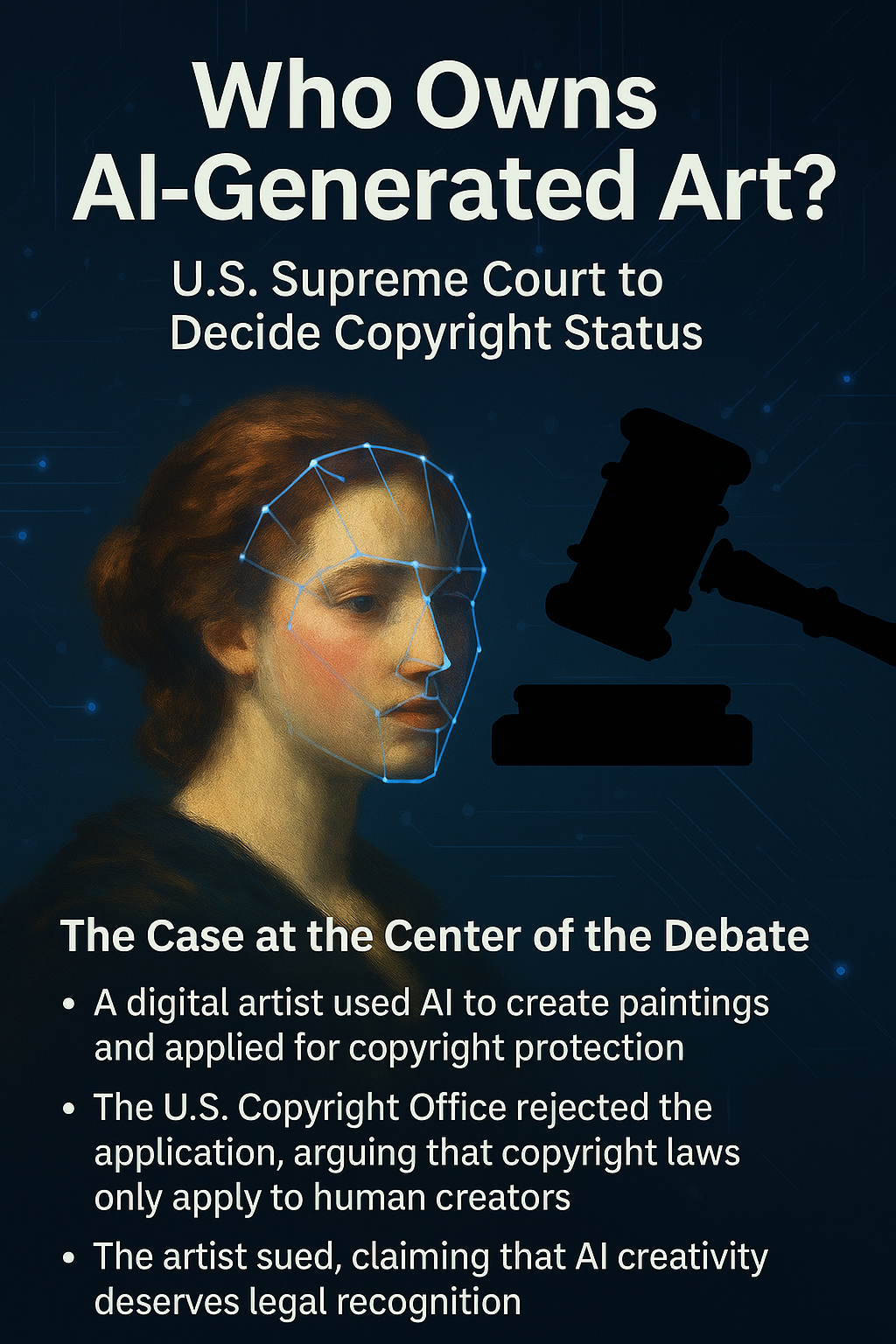
Case 4: Thaler v. Perlmutter (US, 2023)
Facts:
Thaler attempted to copyright an artwork created solely by AI
Claimed ownership as AI’s owner
Legal Issue:
Is human authorship mandatory for copyright?
Decision:
Yes, human authorship is essential
AI-generated works without human creativity are not protected
Court’s Key Observation:
Copyright is meant to protect “the fruits of intellectual labor founded in the creative powers of the human mind.”
Portfolio Implications:
Pure AI outputs = high risk assets
Companies must embed human creativity checkpoints
Case 5: Express Newspapers v. Liverpool Daily Post (UK)
Why Relevant:
This case is foundational for computer-generated works under UK law.
Legal Principle:
UK Copyright Act recognizes computer-generated works and assigns authorship to:
“The person by whom the arrangements necessary for the creation of the work are undertaken.”
Relevance to AI:
UK is more flexible than US
AI-generated works may be protected if:
A human made arrangements (training, prompts, deployment)
Portfolio Advantage:
UK allows broader AI copyright protection, making it a favorable jurisdiction for AI-heavy portfolios.
Case 6: Eastern Book Company v. D.B. Modak (India)
Facts:
Concerned originality in legal databases
Examined whether minimal human input qualifies for copyright
Legal Issue:
What level of human creativity is required?
Decision:
Adopted the “modicum of creativity” standard
Mere labor or automation is insufficient
Application to AI:
AI outputs without creative human input may fail originality
Human editorial intervention is crucial
Indian Portfolio Strategy:
Focus on:
Human curation
Annotation
Adaptation of AI outputs
Case 7: Getty Images v. Stability AI (Ongoing, UK & US)
Facts:
Getty alleged Stability AI trained models on copyrighted images
Outputs allegedly replicated copyrighted material
Key Legal Issues:
Infringement during training
Derivative output liability
Ownership of AI-generated images
Portfolio Risk Highlighted:
Training data legality affects:
Enforceability
Valuation
Licensing viability
Strategic Lesson:
A strong AI IP portfolio is only as clean as its training data provenance.
4. Key Portfolio Management Strategies for AI-Generated Creative IP
(1) Human-in-the-Loop Design
Mandatory human intervention
Document creative choices
(2) Contractual Ownership
Clear AI output ownership clauses
Assignments from developers and users
(3) Layered Protection
Copyright for compilations
Trade secrets for models
Patents for AI-assisted inventions
Trademarks for branding
(4) Jurisdictional Arbitrage
UK for computer-generated works
US for human-assisted creativity
India for curated and edited outputs
5. Conclusion
AI-generated creative IP cannot be managed like traditional IP. Courts globally insist on human creativity, control, and accountability.
An effective AI IP portfolio:
Does not rely on raw AI output
Embeds human authorship
Uses contracts as much as statutes
Treats training data as a legal asset
Anticipates future regulatory shifts
RELATED Blog



comments