



Ipr In Government Policy On AI-Generated Content Ip.
1. Key Government Policy Issues on AI-Generated Content
Copyright and Authorship
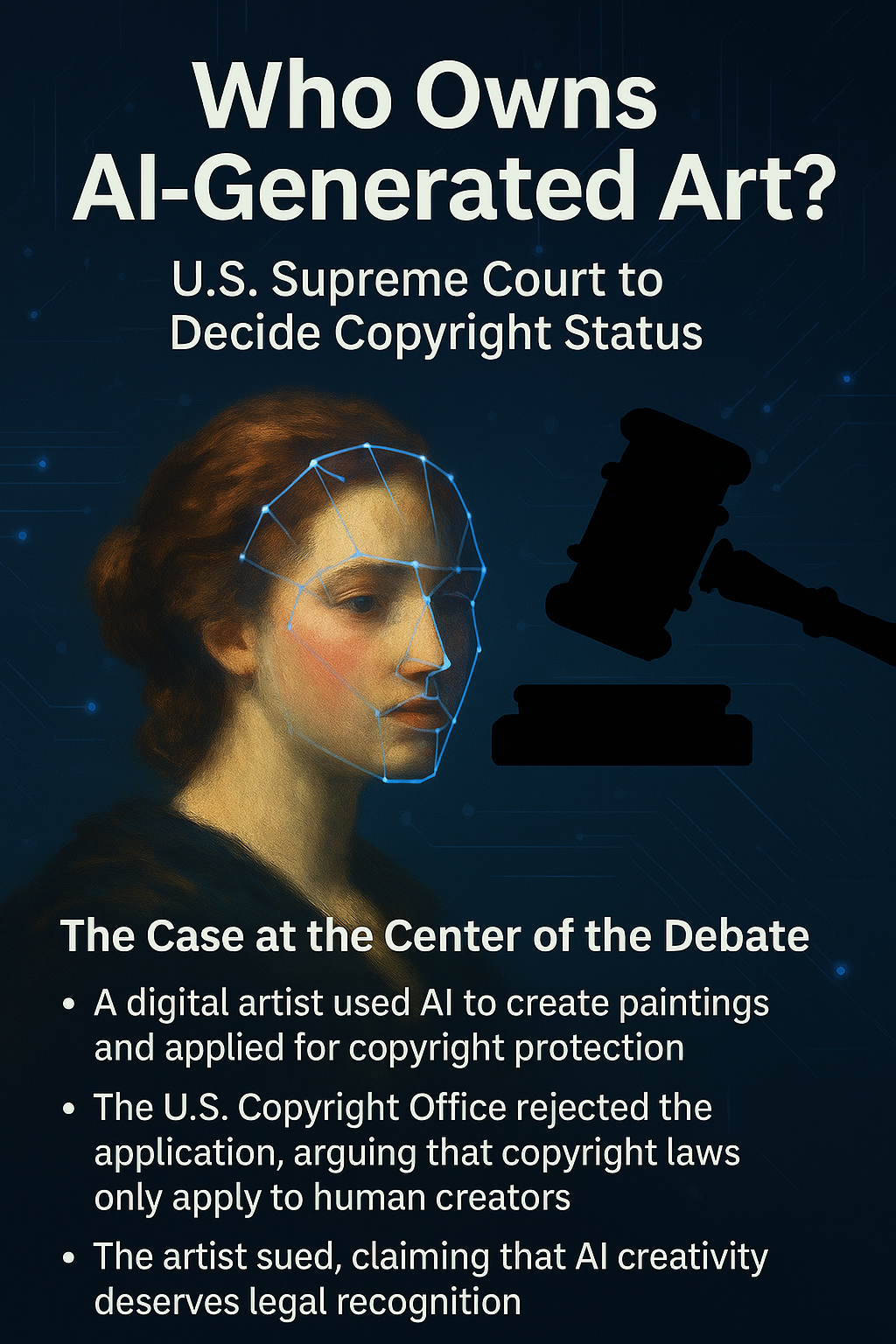
Traditional copyright requires human authorship.
Policies vary on whether AI can be recognized as a co-author or if copyright belongs to the AI developer, user, or owner.
Patent Protection
Patents generally require a human inventor.
AI-generated inventions challenge this requirement if an AI autonomously generates novel solutions without direct human intervention.
Data Licensing and Ownership
AI-generated content often depends on large datasets, raising issues about data rights, consent, and licensing.
Transparency and Accountability
Government policies often require disclosure of AI involvement in content creation for legal and ethical accountability.
Liability
Policies clarify who is responsible if AI-generated content infringes IP or causes harm.
2. Key Government Policies by Region
| Region | Policy Highlights | Example |
|---|---|---|
| USA (Copyright Office) | AI-generated content cannot be copyrighted unless a human authorship is involved. | US Copyright Office policy 2023 |
| UK (IPO) | Copyright arises for content where AI is directed or controlled by a human. | UK Intellectual Property Office guidance |
| EU (EUIPO & European Commission) | AI-assisted creations may be copyrighted if human creative contribution exists. | European Commission AI Act drafts |
| India (IPR Policies) | Draft National IPR Policy recognizes challenges of AI-generated works; copyright only protects human-authored contributions. | National IPR Policy (2022) |
| WIPO | Ongoing studies and consultations on AI-generated inventions; WIPO encourages member states to clarify ownership rules. | WIPO Technology Trends 2021 |
3. Case Laws and Disputes on AI-Generated Content
Here are seven key cases illustrating the current legal approach:
Case 1: Thaler v. US Copyright Office (US, 2022) – “DABUS AI”
Facts: Dr. Stephen Thaler claimed copyright for images and inventions autonomously generated by the AI system DABUS.
Decision: US Copyright Office rejected the claim, stating copyright requires human authorship.
Relevance: Reinforces that AI alone cannot own copyright; human guidance is essential.
Case 2: Thaler v. Commissioner of Patents (Australia, 2021) – AI as Inventor
Facts: Thaler claimed DABUS should be recognized as an inventor on a patent for a container design and neural network-generated invention.
Decision: The Federal Court of Australia allowed the patent to list AI as the inventor.
Learning: Australia recognizes AI-generated inventions in patent law, but this is still limited and controversial globally.
Case 3: UK Intellectual Property Office – DABUS AI Patent Application
Facts: UK IPO rejected a patent listing DABUS as the inventor.
Decision: Affirmed human inventorship requirement.
Relevance: Highlights jurisdictional differences in AI patent recognition.
Case 4: Monkey Selfie Case (Naruto v. Slater, US, 2018)
Facts: A macaque monkey took a selfie; question arose about authorship.
Decision: Court held that only humans can hold copyright.
Relevance: Analogous reasoning applied to AI-generated content: AI without human intervention cannot own copyright.
Case 5: Getty Images v. Stability AI (US/EU, 2023)
Facts: Stability AI trained its AI model on copyrighted images without permission. Getty Images sued for copyright infringement.
Outcome: Litigation ongoing; court examining whether AI training constitutes infringement.
Learning: Licensing datasets is now crucial for AI-generated content.
Case 6: Thaler v. European Patent Office (EPO, 2021)
Facts: DABUS patent application filed in Europe.
Decision: EPO rejected listing AI as an inventor; reaffirmed human inventorship principle.
Relevance: EU aligns with UK and most jurisdictions on human inventorship.
Case 7: US Copyright Office – AI-assisted Music (2022)
Facts: Applications for AI-assisted music compositions submitted for copyright.
Decision: Copyright granted only when human directed the creative choices, not for autonomous AI outputs.
Learning: Human oversight is key to claiming IP in AI-generated content.
4. Key Principles from Government Policies and Cases
| Principle | Explanation | Case Illustration |
|---|---|---|
| Human Authorship Requirement | AI alone cannot hold copyright | Thaler v. US Copyright Office, Monkey Selfie Case |
| AI as Inventor (Limited) | Some jurisdictions allow AI inventorship for patents | Thaler v. Australia |
| Licensing & Dataset Compliance | AI models must respect copyright of training data | Getty Images v. Stability AI |
| Human Oversight | Human guidance required for IP ownership | US Copyright Office AI Music 2022 |
| Cross-Jurisdiction Differences | Policies vary globally; must consider each jurisdiction | DABUS Patent Applications in UK, EU, Australia |
| Liability Clarity | Owner of AI often responsible for infringement | EU AI Act drafts |
| Transparency & Disclosure | AI involvement should be disclosed in IP filings | EU and WIPO guidance |
5. Policy Implications for Businesses and Creators
Ensure Human Authorship
Always include human creative input when using AI to generate content for copyright or patent claims.
Proper Licensing of Datasets
Train AI on legally acquired or licensed content to avoid infringement.
Jurisdictional Strategy
Consider where you file patents or copyrights, as rules differ across US, EU, UK, Australia, and India.
Document Human Contributions
Maintain records showing human direction, decision-making, and supervision over AI outputs.
Engage in Regulatory Compliance
Follow government guidance (e.g., EU AI Act, WIPO consultations) for transparency, liability, and IP recognition.
6. Summary
AI-generated content challenges traditional IP laws globally.
Governments generally require human authorship for copyright and human inventorship for patents, except in limited cases (e.g., Australia).
Licensing of training datasets and AI outputs is increasingly critical.
Courts and policies emphasize human oversight, transparency, and accountability.
Companies must adopt proactive strategies combining IP filings, dataset licensing, and clear attribution.
RELATED Blog



comments