



Ipr In Government Policies On AI-Generated Content Ip.
Intellectual Property Rights (IPR) in Government Policies on AI-Generated Content
1. Introduction
Governments worldwide are increasingly adopting AI systems to generate content, such as:
Policy drafts and reports
Educational material
Public communication content
Legal and administrative documents
This raises critical IP questions:
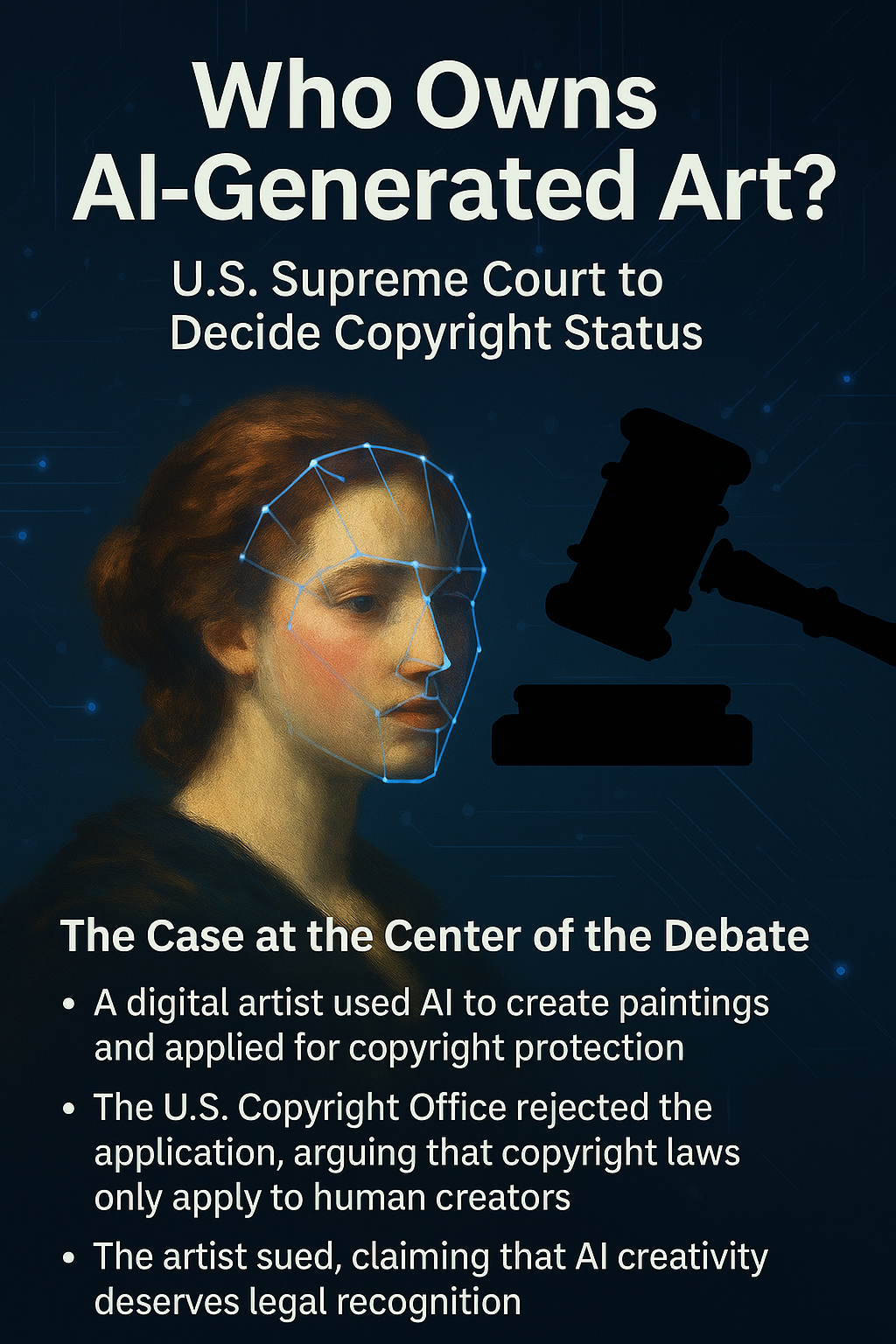
Can AI-generated content receive IP protection?
Who owns IP in AI-generated works produced under government policy?
Does public funding affect copyright ownership?
How do transparency, public interest, and access interact with IP rights?
Since most IP statutes do not explicitly recognize AI as a legal author, courts rely on existing judicial precedents to resolve disputes.
2. Government Policy Approach to AI-Generated Content IP
Government policies generally emphasize:
Human oversight
Public ownership or open access
Non-exclusive licensing
Accountability and transparency
However, these policies must align with existing IP jurisprudence, which is clarified through case law.
Case Law 1: Naruto v. Slater (2018)
Facts:
A macaque took photographs using a camera owned by a human. An animal rights organization claimed copyright ownership on behalf of the monkey.
Judgment:
The court ruled that copyright subsists only in works created by human authors. Non-human entities cannot own copyright.
Relevance to Government AI Policies:
AI systems used by governments cannot be authors.
Government policies typically designate:
The State, or
The human official supervising the AI,
as the rights holder.
Policy Impact:
Governments worldwide rely on this principle to deny autonomous AI authorship, ensuring human accountability in public documents.
Case Law 2: Feist Publications, Inc. v. Rural Telephone Service Co. (1991)
Facts:
Feist copied data from a telephone directory, arguing facts are not copyrightable.
Judgment:
The US Supreme Court held:
Facts are not protected.
Copyright requires original expression.
Application to Government AI Content:
AI-generated government datasets, statistics, and reports are often purely factual.
Governments increasingly release such content under open licenses, consistent with this ruling.
Policy Significance:
Supports open-data and transparency policies for AI-generated public information.
Case Law 3: Eastern Book Company v. D.B. Modak (2008)
Facts:
A legal publisher claimed copyright in edited court judgments.
Judgment:
The Indian Supreme Court rejected the “sweat of the brow” doctrine.
Only works with modicum of creativity are protected.
Relevance to AI-Generated Government Content:
Automated drafting of laws, judgments, or policy notes by AI does not automatically confer copyright.
Government policies require human editorial judgment to ensure IP protection.
Government Policy Angle:
Encourages human review mandates in AI-assisted governance.
Case Law 4: V. Govindan v. E.M. Gopalakrishna Kone (1955)
Facts:
The dispute concerned originality in compilations.
Judgment:
The court held that mere mechanical compilation lacks originality.
Relevance:
AI-generated government compilations (citizen databases, reports) may lack copyright.
Policies favor public domain treatment of such materials.
Policy Outcome:
Supports the government’s role as a custodian of public information, not a monopolist.
Case Law 5: Authors Guild v. Google (2015)
Facts:
Google digitized copyrighted books to create a searchable database.
Judgment:
The court held the use was transformative and qualified as fair use.
Relevance to Government AI Training:
Governments often train AI on copyrighted works.
Training for policy analysis, governance, or public service may be fair use.
Policy Implication:
Justifies AI training exceptions for public interest purposes, reflected in many national AI strategies.
Case Law 6: Alice Corp. v. CLS Bank International (2014)
Facts:
Alice Corp’s patent claims involved abstract ideas implemented on a computer.
Judgment:
Abstract ideas are not patentable unless accompanied by technical innovation.
Relevance to Government AI Policy:
Governments discourage patent monopolies over core AI governance tools.
Policies promote open standards instead of exclusive patents.
Policy Impact:
Prevents privatization of foundational AI systems used in public administration.
Case Law 7: Diamond v. Diehr (1981)
Facts:
A computer-controlled rubber curing process was challenged as non-patentable.
Judgment:
The invention was patentable because it applied a mathematical formula to a real-world industrial process.
Relevance:
Government-funded AI inventions can be patented if they demonstrate technical effect.
Policies often require such patents to be non-exclusive or government-owned.
Case Law 8: State of Uttar Pradesh v. Raja Mohammad Amir Ahmad Khan (1961)
Facts:
The case dealt with government publications and ownership.
Judgment:
Government works are protected unless expressly placed in the public domain.
Relevance:
AI-generated government content may be copyrighted under “government works”.
However, modern policies increasingly waive exclusivity for public access.
3. Core Policy Challenges in AI-Generated Government Content
1. Authorship and Accountability
AI cannot be an author
Human oversight is legally mandatory
2. Public Interest vs IP Monopoly
Government-created AI content should benefit the public
Excessive IP control undermines transparency
3. Data Sovereignty
Training datasets may involve third-party IP
4. Cross-Border Policy Conflicts
Different jurisdictions treat AI works differently
4. Conclusion
Government policies on AI-generated content IP are shaped by judicial insistence on human authorship, originality, and public interest. Courts consistently:
Reject non-human authorship
Limit protection for factual or automated works
Support transformative use and open access
Emphasize accountability in public governance
Until legislatures enact AI-specific IP laws, existing case law remains the legal foundation guiding government AI policies.
RELATED Blog



comments