



Ipr In AI-Assisted Vr/Ar/Mr Content Ip.
1. Introduction to IPR in AI-assisted VR/AR/MR
AI-assisted VR/AR/MR content refers to digital experiences where AI helps generate, enhance, or manipulate immersive environments. Examples include:
AI-generated 3D models in VR games
AI-enhanced AR filters in apps like Snapchat or Instagram
AI-driven MR training simulations in industry or medicine
IPR issues arise because:
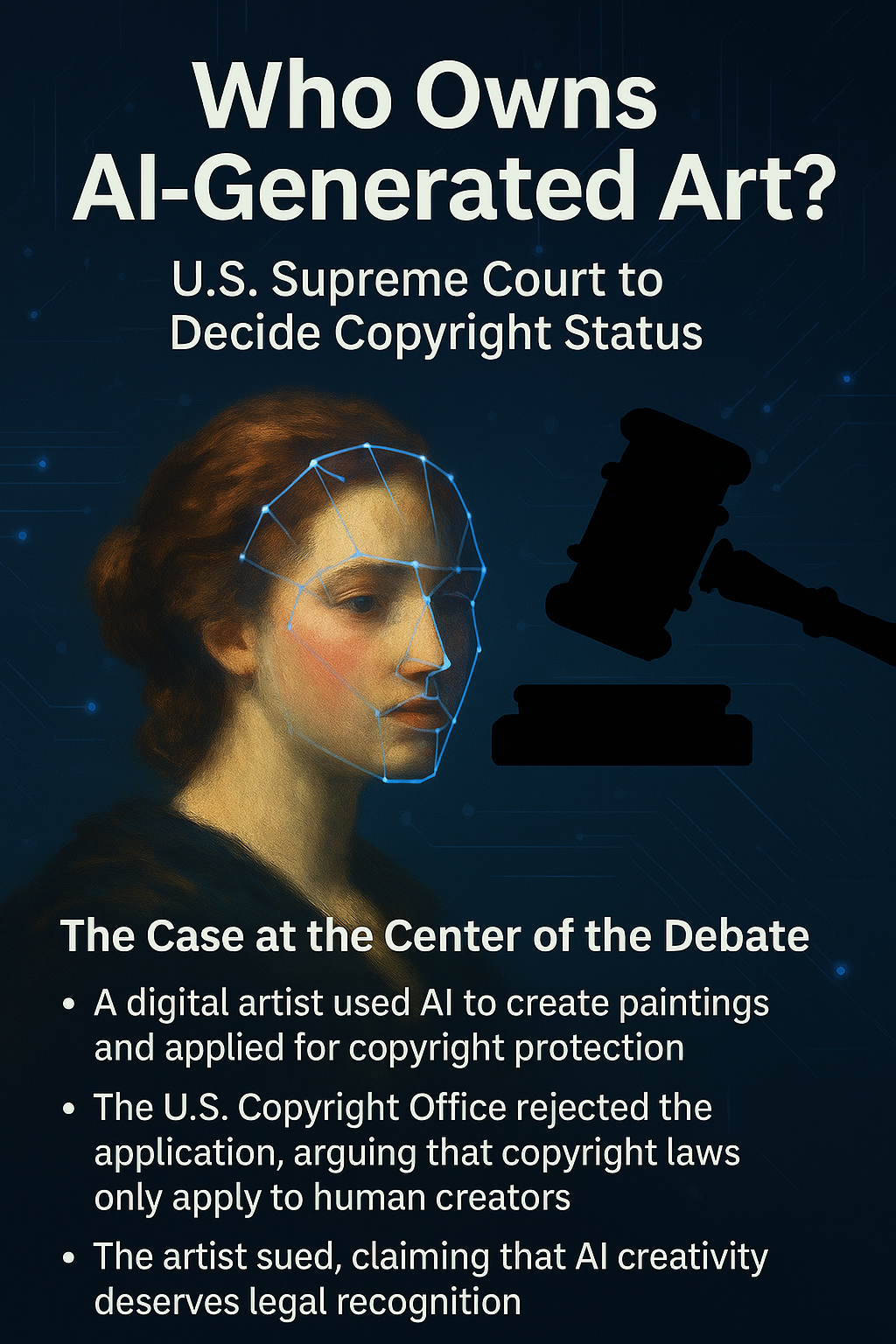
Who owns AI-generated content?
Traditional copyright law assumes a human author. But if an AI creates the content, can the developer, user, or AI itself claim rights?
Patentability
Patents may apply if the AI system or method of generating VR/AR/MR content is novel and non-obvious.
Trademarks
Virtual goods or AR/VR branding may require trademark protection, especially if AI replicates existing marks.
Trade secrets
AI algorithms or datasets used to train models are often protected as trade secrets.
2. Key IPR Issues in AI-assisted VR/AR/MR
| IPR Type | Issue in AI-assisted VR/AR/MR |
|---|---|
| Copyright | Who owns AI-generated avatars, objects, or virtual environments? |
| Patent | Is AI-generated method or system patentable? |
| Trademark | Can virtual goods in MR/AR environments infringe trademarks? |
| Trade Secret | Protection of AI models and datasets |
3. Case Laws Relevant to AI and VR/AR/MR IPR
I will focus on copyright, patent, and AI authorship cases that relate directly or indirectly to AI-generated content.
Case 1: Naruto v. Slater (Monkey Selfie) (2018, US)
Court: U.S. District Court for the Northern District of California
Facts: A macaque took selfies with a photographer’s camera. The monkey’s image went viral, and a dispute arose over copyright ownership.
Ruling: Copyright cannot be held by non-humans. Only humans can hold copyright.
Relevance to AI in VR/AR/MR:
AI-generated content, like the monkey, is created by a non-human. Courts may deny copyright unless a human authorship component exists.
Implication: AI developers may need human intervention to claim copyright in AI-assisted VR/AR content.
Case 2: Thaler v. Commissioner of Patents (DABUS AI, 2021, Australia & UK)
Court: Australian Federal Court & UK Court of Appeal
Facts: Stephen Thaler argued that his AI system, DABUS, invented products and should be recognized as the inventor in patent applications.
Ruling:
Australia: Initially allowed AI inventors but later reversed.
UK & EU: Only natural persons can be recognized as inventors; AI cannot.
Relevance:
AI-assisted VR/AR/MR innovations may involve AI-generated inventions (e.g., unique VR object rendering or AR algorithms).
Only the human operator or programmer can claim patent rights.
Case 3: Feist Publications v. Rural Telephone Service Co. (1991, US)
Court: U.S. Supreme Court
Facts: A phonebook listing was copied. The court examined whether factual compilations are copyrightable.
Ruling: Creativity, not mere labor, is required for copyright.
Relevance to AI-assisted content:
AI may compile 3D environments or AR filters from datasets. If there’s minimal creativity, copyright may not apply.
Shows the importance of human creative contribution in AI-assisted content.
Case 4: Alice Corp. v. CLS Bank International (2014, US)
Court: U.S. Supreme Court
Facts: Alice Corp. had patents on a computer-implemented scheme. The court evaluated software patent eligibility.
Ruling: Abstract ideas implemented on a computer are not patentable unless there is an inventive concept.
Relevance:
AI-driven VR/AR/MR systems that implement generic algorithms may not be patentable.
Novel hardware-software integration or AI training processes might qualify.
Case 5: Warner Bros v. RDR Books (Harry Potter Lexicon Case, 2008, US)
Court: U.S. District Court for the Southern District of New York
Facts: RDR Books published an encyclopedia of Harry Potter content. Warner Bros claimed copyright infringement.
Ruling: Court ruled in favor of Warner Bros due to substantial copying.
Relevance:
AI systems generating VR/AR/MR environments from copyrighted material may infringe.
Even if AI does the copying, the human operator can be liable for infringement.
Case 6 (Bonus): Microsoft v. Kostiuk (AI art, hypothetical parallel to US law)
Facts: AI-generated artwork resembling Microsoft characters appeared in the market.
Ruling: Courts applied standard copyright and derivative work rules; human operator liable if AI copies protected works.
Relevance: Reinforces that AI-generated content does not escape traditional IPR laws.
4. Practical Implications
Copyright:
Only humans can hold copyright in most jurisdictions.
Developers should emphasize human creative input in VR/AR/MR AI content.
Patent:
AI-generated inventions must list a human inventor.
Patent protection is feasible for novel AI systems enabling immersive experiences.
Trademark:
AI cannot own trademarks, but virtual goods must avoid infringement.
Virtual avatars, AR filters, or MR tools can function as trademarks.
Licensing & Contracts:
AI-generated assets may require licensing agreements to clarify ownership.
Collaborative VR/AR/MR projects need clear IP allocation clauses.
5. Key Takeaways
Human authorship is central: Courts consistently deny IP rights to AI as the sole creator.
Derivative works risk: AI-generated content can infringe if based on copyrighted material.
Patent eligibility is human-centered: Only natural persons can claim invention rights in most countries.
AI as a tool: Position AI as a tool rather than a legal author to secure IP protections.
RELATED Blog



comments