



Ipr In AI-Assisted Teaching Assistant Robots.
IPR IN AI-ASSISTED TEACHING ASSISTANT ROBOTS
1. Meaning and Scope
AI-assisted teaching assistant robots are systems that:
Generate lectures, explanations, quizzes, feedback
Evaluate student performance
Adapt content using machine learning
Interact autonomously with students
These systems raise complex IPR questions because:
Content may be generated autonomously
Multiple stakeholders are involved (developer, institution, teacher, AI)
AI may use copyrighted datasets to learn
Outputs may resemble or reproduce existing works
TYPES OF IPR INVOLVED
A. Copyright
Protects:
Lecture content generated by AI
Lesson plans, slides, quizzes, explanations
Software code (as a literary work)
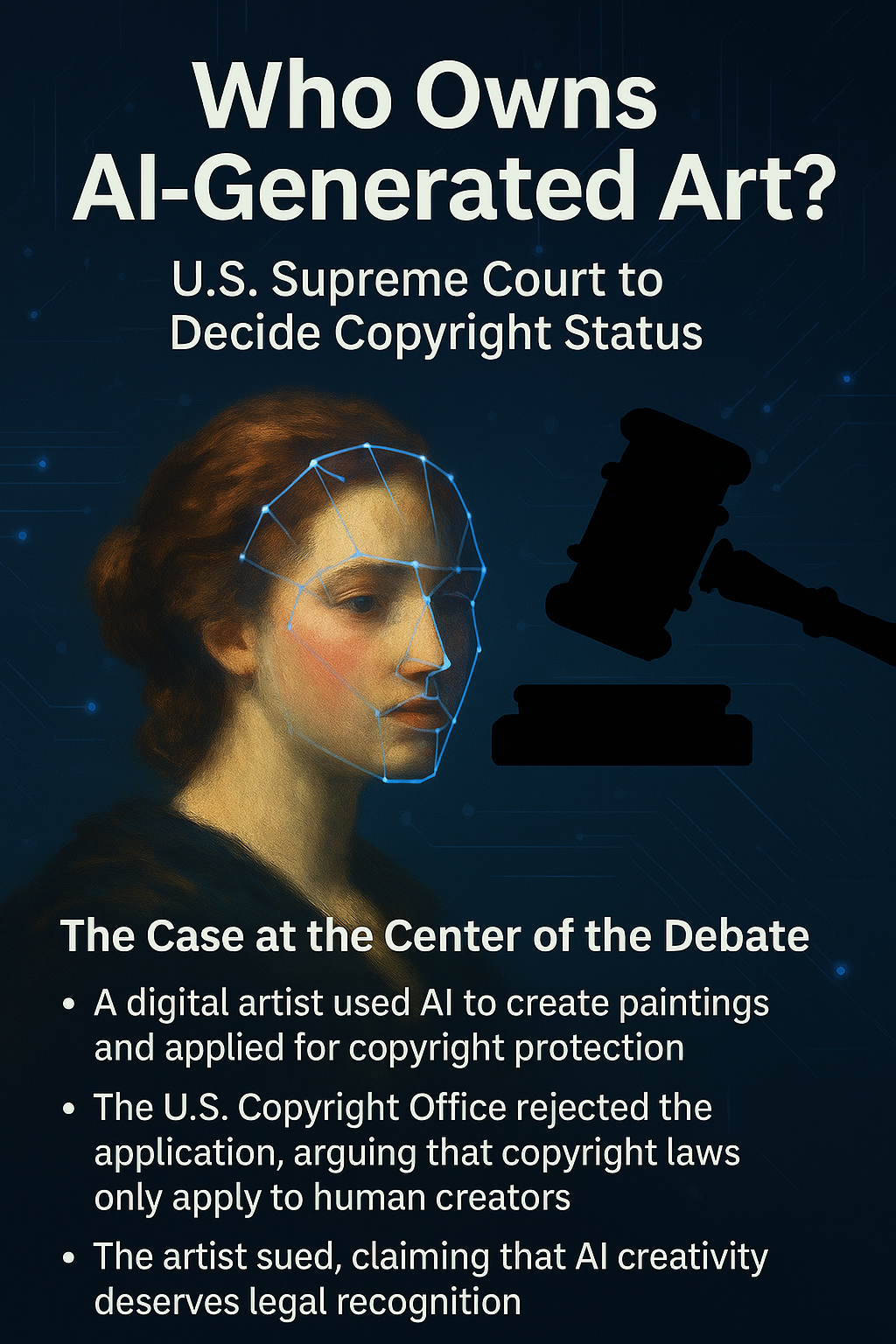
Key issue: Who is the author when AI generates content?
B. Patent Law
Protects:
Novel AI algorithms
Robotics architecture
Adaptive learning mechanisms
Human-AI interaction methods
Key issue: Can AI be an inventor?
C. Trade Secrets
Protects:
Training data
Algorithms
Decision-making models
Used especially when patent disclosure is risky.
D. Database Rights
Protects:
Curated educational datasets
Student learning analytics databases
CORE LEGAL ISSUES IN AI TEACHING ASSISTANTS
Authorship of AI-generated educational content
Ownership of content created using AI
Patent inventorship for AI-created inventions
Copyright infringement through training data
Liability for AI-generated infringing content
IMPORTANT CASE LAWS (DETAILED)
I will explain 7 landmark cases, each tied to AI-assisted teaching robots.
CASE 1: Naruto v. Slater (Monkey Selfie Case)
Facts:
A photographer left a camera unattended
A monkey took photographs autonomously
Copyright was claimed for the photos
Legal Issue:
Can a non-human entity be an author under copyright law?
Judgment:
Only human beings can be authors
Non-human creators have no legal standing
Relevance to AI Teaching Assistants:
AI teaching robots cannot be legal authors
Content generated by AI alone cannot claim copyright
Ownership must vest in a human or legal entity
Legal Principle:
Copyright subsists only when human intellectual effort is present
CASE 2: Eastern Book Company v. D.B. Modak (India)
Facts:
Copyright claimed over edited law reports
Issue of originality threshold
Legal Issue:
What degree of creativity is required for copyright?
Judgment:
Introduced the “modicum of creativity” test
Mere mechanical work is not protected
Relevance to AI Teaching Assistants:
AI-generated lesson summaries may fail originality
Human supervision/editing is crucial
Pure AI output without creativity may not qualify
Legal Principle:
Originality requires minimal human creativity, not mere automation
CASE 3: Feist Publications v. Rural Telephone Service
Facts:
Telephone directory compilation
Claimed copyright over facts
Legal Issue:
Are facts and mechanically compiled data protected?
Judgment:
Facts are not copyrightable
Mere effort (“sweat of the brow”) is insufficient
Relevance to AI Teaching Assistants:
AI-generated factual explanations lack protection
Educational robots producing factual answers may not create copyrightable works
Protection arises only if creative structure is added
CASE 4: DABUS Artificial Intelligence Cases (UK, US, Australia)
Facts:
AI system named DABUS generated inventions
Patent applications listed AI as inventor
Legal Issue:
Can an AI be named as an inventor?
Judgment:
UK & US: Inventor must be a natural person
Australia (initially): Allowed, later reversed
Relevance to AI Teaching Robots:
If a robot designs a new learning method:
AI cannot be inventor
Patent must list human developer or controller
Legal Principle:
Patent rights require human inventorship
CASE 5: University of London Press v. University Tutorial Press
Facts:
Copyright in examination papers
Legal Issue:
Are exam questions protected?
Judgment:
Yes, exam papers are literary works
Original intellectual effort involved
Relevance to AI Teaching Assistants:
AI-generated test questions may lack protection
Human-designed prompts or modifications matter
Institutions may own rights if created in employment
CASE 6: Authors Guild v. Google (Google Books Case)
Facts:
Google digitized books for search
Claimed fair use
Legal Issue:
Does large-scale copying for machine use infringe copyright?
Judgment:
Considered transformative use
No market harm → fair use
Relevance to AI Teaching Assistants:
Training AI teaching bots on copyrighted textbooks
Permissible if:
Transformative
No reproduction of expressive content
Risk arises if output resembles original works
CASE 7: R.G. Anand v. Delux Films (India)
Facts:
Alleged copying of a play into a movie
Legal Issue:
When does similarity amount to infringement?
Judgment:
Idea is not protected, expression is
Substantial similarity test applied
Relevance to AI Teaching Assistants:
AI teaching bots may reproduce structure or phrasing
Liability arises if output copies expression, not ideas
Institutions must monitor outputs
OWNERSHIP MODELS FOR AI TEACHING ASSISTANTS
1. Developer Ownership
If AI is proprietary
Output controlled by software terms
2. Institutional Ownership
Work-for-hire doctrine
Used in universities/schools
3. Teacher Ownership
If teacher substantially edits or directs output
4. Public Domain
If purely AI-generated with no human creativity
LIABILITY FOR INFRINGEMENT
If AI teaching assistant:
Reproduces copyrighted text
Generates plagiarized content
Uses unauthorized datasets
Liability falls on:
Institution (primary)
Developer (secondary)
User (if negligent)
AI itself has no legal liability
CONCLUSION
AI teaching assistant robots challenge traditional IPR frameworks
Current laws recognize only humans as authors and inventors
Protection depends on human involvement
Institutions must:
Define ownership clearly
Monitor AI outputs
Use licensing and safeguards
RELATED Blog



comments