



Ipr In AI-Assisted Space Communication Patents
1. Concept of AI-Assisted Space Communication
AI-assisted space communication refers to the integration of machine learning and autonomous decision-making into space communication systems, such as:
Satellite constellation traffic management
Adaptive signal routing and bandwidth allocation
Autonomous fault detection and recovery
AI-based interference mitigation
Deep-space communication optimization
Space-based IoT and data relay systems
These innovations combine aerospace engineering, telecommunications, and advanced software, resulting in complex intellectual property landscapes.
2. Types of Intellectual Property Protection
A. Patents
Patents are the primary form of protection for:
AI-based signal modulation methods
Autonomous communication protocols
Neural network-based satellite routing systems
AI-driven antenna alignment technologies
Requirements:
Novelty
Non-obviousness (inventive step)
Industrial applicability
Key issue: Whether AI-generated inventions satisfy inventorship requirements.
B. Copyright
Protects:
Software code
AI training models
Interface designs
Simulation environments
However, copyright protects expression, not functional concepts.
C. Trade Secrets
Often used for:
Optimization algorithms
Training datasets
Signal-processing techniques
Proprietary communication architectures
D. Trademarks
Protect brand identity of satellite communication platforms and services.
E. Standards-Essential Patents (SEPs)
Space communication technologies may become part of international standards, creating:
Licensing obligations
FRAND (Fair, Reasonable, Non-Discriminatory) requirements.
3. Patentability Issues in AI Space Communication
a. Software vs Technical Effect
Courts require technical innovation beyond abstract algorithms.
Example:
AI optimizing radio-frequency spectrum = potentially patentable.
Pure data analysis model = may be rejected.
b. AI Inventorship
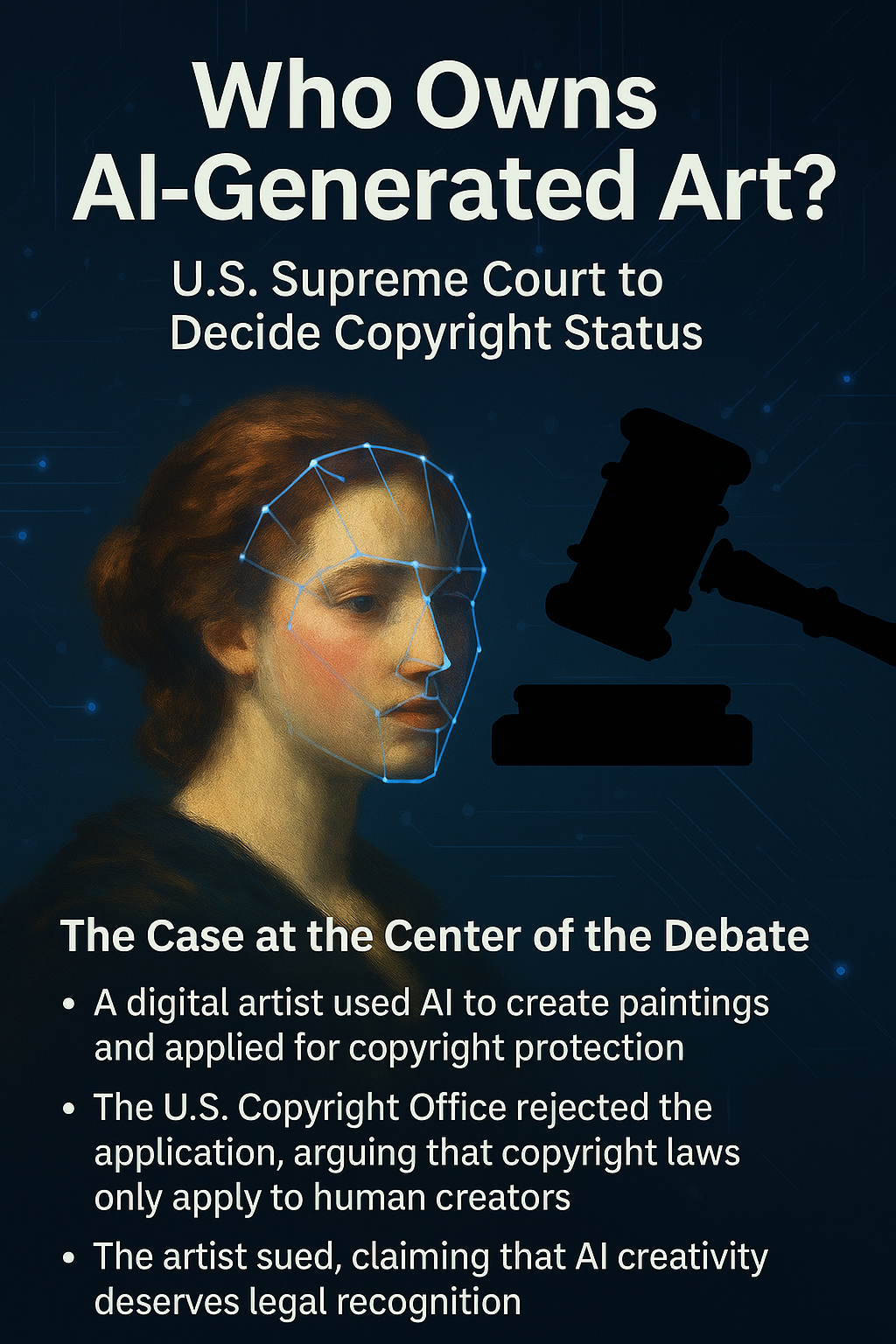
Legal systems generally require human inventors even if AI contributes significantly.
c. Cross-Border Jurisdiction
Space technology operates globally, leading to:
Conflicting patent laws
International treaty implications.
d. Government and Defense Regulations
Space communications often involve national security restrictions affecting licensing and patent disclosure.
4. Detailed Case Laws
Below are significant cases influencing patent law relevant to AI-assisted space communication technologies.
Case 1: Alice Corp v. CLS Bank International
Background
Concerned software patents related to financial systems.
Legal Principle
Abstract ideas implemented on computers are not patentable unless they include a technical improvement.
Application to AI Space Communication
AI algorithms for satellite communication must demonstrate:
Technical innovation
Improvement in signal processing or network functionality.
Merely claiming “AI-based optimization” is insufficient without technical details.
Case 2: Diamond v. Diehr
Background
Patent involving computer-controlled rubber curing process.
Court Holding
Software integrated into a physical industrial process is patentable.
Relevance
AI-assisted antenna alignment, signal calibration, or communication hardware control can be patentable because:
AI interacts with physical systems.
Produces real-world technical effects.
Case 3: Thaler v. Vidal (DABUS AI Inventorship Case)
Background
Applications named an AI system as inventor.
Decision
Courts ruled inventors must be natural persons.
Impact
AI-assisted space communication innovations must list human inventors.
Companies must:
Track human contributions
Document invention processes.
Case 4: Parker v. Flook
Background
Patent claim involved algorithm-based updating of alarm limits.
Holding
Mathematical formulas alone are not patentable without inventive application.
Application
AI signal prediction models alone may not qualify unless tied to technical hardware implementation.
Case 5: Qualcomm Inc. v. Broadcom Corp.
Background
Patent dispute over communication technology standards.
Legal Significance
Highlighted issues of:
Standard-essential patents
Licensing obligations
Enforcement challenges.
Relevance
Space communication systems adopting global protocols may involve SEPs, requiring fair licensing.
Case 6: Ericsson v. D-Link Systems
Background
Case concerning FRAND licensing obligations for communication patents.
Legal Principle
Patent holders must license standard-essential technologies on fair terms.
Application
If AI communication protocols become industry standards for satellite networks, similar obligations may arise.
Case 7: Mayo Collaborative Services v. Prometheus Laboratories
Background
Focused on patent eligibility and natural laws.
Relevance
AI predicting cosmic signal propagation or space environment effects must include inventive technical steps beyond natural phenomena.
Case 8: Koninklijke Philips v. ASUS
Background
Patent enforcement relating to communication standards.
Importance
Demonstrated:
Cross-border enforcement challenges.
Licensing complexities.
Relevant for satellite communication companies operating internationally.
5. Regulatory and Treaty Framework
Space communication IP is influenced by:
Outer Space Treaty (non-appropriation principles)
ITU spectrum allocation rules
National export control laws
International patent treaties (PCT).
6. Emerging Legal Trends
AI-managed mega-constellations (e.g., autonomous routing)
Quantum satellite communication patents
Edge AI processing in orbit
Autonomous space mesh networks
Satellite cybersecurity patents.
Conclusion
IPR in AI-assisted space communication patents requires navigating complex legal challenges involving software patentability, hardware integration, international jurisdiction, and AI inventorship. Courts have clarified through cases like Alice Corp v. CLS Bank, Diamond v. Diehr, Parker v. Flook, Thaler v. Vidal, Qualcomm v. Broadcom, Ericsson v. D-Link, and Mayo v. Prometheus that:
Technical implementation is critical for patent eligibility.
AI cannot currently be recognized as an inventor.
Communication technologies tied to industry standards create licensing obligations.
Integration with physical systems strengthens patent protection.
RELATED Blog



comments