



Ipr In AI-Assisted Drone-Integrated Robotics Ip.
IPR IN AI-ASSISTED DRONE-INTEGRATED ROBOTICS
(Patents, Copyright, Trade Secrets & Liability)
AI-assisted drone-integrated robotics typically involves:
• Autonomous navigation (AI algorithms)
• Sensor fusion (LiDAR, GPS, vision systems)
• Machine learning models trained on data
• Embedded software + hardware integration
• Real-time decision-making systems
Each of these components triggers different IPR regimes, and courts worldwide have already laid important groundwork.
1. PATENT LAW ISSUES
(Most critical for AI-drone robotics)
Key questions:
Is AI software patentable?
Who is the inventor — human or AI?
Is an autonomous system “abstract” or “technical”?
CASE 1: Alice Corp. v. CLS Bank International (2014, US Supreme Court)
Facts:
Alice Corp. owned patents for a computer-implemented system that reduced settlement risk using software algorithms.
Legal Issue:
Whether implementing an abstract idea on a computer makes it patentable.
Judgment:
The Supreme Court held that:
• Abstract ideas are not patentable
• Simply using a computer or software does not add inventiveness
Two-Step Test (Now Universal in AI Patents):
Is the claim directed to an abstract idea?
If yes, does it contain an “inventive concept” that transforms it into patent-eligible subject matter?
Impact on AI-Drone Robotics:
AI navigation algorithms alone may be rejected.
BUT:
• AI controlling physical drone movement
• AI interacting with sensors, motors, and hardware
= technical application, not abstract
📌 Key takeaway:
Drone AI patents must emphasize technical effects (collision avoidance, path optimization, energy efficiency), not just algorithms.
CASE 2: Diamond v. Chakrabarty (1980, US Supreme Court)
Facts:
A genetically engineered bacterium was created to break down crude oil.
Legal Issue:
Can a man-made living organism be patented?
Judgment:
Yes — anything made by human ingenuity is patentable.
Relevance to AI-Robotics:
Although about biotech, the principle applies broadly:
• Human-created systems
• Non-natural functionality
• Technical utility
📌 Application to AI drones:
AI-assisted robotic drones are:
• Man-made
• Technically engineered
• Industrially applicable
Therefore, hardware-software integrated AI drones are patentable, as long as a human is involved in creation.
CASE 3: Thaler v. Vidal (2023, US Supreme Court)
(DABUS AI Inventor Case)
Facts:
Stephen Thaler filed patents listing DABUS (an AI system) as the inventor.
Legal Issue:
Can an AI be legally recognized as an “inventor”?
Judgment:
No.
Under US patent law:
• An inventor must be a natural person
• AI cannot own rights or invent independently
Impact on AI-Drone Robotics:
Even if:
• A drone’s AI autonomously designs a new flight mechanism
• Or optimizes hardware beyond human input
👉 A human must be named as inventor
📌 Strategic implication for companies:
Organizations must:
• Document human contribution
• Attribute invention to system designers, trainers, or supervisors
CASE 4: Thaler v. Comptroller General of Patents (2021, UK Supreme Court)
Facts:
Same DABUS system, but filed in the UK.
Judgment:
AI cannot be an inventor.
Patent law assumes:
• Legal personality
• Transfer of rights
• Accountability
Why this matters globally:
This judgment influenced:
• EU patent offices
• Indian patent examination practice
• WIPO discussions
📌 For drone robotics firms operating internationally:
You must align inventor attribution across jurisdictions.
CASE 5: Burrow-Giles Lithographic Co. v. Sarony (1884, US Supreme Court)
(Copyright foundation case)
Facts:
A photographer claimed copyright over a photograph.
Legal Issue:
Is mechanical reproduction copyrightable?
Judgment:
Yes — because of human creative choices.
Relevance to AI-Drone Systems:
Drone AI generates:
• Aerial imagery
• Surveillance videos
• 3D terrain maps
Copyright exists only if:
• Human control or creative input is present
📌 If a drone autonomously records data:
❌ No copyright
📌 If a human directs angle, parameters, or selection:
✅ Copyright
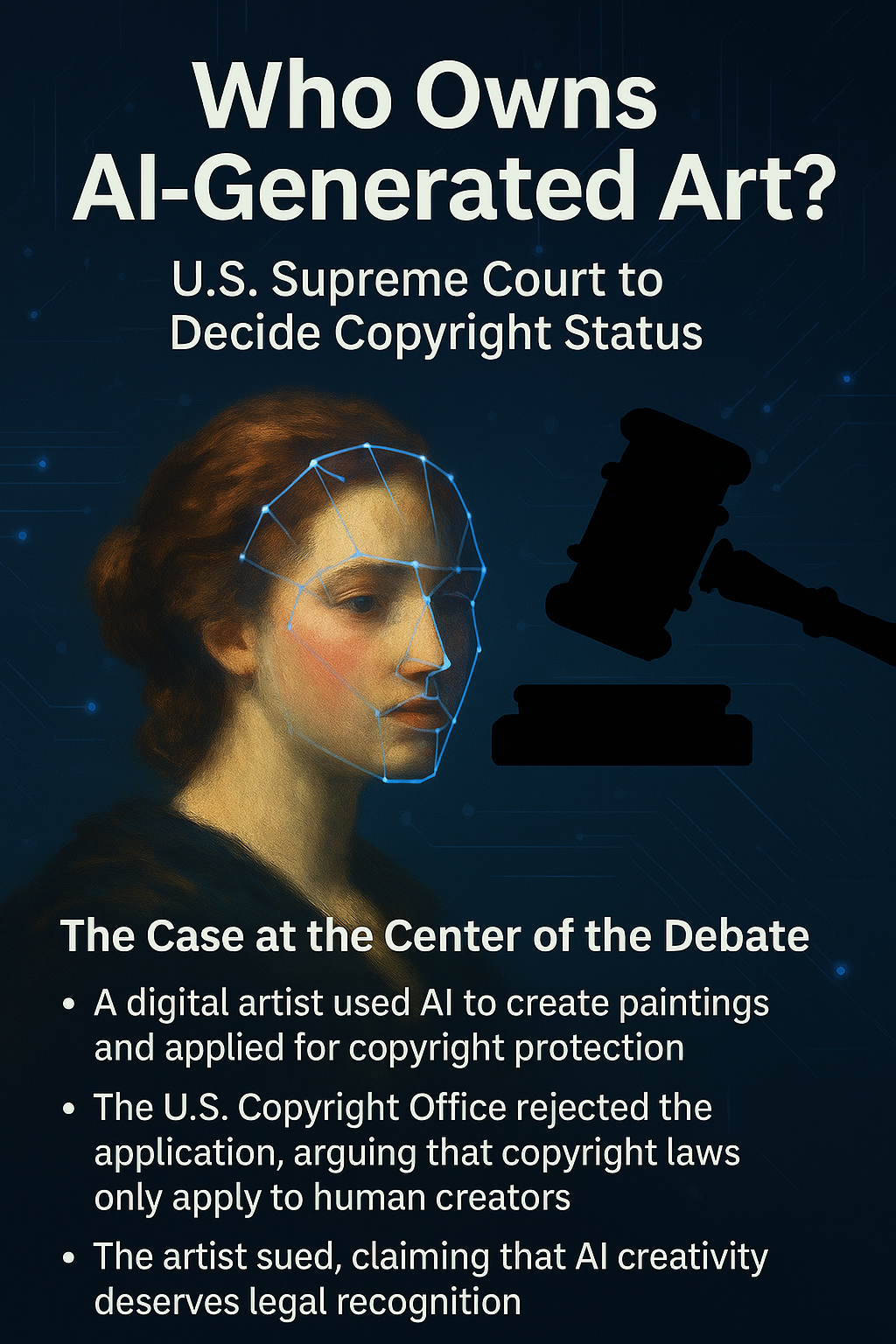
2. COPYRIGHT LAW & AI-GENERATED OUTPUT
CASE 6: Naruto v. Slater (Monkey Selfie Case, 2018)
Facts:
A monkey took a photograph using a camera.
Judgment:
Non-humans cannot own copyright.
Application to AI Drones:
• AI-generated maps, images, or videos
• Fully autonomous data capture
➡️ Without human authorship = no copyright
📌 This directly affects:
• Surveillance drone footage
• AI-generated reconnaissance data
• Autonomous mapping systems
3. TRADE SECRETS & CONFIDENTIALITY
For AI-drone robotics, companies often rely on:
• Proprietary training data
• AI weight parameters
• Flight-control logic
Legal Protection:
Trade secret law protects:
• Information with economic value
• Reasonable secrecy measures
📌 Unlike patents, trade secrets:
• Don’t require disclosure
• Protect AI models indefinitely
• Are crucial for defense robotics
4. LIABILITY & OWNERSHIP ISSUES
Who is liable if an AI-drone causes harm?
Current legal consensus:
• Manufacturer
• Programmer
• Operator
📌 AI has no legal personhood.
Courts treat AI drones as:
• Advanced tools
• Not independent legal actors
SUMMARY TABLE (EXAM-FRIENDLY)
| Legal Issue | Principle Established |
|---|---|
| Patentability | AI must show technical application |
| Inventorship | Human inventor mandatory |
| Copyright | Human creativity required |
| Drone imagery | Depends on human control |
| Trade secrets | Strong protection for AI models |
| Liability | Humans & companies liable |
CONCLUSION
AI-assisted drone-integrated robotics sits at the intersection of software, hardware, and autonomy, but current IPR law remains human-centric.
Courts worldwide agree:
• AI is a tool, not a legal person
• Technical contribution matters more than intelligence
• Ownership flows from human involvement
RELATED Blog



comments