



Ipr In AI-Assisted Digital Storytelling Ip.
1. What is AI-Assisted Digital Storytelling (from an IP lens)?
AI-assisted digital storytelling means humans using AI tools to create or enhance stories—
scripts, novels, poems
comics, animations, films
games, interactive narratives, metaverse stories
The key point for IP law is “assisted”, not fully autonomous.
This raises four core IP questions:
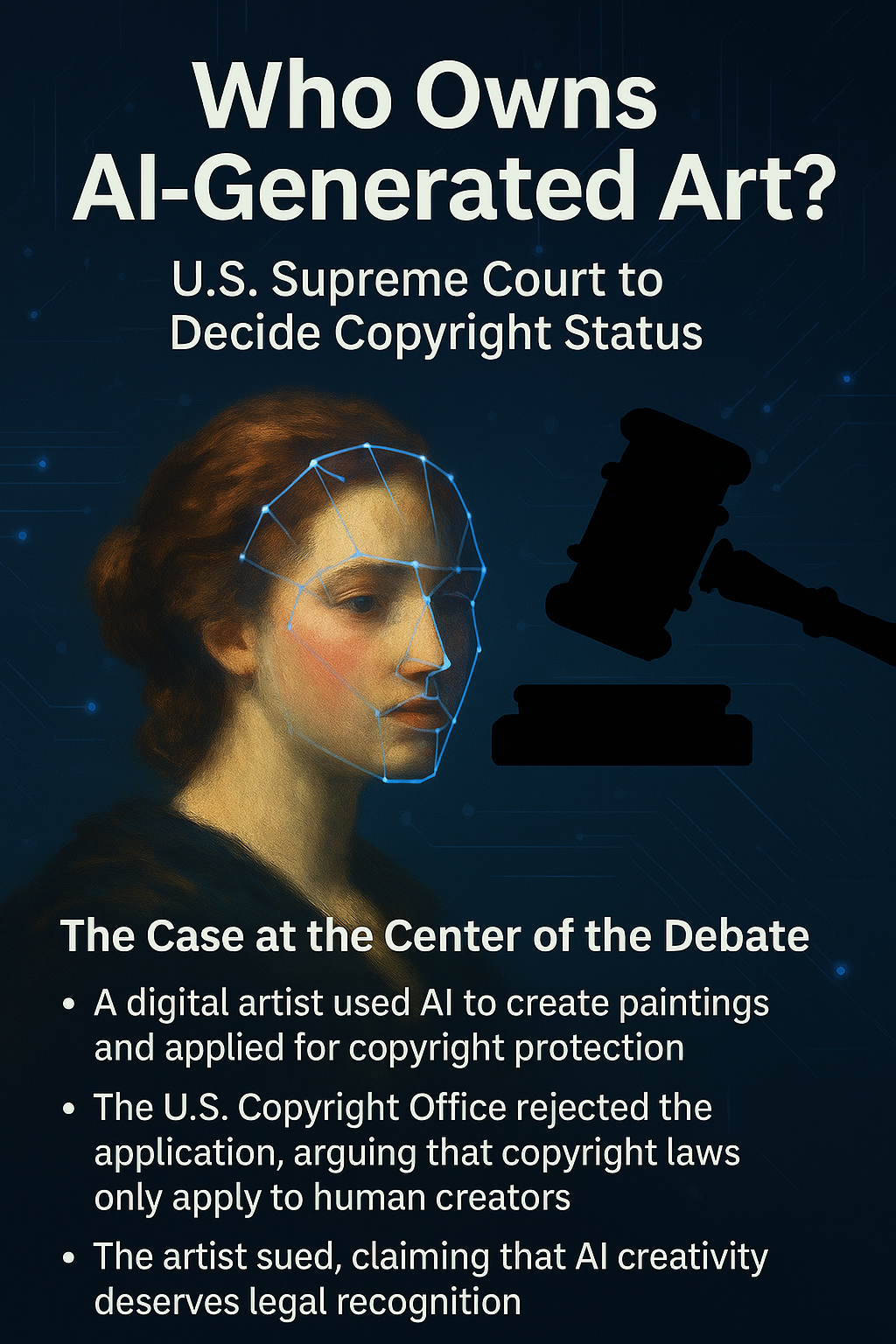
Authorship – Who is the author when AI helps create a story?
Ownership – Who owns the copyright: the user, the AI developer, or no one?
Originality – Is AI-generated content “original” under copyright law?
Infringement – Does AI unlawfully copy from existing works it was trained on?
2. Applicable IPR Regimes
A. Copyright
Most relevant for:
story text
character design
dialogue
illustrations
music and audiovisual storytelling
B. Trademark
Story titles
Character names (e.g., superheroes, franchises)
C. Patent
AI storytelling systems and algorithms (not the story itself)
D. Moral Rights
Right of attribution
Right against distortion (important when AI modifies a human’s story)
3. Core Legal Principle Emerging Globally
Copyright protects human creativity, not machine output—unless there is meaningful human involvement.
Now let’s ground this with case law.
4. Case Laws (Detailed)
Case 1: Naruto v. Slater (2018) – “Monkey Selfie Case” (USA)
Facts:
A photographer set up a camera.
A monkey (Naruto) clicked the photo.
Animal rights activists sued, claiming the monkey owned the copyright.
Legal Issue:
Can a non-human be an author under copyright law?
Court’s Decision:
Copyright law protects human authors only.
Non-humans (animals, machines) cannot own copyright.
Legal Principle Established:
Authorship requires legal personhood and human creativity.
Relevance to AI Storytelling:
AI, like the monkey, is not a legal person
Pure AI-generated stories cannot be authorship-protected
If a story is entirely generated by AI without human creative control → no copyright
This case is frequently cited to argue that AI cannot be an author.
Case 2: Feist Publications v. Rural Telephone Service (1991) – Originality Standard (USA)
Facts:
Rural Telephone published a phone directory.
Feist copied the data but rearranged it.
Rural claimed copyright infringement.
Legal Issue:
What level of originality is required for copyright?
Court’s Decision:
Mere facts are not protected.
A work must show minimal creativity.
Legal Principle:
“Originality requires independent creation plus a modicum of creativity.”
Relevance to AI Storytelling:
AI outputs often remix existing patterns.
If AI-generated stories lack creative choices by a human, originality is questionable.
Human prompts, editing, story structuring can supply that creativity.
This case underpins the argument that human intervention restores copyrightability.
Case 3: Aalmuhammed v. Lee (2000) – Authorship & Creative Control (USA)
Facts:
Aalmuhammed contributed scenes and dialogue to the movie Malcolm X.
He claimed joint authorship.
Legal Issue:
Who qualifies as an “author” in collaborative works?
Court’s Decision:
Authorship requires creative control over the work as a whole.
Merely contributing ideas or parts is insufficient.
Legal Principle:
An author must:
Control the work
Make creative decisions
Intend to be an author
Relevance to AI Storytelling:
If AI “suggests” content but the human:
decides plot
edits dialogue
controls narrative flow
→ the human is the author.
AI is treated as a tool, like a camera or word processor.
This case strongly supports user ownership in AI-assisted storytelling.
Case 4: Thaler v. Comptroller-General of Patents (2021–2023) – AI as Creator (UK)
Facts:
Dr. Stephen Thaler claimed an AI system created inventions.
He applied for IP protection listing AI as the inventor.
Legal Issue:
Can an AI be recognized as a creator or inventor?
Court’s Decision:
AI cannot be an inventor or rights holder.
Only natural or legal persons can own IP.
Legal Principle:
IP law does not recognize machine authorship.
Relevance to AI Storytelling:
AI cannot own copyright in stories.
Someone else must qualify—or the work enters the public domain.
Reinforces global reluctance to recognize AI as a legal creator.
Case 5: Zarya of the Dawn (US Copyright Office Decision, 2023)
Facts:
A comic book was created using Midjourney (AI).
The author claimed full copyright.
Legal Issue:
Are AI-generated images copyrightable?
Decision:
Text written by the human → protected
Selection and arrangement → protected
AI-generated images → not protected
Legal Principle:
Copyright applies only to human-authored elements.
Relevance to AI Storytelling:
Hybrid works are possible:
Human-written story + AI visuals
Protection is fragmented, not total.
Encourages clear documentation of human contribution.
This case is a blueprint for future AI storytelling disputes.
Case 6: Andersen v. Stability AI (2023, ongoing) – Training Data & Infringement
Facts:
Artists sued AI companies for training models on copyrighted art.
Claim: AI outputs imitate distinctive styles.
Legal Issues:
Is training AI on copyrighted works infringement?
Are AI-generated outputs “derivative works”?
Legal Arguments:
Plaintiffs: Unauthorized copying during training
Defendants: Fair use, non-expressive learning
Relevance to AI Storytelling:
If AI imitates a known author’s style too closely, risk of infringement.
Storytelling AI trained on copyrighted novels raises similar issues.
Even unresolved, this case shapes how AI-generated stories are evaluated.
5. Key Legal Takeaways for AI-Assisted Digital Storytelling
1. Authorship
AI cannot be an author
Human must exercise creative control
2. Ownership
User owns the work only if there is meaningful human input
Otherwise, no copyright exists
3. Originality
Prompt engineering alone may not be enough
Editing, structuring, and narrative choices matter
4. Infringement Risk
AI outputs mimicking identifiable works or styles can infringe
Especially dangerous in character-driven storytelling
5. Best Practices for Creators
Keep records of prompts and edits
Avoid naming specific authors/styles
Add substantial human creativity
6. Conclusion
AI-assisted digital storytelling sits at a legal crossroads:
Courts consistently protect human creativity
AI is treated as a tool, not a creator
Copyright attaches only where human intellectual effort dominates
As law stands today:
AI can help tell the story, but only humans can own it.
RELATED Blog



comments