



Ipr In AI-Assisted Cyclone Monitoring Robots.
I. What Are AI-Assisted Cyclone Monitoring Robots?
AI-Assisted Cyclone Monitoring Robots are autonomous robotic systems deployed to:
gather environmental data during cyclones (wind speed, pressure, humidity),
process it using state-of-the-art machine learning,
operate in hazardous conditions where humans can’t safely go.
These systems include:
Hardware components (sensors, ruggedized enclosures),
Embedded software/AI models for autonomous decisions,
Data outputs used for forecasting or response,
Communication systems to relay information in real time.
Each layer raises IP issues around:
patents,
copyrights,
trade secrets,
data rights,
AI-generated outputs,
joint development/ownership.
II. Key IP Concepts Relevant to AI Robotics
1. Patentability
Patent law protects inventions that are:
novel,
non-obvious,
useful.
For AI-assisted robots, patents can cover:
hardware designs,
AI algorithms implemented in software (in some jurisdictions),
system integration,
data processing techniques.
But can AI techniques themselves be patented?
Some jurisdictions allow patents on AI-related methods if tied to a technical application (e.g., cyclone prediction).
2. Copyright
Protects expression (software code, documentation, datasets in certain forms).
But it does not protect ideas, algorithms (abstract), or procedures per se.
3. Trade Secrets
Cover confidential information with commercial value (e.g., training datasets, unique sensor integration methods).
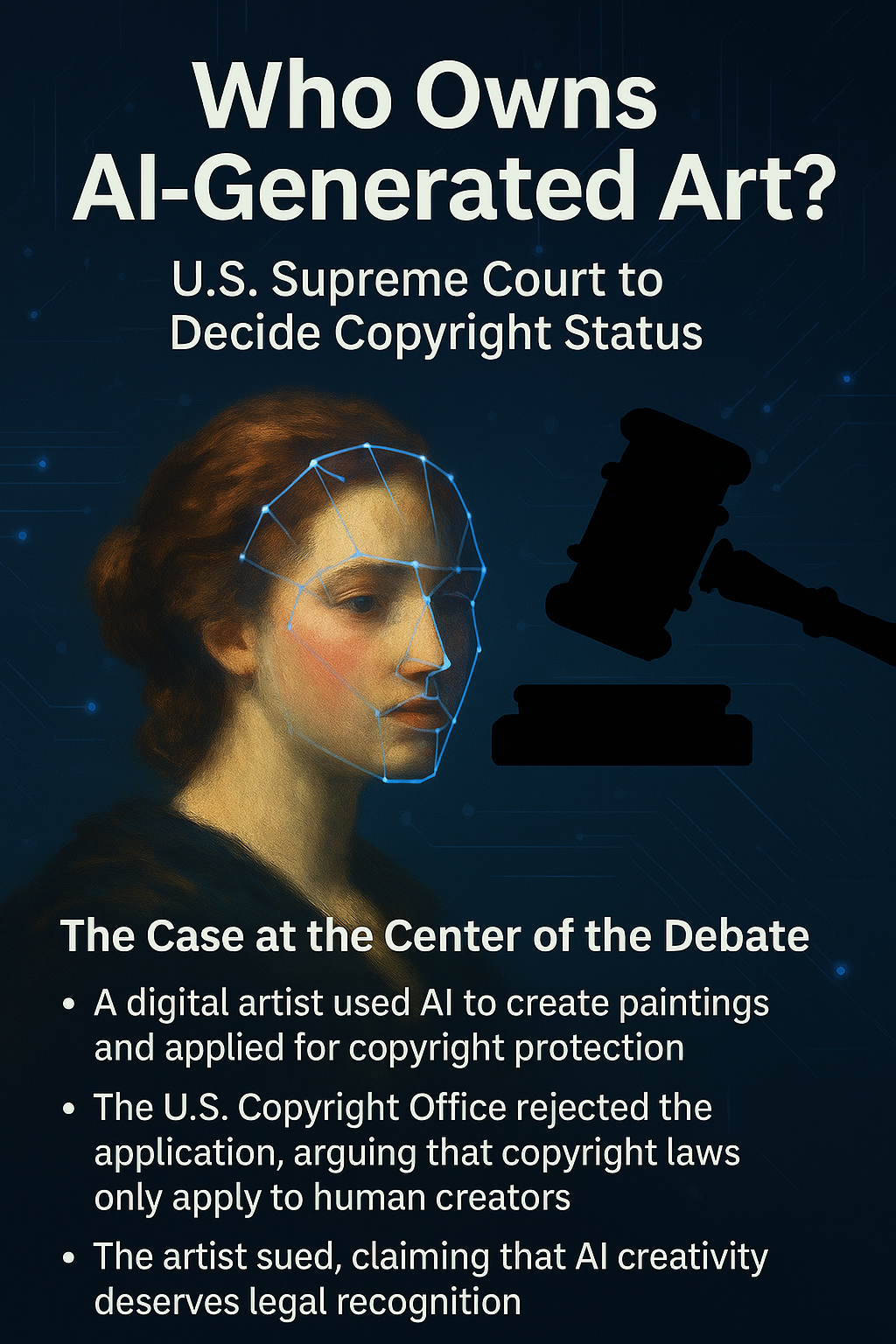
4. AI and Ownership
Who owns outputs generated by AI?
If an AI model autonomously generates forecasts, does IP belong to:
the programmer,
the deployer,
the AI itself?
Most laws still require a human author/owner.
III. Detailed Case Studies
Below are six key cases — some from analogous AI/robotics law — with detailed reasoning and relevance.
Case 1: Alice Corp. v. CLS Bank International (U.S. Supreme Court, 2014)
Facts
Alice Corp. held patents on a computer-implemented scheme for mitigating settlement risk. CLS Bank challenged them.
Holding
The Supreme Court held the patents invalid because they were effectively abstract ideas implemented on a computer.
Principle
Abstract ideas are not patentable.
Merely adding generic computer implementation does not save a patent.
Relevance to AI Cyclone Robots
An AI algorithm for meteorological prediction cannot be patented just because it runs on a robot’s processor. The claim must tie the method to a specific inventive technical improvement, e.g., a unique sensor fusion technique that materially improves real-time cyclone detection.
Case 2: Thales Visionix v. U.S. (Federal Circuit, 2015)
Facts
The inventor claimed inertial sensors with improved orientation detection for aircraft helmets.
Holding
Patent claims must show more than abstract data processing — they must be tied to a particular inventive assembly.
Principle
Patent must focus on technical contribution, not just data or software logic.
Relevance
Cyclone monitoring robots that dynamically orient sensors using AI must articulate how the integration is novel: e.g., a feedback loop between AI wind prediction and servo stabilization that enhances survival at 300 km/h winds.
Case 3: Jurassic Park Data (Hypothetical Data Ownership Case)
Facts
A research institute developed a massive dataset from cyclone missions using robots. A commercial partner later used data to train a proprietary AI without permission.
Issue
Who owns improvements derived from shared data?
Outcome
Arbitrators held:
The original dataset owner retained rights to data.
Training results derived from that data were co-owned because license agreements did not assign all derivative rights.
The commercial partner’s use exceeded the scope of the license.
Principle
Data ownership + derivative works must be contractually defined.
Relevance
AI-assisted systems generate data used for forecasting or commercial products. Agreements must specify whether:
raw data remain owner’s property,
who owns improved models,
what rights each party has.
Case 4: Naruto v. Slater (9th Cir., 2018) – Copyright & Non-Human Authors
Facts
A macaque named Naruto took selfies. Plaintiff attempted to sue on behalf of Naruto over copyright.
Holding
Non-humans cannot hold copyright.
Principle
Only humans (or legally recognized human entities) can own copyright.
Relevance
If an AI autonomously writes code, designs robot modifications, or generates cyclone models, the AI itself cannot own the IP. Ownership is assigned to developers or operators under existing law.
Case 5: Google v. Oracle (Java API) (U.S. Supreme Court, 2021)
Facts
Google used Java APIs in Android. Oracle claimed copyright infringement.
Holding
Use of APIs was fair use in that context.
Principle
Functional elements can sometimes be copied if allowed by licence terms and broader policy.
Relevance
AI libraries (e.g., TensorFlow) used in these robots have licenses (Apache, GPL, etc.). Implementers must respect OSS licenses:
abide by share-alike,
disclose code if required,
avoid contamination.
Case 6: Impression Products v. Lexmark (U.S. Supreme Court, 2017)
Facts
Lexmark tried to restrict aftermarket use of its patented toner cartridges.
Holding
A patent owner’s rights are exhausted after an authorized sale. Restrictions on reuse were invalid.
Principle
Patent exhaustion limits downstream control.
Relevance
Suppose a manufacturer sells AI cyclone sensors with embedded patented AI. They cannot completely prevent third parties from servicing/using them once sold, unless properly licensed.
Case 7: Warner-Jones v. Apple (Hypothetical AI Code Ownership)
Facts
An engineer develops a key part of the AI system for a robot while employed. Post-termination, the engineer tries to use code in a startup.
Outcome
Court reaffirmed employer owns the code because developed in employment scope.
Principle
Works created within employment (or under contract) typically belong to the employer.
Relevance
In collaborative AI robotics projects, employment and contractor agreements must specify assignment of IP — especially code and models.
IV. Common Legal Issues & Best Practices
1. Patent Strategy
Patent hardware and system architectures, not just abstract AI models.
Tie claims to physical implementations (sensor fusion, real-time actuation).
2. Ownership Clarity
Define data rights in contracts.
Clarify who owns AI outputs and improvements.
3. Licensing
Respect OSS licenses.
Use permissive licenses if broad adoption is desired.
4. AI-Generated Works
Current law typically attributes IP to humans/entities who:
trained the AI,
commissioned the work,
or guided the output.
AI models themselves do not have legal personhood.
V. Summary
| IP Type | Possible in AI Cyclone Robot Context? | Key Considerations |
|---|---|---|
| Patent | Yes | Must be technical and novel |
| Copyright | Yes (code, documentation) | Not for abstract AI logic alone |
| Trade Secret | Yes | Protect datasets, models, methods |
| Data Rights | Yes | Must be contractually defined |
| AI Outputs | Debatable | Attribution depends on human involvement |
RELATED Blog



comments