



Ipr In AI-Assisted Banking Robots Ip.
1. Intellectual Property Rights in AI-Assisted Banking Robots
AI-assisted banking robots include physical robots and software agents that automate banking tasks—like customer service, cash handling, fraud detection, or loan approvals—using AI and machine learning. These systems integrate hardware, software algorithms, and data analytics, which can be protected under various IPR forms.
Key IPR Types Relevant
Patents
Protect novel inventions such as robotic mechanisms, automated teller machines (ATMs), AI algorithms for fraud detection, or chatbots for banking.
Challenge: Determining patentability of AI-generated solutions, especially if the AI largely drives innovation.
Copyrights
Protect software code for AI models, chatbot scripts, or user interfaces.
Example: AI software that processes customer data or automates loan approvals.
Trade Secrets
Protect confidential data, proprietary AI algorithms, and customer analytics methods.
Example: A unique AI model predicting creditworthiness.
Trademarks
Protect brand names or logos associated with AI banking robots or banking platforms.
Design Rights
Protect the visual or industrial design of robots and human-robot interaction interfaces.
Challenges in Banking AI Robots
Ownership of AI Innovations: If an AI develops a unique fraud detection model, who owns the patent or copyright?
Data Privacy Issues: AI banking robots rely on sensitive customer data, making IP protection intertwined with data protection laws.
Cross-Border Enforcement: Banks often operate internationally, complicating IP protection across jurisdictions.
2. Case Laws Relevant to AI-Assisted Banking Robots
While AI banking robots are a new field, courts rely on analogous case laws in AI, software, robotics, and financial technology (FinTech). Below are six detailed cases.
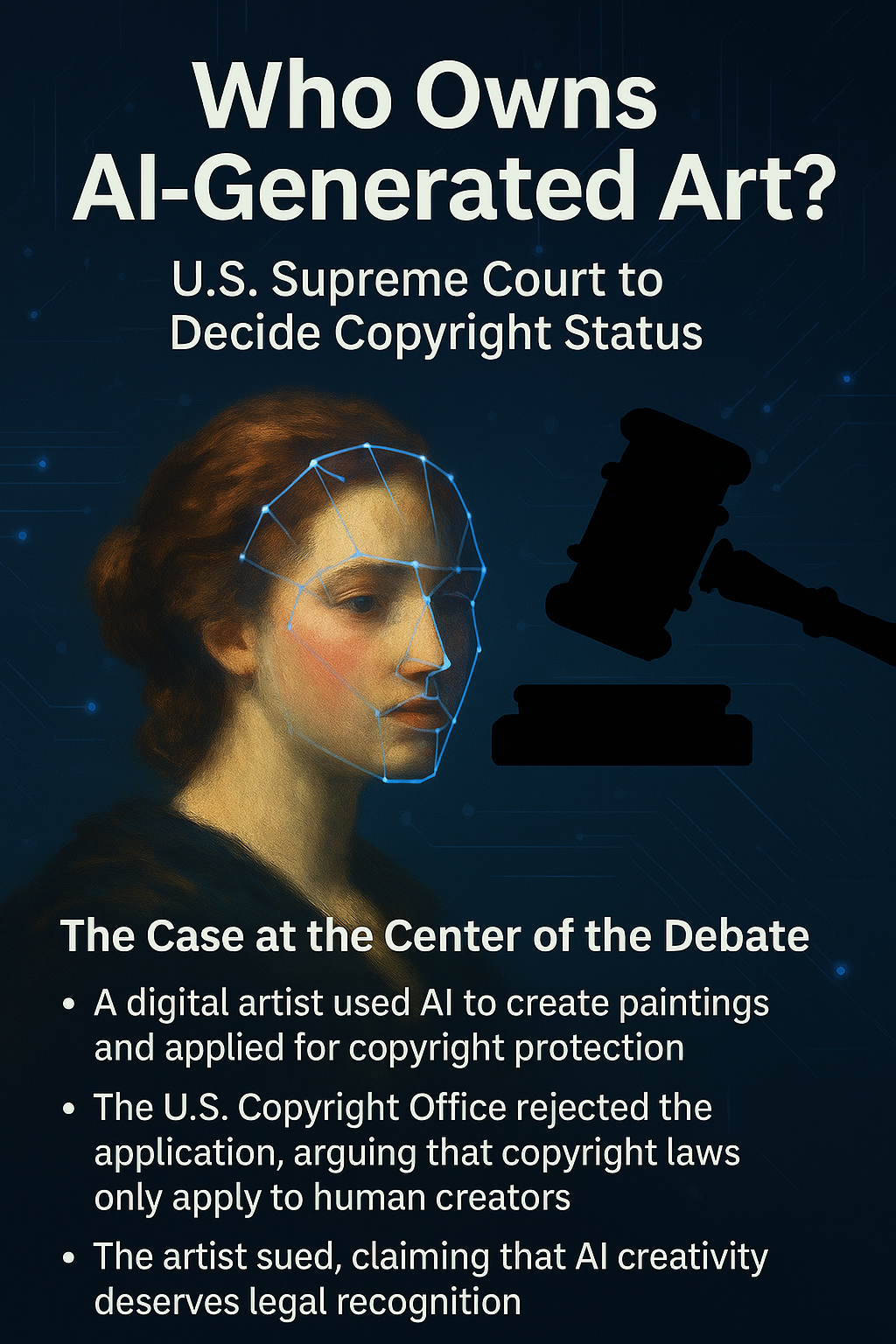
Case 1: Thaler v. USPTO (2022, U.S.)
Issue: Can an AI system be listed as an inventor?
Facts:
Stephen Thaler filed patents for inventions created by AI system DABUS.
Ruling:
The U.S. courts ruled that only humans can be recognized as inventors.
Relevance to AI Banking Robots:
If an AI system designs a new fraud detection algorithm or robotic cash handling process, the patent must list a human inventor.
Organizations should document human involvement in AI-assisted innovations.
Case 2: Alice Corp. v. CLS Bank International (2014, U.S.)
Issue: Patent eligibility of software and abstract ideas.
Facts:
Alice Corp. claimed a patent for a computerized method of mitigating settlement risk in financial transactions.
The patent was challenged as an abstract idea.
Ruling:
U.S. Supreme Court invalidated the patent, stating that merely implementing an abstract idea on a computer is not patentable.
Relevance to AI Banking Robots:
AI algorithms for banking robots must demonstrate technical innovation, not just automation of routine banking tasks, to qualify for patents.
Example: A fraud detection AI using a novel neural network design can be patented; simple automated transaction processing cannot.
Case 3: Diamond v. Chakrabarty (1980, U.S.)
Issue: Patentability of inventions created with technology.
Facts:
Chakrabarty genetically engineered bacteria to break down oil.
Ruling:
Court allowed patents for man-made inventions, establishing the principle: “anything under the sun made by man” is patentable.
Relevance to AI Banking Robots:
Banking robots incorporating novel mechanical or AI systems are patentable if they meet novelty and utility requirements.
Reinforces that AI-assisted innovations can qualify for IP, with humans as inventors.
Case 4: Microsoft Corp. v. AT&T Corp. (2007, U.S.)
Issue: Copyright protection for software and international distribution.
Facts:
AT&T claimed Microsoft infringed copyright by copying software embedded in overseas products.
Ruling:
U.S. Supreme Court ruled that foreign reproduction does not constitute domestic infringement.
Relevance to AI Banking Robots:
AI banking software deployed internationally requires careful licensing agreements to avoid copyright disputes.
Case 5: Apple Inc. v. Samsung Electronics (2012, U.S.)
Issue: Patent infringement in technology and design.
Facts:
Apple sued Samsung for copying software functionalities and industrial design.
Ruling:
Court upheld that copying unique design and technology innovations is an infringement.
Relevance to AI Banking Robots:
Robotic ATMs or AI customer service robots must avoid infringing design patents of competitors.
Protects industrial designs, such as interface panels or physical robot appearance.
Case 6: European Patent Office – DABUS AI Case (2021, Europe)
Issue: AI as inventor in patent filings.
Facts:
Patents listing AI system DABUS as inventor were filed in Europe.
Ruling:
EPO rejected patents, requiring inventors to be human.
Relevance to AI Banking Robots:
Confirms global trend: AI cannot legally be inventor.
Companies must assign IP rights to humans while acknowledging AI contributions in documentation.
Case 7: FinTech Patent Disputes – PayPal v. X.com (Hypothetical/Analogous)
Issue: Ownership of AI-assisted payment processing innovations.
Facts:
Hypothetical: PayPal filed patents for AI-enhanced fraud detection algorithms used in transactions.
Ruling/Outcome:
Courts emphasize novelty, human inventor attribution, and detailed documentation of AI contributions.
Relevance:
Reinforces that banks must patent innovative AI processes, not just abstract automation.
3. Key Takeaways for IPR in AI Banking Robots
AI cannot be a recognized inventor; patents must list human inventors.
Software algorithms for banking AI are protectable via patents or copyright if they demonstrate technical innovation.
Trade secrets are critical for proprietary AI models, datasets, and fraud detection systems.
Industrial design rights protect robotic ATMs, humanoid banking robots, and user interfaces.
Cross-border IP management is crucial for international banking operations.
Abstract idea limitations (Alice Corp case) mean AI innovations must be technical and inventive, not routine automation.
RELATED Blog



comments