



Ipr In AI-Assisted Animation Studio Ip
1. Meaning of IPR in AI-Assisted Animation Studios
AI-assisted animation refers to the use of machine learning or generative AI systems to help create animation content such as:
Character designs
Background art
Motion generation
Scriptwriting assistance
Voice or facial animation
In such environments, intellectual property rights may belong to:
Human animators or creative directors
Animation studios
AI software developers
Data owners whose works were used to train AI models
2. Types of Intellectual Property Relevant
a) Copyright
Protects original creative works such as:
Animated films
Character designs
Storyboards
Scripts
Digital assets
Key issue: whether AI-generated content qualifies for copyright if there is minimal human creativity.
b) Patent Rights
AI animation technologies or algorithms may be patented if they meet novelty and inventive step requirements.
c) Trademark Rights
Character branding, studio logos, and franchise identities are protected through trademarks.
d) Trade Secrets
AI models, datasets, animation pipelines, and proprietary software tools may be protected as confidential information.
3. Key Legal Issues in AI-Assisted Animation
a) Authorship and Ownership
If AI creates significant parts of animation:
Who is the author?
Is human input sufficient for copyright protection?
Different jurisdictions generally require human authorship.
b) Training Data and Copyright
AI models often train on existing artwork, raising issues of:
Unauthorized copying
Derivative works
Fair use defense
c) Liability for AI Output
If AI generates infringing content, responsibility may lie with:
Studio
AI developer
User who provided prompts
d) Licensing and Commercial Exploitation
Studios must ensure licensing rights for datasets and AI-generated content used commercially.
4. Important Case Laws Related to AI-Assisted Creative Works
(1) Naruto v. Slater (Monkey Selfie Case) (2018)
Facts: A monkey captured photographs using a photographer’s camera. Animal rights organizations argued the monkey owned copyright.
Issue: Whether non-human entities can hold copyright.
Judgment: Court held that only humans can be authors under copyright law.
Relevance to AI Animation Studios:
Reinforces principle that AI cannot be an author.
Copyright likely belongs to human creators guiding AI processes.
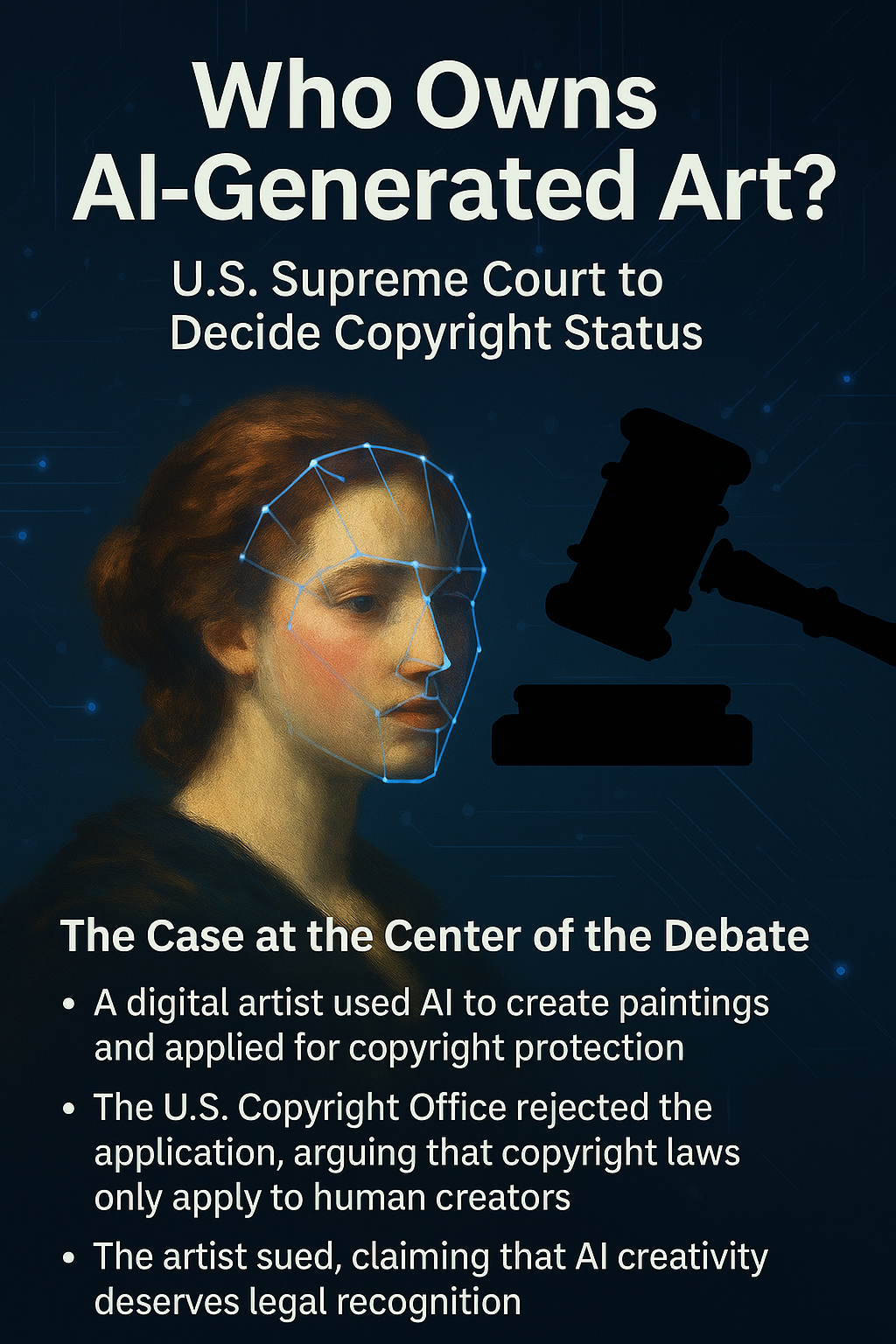
(2) Thaler v. Perlmutter (2023)
Facts: Stephen Thaler attempted to register copyright for artwork created solely by an AI system called DABUS.
Issue: Whether AI-generated works without human authorship qualify for copyright.
Judgment: Court rejected registration, confirming human authorship requirement.
Significance:
AI-only animation content may lack copyright protection.
Studios must ensure human creative input.
(3) Andersen v. Stability AI (Pending Litigation)
Facts: Artists sued AI developers alleging training on copyrighted images without consent.
Issue: Whether training AI models on copyrighted works constitutes infringement.
Legal Importance:
Central issue for AI animation studios using generative tools.
May determine legality of dataset usage.
(4) Getty Images v. Stability AI (Ongoing Litigation)
Facts: Getty Images alleged unauthorized use of copyrighted images to train AI models.
Issue: Whether scraping copyrighted images for AI training violates copyright.
Relevance:
Animation studios must verify lawful datasets.
Risk of liability if AI tools rely on infringing training material.
(5) Authors Guild v. Google (Google Books Case) (2015)
Facts: Google digitized books for searchable indexing.
Issue: Whether scanning copyrighted works constituted fair use.
Judgment: Court held that transformative use for search purposes was fair use.
Significance:
Influences debates about AI training datasets.
Shows that transformative technological uses may be permitted under certain conditions.
(6) Andy Warhol Foundation v. Goldsmith (2023)
Facts: Warhol created artworks based on a photographer’s image.
Issue: Scope of transformative use.
Judgment: Court narrowed transformative fair use when commercial licensing overlaps with original work.
Relevance:
AI-generated animation derived from existing images may face stricter scrutiny.
(7) Aalmuhammed v. Lee (2000)
Facts: A contributor to the film “Malcolm X” claimed co-authorship.
Issue: What level of contribution creates authorship rights.
Judgment: Court emphasized creative control as key factor.
Importance:
Helps determine authorship in AI-assisted animation teams.
Human direction and creative control are critical.
5. Practical IPR Management Strategies for AI Animation Studios
Maintain records of human creative contribution.
Use licensed or public-domain datasets.
Include clear ownership clauses in contracts.
Implement AI output review systems.
Ensure proper attribution and moral rights compliance.
6. Legal Challenges and Emerging Issues
Lack of clear global standards for AI-generated works.
Difficulty determining originality.
Cross-border copyright enforcement.
Deepfake animation risks.
Ownership disputes between studio and AI software providers.
Conclusion
IPR in AI-assisted animation studios lies at the intersection of traditional copyright principles and emerging AI technologies. Courts generally maintain that human authorship is essential for copyright protection, as reflected in cases like Naruto v. Slater and Thaler v. Perlmutter. Ongoing cases such as Andersen v. Stability AI and Getty Images v. Stability AI may significantly shape the future of AI training and creative ownership. Animation studios must adopt careful licensing, human oversight, and compliance strategies to safeguard intellectual property while leveraging AI innovation.
RELATED Blog



comments