



Ipr Challenges In AI-Generated Works
1. Overview of AI-Generated Works and IPR Challenges
AI-generated works are creations produced autonomously or semi-autonomously by artificial intelligence systems, including:
Text (articles, stories, code)
Images (art, designs)
Music
Inventions (AI-assisted inventions, biotech designs)
Software
These works raise unique IP challenges because traditional IP law is designed around human authorship or inventorship.
Key IPR Challenges in AI-Generated Works
Authorship and Ownership
Copyright law requires a human author in most jurisdictions.
AI cannot be a legal author or inventor; ownership must be assigned to a human or legal entity.
Patentability
Patent law requires a human inventor.
AI-generated inventions challenge the concept of inventorship, novelty, and non-obviousness.
Originality and Creativity
Works produced by AI may lack the human creative input required for copyright protection.
Liability and Enforcement
If AI-generated content infringes another’s IP, who is liable? The programmer, user, or AI system?
Moral Rights
Moral rights (like attribution and integrity) apply to humans; unclear if AI can claim these.
Jurisdictional Differences
US, UK, EU, India, and China have varying approaches to AI-generated works.
2. Key Case Laws on AI-Generated Works
Case 1: Thaler v. USPTO (DABUS AI Invention, US)
Facts:
Stephen Thaler submitted a patent application claiming that an AI system called DABUS created a novel invention.
Outcome:
USPTO rejected the application because AI cannot be listed as an inventor under US patent law.
Court reaffirmed that only natural persons can be inventors.
Significance:
Establishes the principle that AI cannot hold patent rights in the US.
Human ownership is required for enforceable patents.
Case 2: Thaler v. UK Intellectual Property Office
Facts:
Thaler applied for a patent in the UK listing DABUS (AI) as inventor.
Outcome:
UK IPO rejected the application.
Court upheld rejection: only a human can be an inventor.
Appeal to the Court of Appeal also failed.
Significance:
Confirms international consistency on AI inventorship.
Raises the question: can humans claim inventorship for AI-generated inventions?
Case 3: European Patent Office (EPO) – DABUS AI
Facts:
Same AI (DABUS) patent applications submitted to EPO.
Outcome:
EPO rejected AI as inventor.
EPO emphasized that patents require human creative input.
However, some countries are reviewing laws to allow AI as co-inventor in future.
Significance:
Highlights evolving global debate.
Shows tension between technology innovation and IP frameworks.
Case 4: Naruto v. Slater (Monkey Selfie, US)
Facts:
Although not AI, this case is often cited for non-human authorship.
A monkey took a selfie using photographer David Slater’s camera.
Dispute arose over copyright ownership.
Outcome:
US court ruled animals cannot hold copyright.
Only humans can claim authorship.
Significance for AI:
Analogous reasoning: AI cannot hold copyright, similar to animals.
Ownership must be assigned to a human creator or programmer.
Case 5: Thaler v. IP Australia
Facts:
AI DABUS invented a beverage container.
Outcome:
IP Australia initially allowed listing AI as inventor but was later reversed.
Court stated inventorship requires human intellect.
Significance:
Even if AI generates novel output, law prioritizes human authorship for enforceable IP.
Case 6: GitHub Copilot & OpenAI ChatGPT Controversies (US)
Facts:
Developers using AI-generated code claimed copyright issues because AI trained on public code repositories.
Some AI outputs closely resembled existing copyrighted code.
Outcome:
Multiple claims filed in US courts.
Court highlighted that AI cannot own IP, but humans using AI may face infringement liability.
Significance:
Establishes liability issues in AI-assisted content creation.
Raises enforcement challenges when AI replicates copyrighted material.
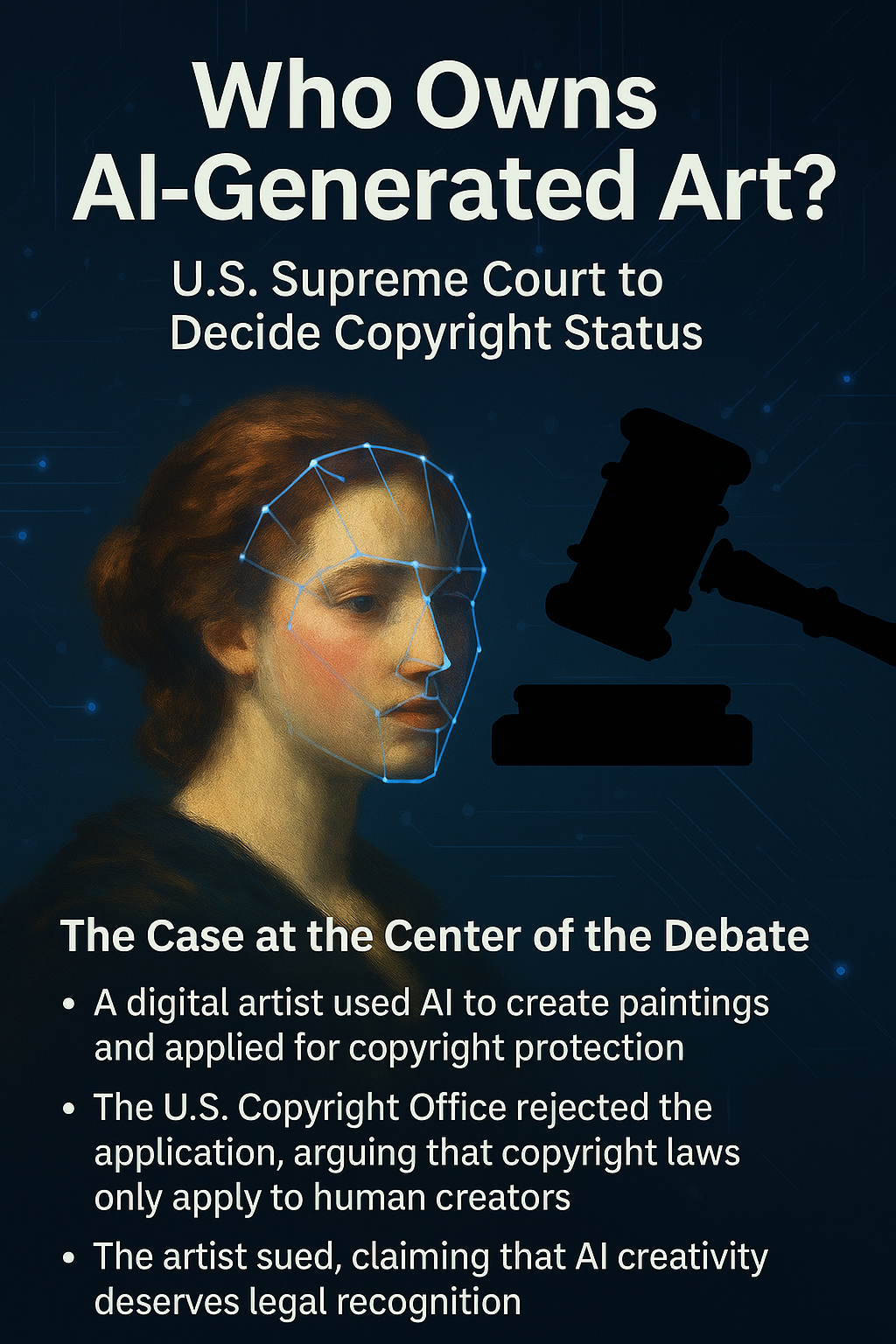
Case 7: Zarya v. Russian AI Art Case
Facts:
Russian artist AI-created artwork published online.
Others reproduced it commercially, claiming AI-generated works are public domain.
Outcome:
Court sided with the human operator of the AI as copyright holder.
Reinforces principle of human ownership for AI-generated works.
Significance:
Supports attribution and enforcement of rights to the human controlling AI.
3. Emerging Legal Principles
From these cases, several principles emerge:
AI cannot be an author or inventor – human authorship is mandatory.
Human control is key – ownership is assigned to the programmer, operator, or person commissioning the AI work.
Liability for infringement falls on humans – developers, users, or companies may be held accountable.
Jurisdictions differ – some countries are exploring special AI IP laws (UK, EU, China) to address AI creativity.
Training data concerns – copyright issues arise if AI is trained on copyrighted material.
4. Challenges for Rights Holders and Policy Makers
AI-generated inventions may not fit traditional patent law: novelty, inventive step, and non-obviousness must be linked to human ingenuity.
AI-generated content enforcement is complex: who is liable if the AI copies someone else’s IP?
Global harmonization is lacking: IP laws are jurisdiction-specific, creating cross-border uncertainty.
RELATED Blog



comments