



Intellectual Property For AI-Generated Musical Compositions.
I. Introduction
The rise of Artificial Intelligence (AI) in creative fields, particularly in music composition, has introduced significant challenges and opportunities in the realm of intellectual property (IP). AI-generated music is becoming increasingly sophisticated, with models like OpenAI's MuseNet, Google's Magenta, and others being able to compose original pieces across various genres. This raises several important questions:
Who owns the rights to AI-generated music?
Can AI be considered an author of a work for copyright purposes?
What forms of IP protection are available for AI-generated musical compositions?
These questions intersect with traditional IP law, particularly copyright, which protects original works of authorship, and patent law, which protects novel and non-obvious inventions. However, AI-generated compositions often challenge the basic assumptions underlying IP law.
In this detailed analysis, we will explore copyright and patent protection for AI-generated musical compositions, reviewing several relevant case laws that illuminate the evolving legal landscape.
II. Intellectual Property Law and AI-Generated Music
AI-generated music poses unique challenges under traditional IP frameworks. Specifically:
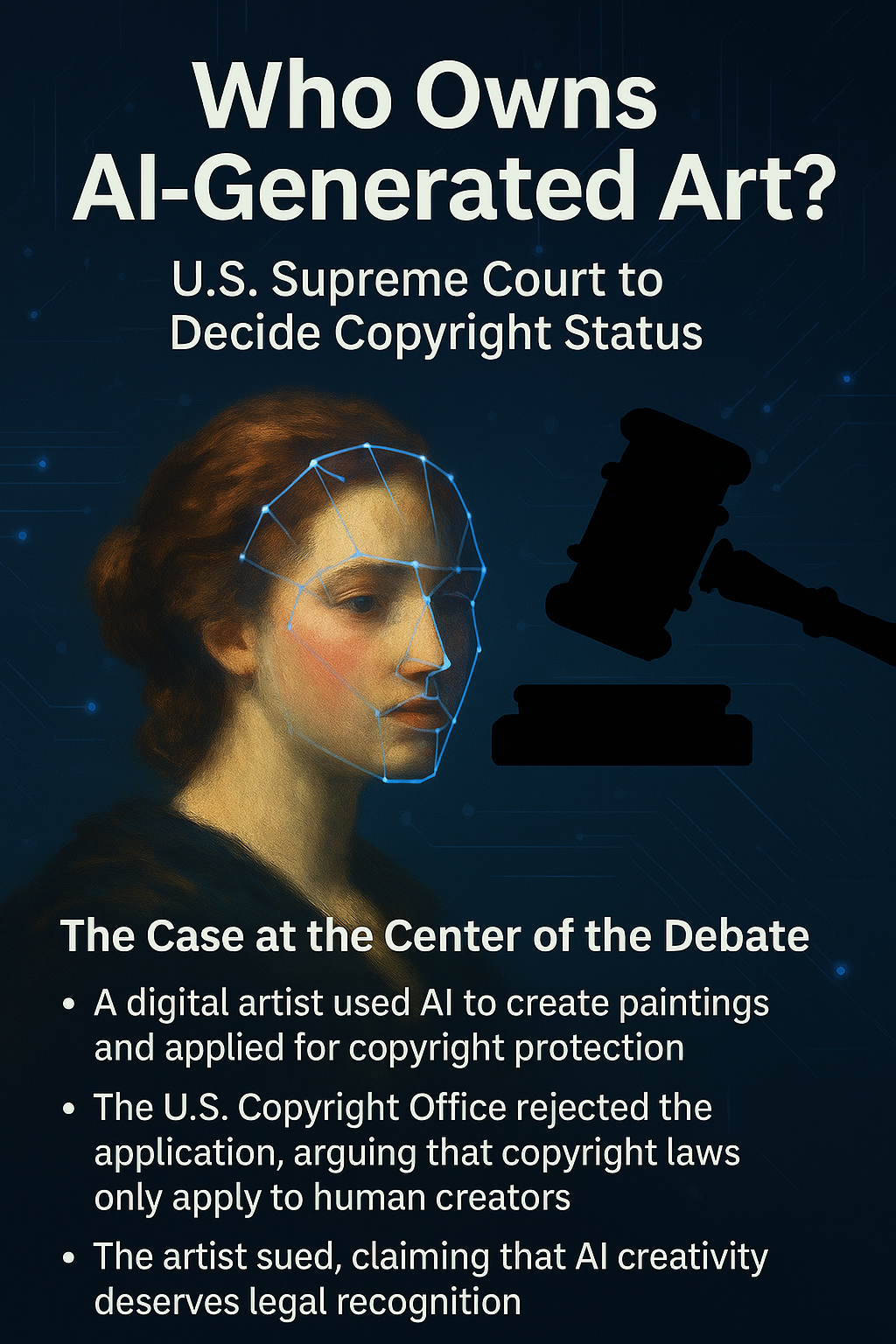
Copyright Law: In most jurisdictions, copyright law is designed to protect "original works of authorship" that are created by a human author. Copyright law, particularly under U.S. law (17 U.S.C. § 101) and the European Union (EU), requires human authorship. This raises the question: Can AI be an "author" under copyright law?
Patent Law: Patent protection may also apply to the innovative algorithms or systems behind AI-generated music, though this is distinct from protecting the music itself. The patent system is focused on protecting inventions and innovations that have technical value, such as new processes or devices.
III. Key Legal Issues with AI-Generated Music
The primary legal questions are as follows:
Ownership of Copyright: If an AI generates music, can the AI itself own the copyright? Or does ownership automatically go to the creator of the AI (the programmer), the person who commissioned the music, or someone else?
Authorship: Copyright law generally recognizes a "natural person" as the creator of a work. Can an AI, which is not a person, be considered the author of a musical composition?
Infringement and Liability: If an AI generates music based on existing works (such as using an algorithm trained on a large dataset of copyrighted music), how do issues of infringement and fair use apply?
IV. Case Law on AI and Copyright in Music
To understand how courts may address these issues, let’s examine several significant legal cases, focusing on copyright and authorship.
1. Burrow-Giles Lithographic Co. v. Sarony (1884) - U.S. Supreme Court
Facts: This landmark case involved a photograph of actress Lillie Langtry taken by photographer Sarony. Sarony sought copyright protection for the photograph, and the issue was whether the photograph could be copyrighted under U.S. law, as it was a work created by a human author.
Holding: The U.S. Supreme Court ruled that photographs could be copyrighted because they are the result of human creativity. The Court emphasized that copyright protection applies to original works that are created by the author's skill and judgment.
Relevance to AI-Generated Music:
In this case, the Court defined authorship in terms of human creativity.
The ruling would suggest that AI itself, being non-human, cannot be the "author" of a work.
AI-generated music, even if technically original, would likely not be eligible for copyright protection unless a human could be attributed as the author.
2. Naruto v. Slater (2018) - U.S. Court of Appeals for the Ninth Circuit
Facts: This case involved a monkey (named Naruto) who took a selfie with a camera that had been left unattended by photographer David Slater. Naruto’s legal team filed to assert that Naruto, the monkey, owned the copyright to the photograph.
Holding: The Ninth Circuit Court ruled that only humans could hold copyrights and that the monkey did not have standing to assert copyright claims.
Relevance to AI-Generated Music:
This case solidified the idea that non-human entities (even animals) cannot be the author of a work under U.S. copyright law.
By extension, AI-generated music, unless a human creator is involved, is unlikely to be granted copyright protection in the U.S.
3. Thaler v. The United States Patent and Trademark Office (2021) - U.S. District Court
Facts: This case involved Stephen Thaler, who sought to list an AI system (DABUS) as the inventor on a patent application for inventions that were autonomously generated by the AI. The U.S. Patent and Trademark Office (USPTO) rejected the application, stating that only human beings can be inventors under U.S. law.
Holding: The District Court ruled that only humans can be listed as inventors on patent applications, reinforcing that AI cannot be an inventor.
Relevance to AI-Generated Music:
Although this case primarily addresses patent law, it reinforces the principle that non-human entities (such as AI systems) are not recognized as authors or inventors under U.S. law.
If AI is treated as a tool for creating music, the rights to the resulting compositions will likely belong to the human who programmed or used the AI (e.g., the developer, artist, or producer).
*4. Warner/Chappell Music, Inc. v. Hanan (2016) - U.S. District Court
Facts: This case centered on a music sampling issue, where the defendant had used a copyrighted melody and turned it into a new composition. The issue was whether this was a transformative use under the fair use doctrine.
Holding: The court found that the use of copyrighted material in the music was not fair use because it did not sufficiently transform the original work into something new and different.
Relevance to AI-Generated Music:
AI systems that learn from pre-existing music could encounter similar fair use issues.
If an AI system creates music based on sampled material, it may infringe upon the copyrights of the original works unless the new work can be argued to be sufficiently transformative.
This raises the question of whether an AI can intentionally transform a work in a way that protects it from infringement claims.
5. Feist Publications, Inc. v. Rural Telephone Service Co. (1991) - U.S. Supreme Court
Facts: This case involved a phone directory that was copied and slightly modified by Feist Publications. The issue was whether the phone book’s contents (data) could be protected under copyright law, given that the data was arranged alphabetically, a process not inherently creative.
Holding: The Court ruled that facts (such as phone numbers) are not subject to copyright protection, and only original works of authorship with a minimal degree of creativity can be protected.
Relevance to AI-Generated Music:
If an AI-generated composition is simply an arrangement of pre-existing data or musical elements (such as through sampling), it may not meet the originality requirement under copyright law.
For AI music to be protected, it would need to demonstrate significant originality beyond mere compilation or arrangement of data.
V. Potential Solutions for IP Protection of AI-Generated Music
Given the legal complexities surrounding AI-generated music, the following solutions may be explored:
Human Attribution: In most cases, humans will likely need to be credited as the authors of AI-generated music. The person who programs or commissions the AI system could be considered the author or owner of the work.
Licensing and Ownership Agreements: Clear contractual agreements can specify ownership and licensing rights for AI-generated works, particularly when a human is involved in the creation process.
Technological Protection: Musicians and producers using AI systems could embed digital rights management (DRM) systems to track and manage the usage of AI-generated compositions, similar to how music rights are managed today.
Future Reform of Copyright Law: Some legal experts suggest that copyright laws may need to be reformed to account for AI as an "author" or "creator", especially as AI continues to evolve and take on more creative tasks. However, this would require significant legal and philosophical changes in the understanding of authorship and creativity.
VI. Conclusion
The issue of IP protection for AI-generated musical compositions is complex and still evolving. Traditional legal frameworks, particularly copyright law, focus on human authorship, which poses challenges when it comes to works created by AI.
While AI systems cannot be considered authors in most jurisdictions, human creators—whether they are the programmers, users, or commissioners of AI—are generally considered the owners of the AI-generated compositions. Trade secret protection and contractual agreements will play a significant role in protecting the IP of AI-generated works.
As AI continues to advance, it is possible that copyright law may need to evolve to address the growing role of AI in creative fields. In the meantime, human creators will remain the primary holders of rights to AI-generated music.
RELATED Blog



comments