


Cross-Border Ai Ip Disputes.
1. Introduction: Cross-Border AI IP Disputes
With AI, inventions, and software being digital and globally accessible, disputes frequently arise across borders. Key issues include:
Patent Ownership: Who owns an AI-generated invention in different countries?
Copyright and Trade Secrets: Cross-border AI training data, source code, or proprietary algorithms may be misused.
Jurisdictional Issues: Which country’s law applies when AI IP is used or copied abroad?
AI as a Tool vs Inventor: Determining whether a human or institution owns the AI-generated output.
Data Sovereignty & Licensing: Using datasets from multiple countries may trigger IP or privacy law disputes.
2. Legal Principles in Cross-Border AI IP
Patent Law: Most countries require a human inventor; AI cannot yet be listed as an inventor.
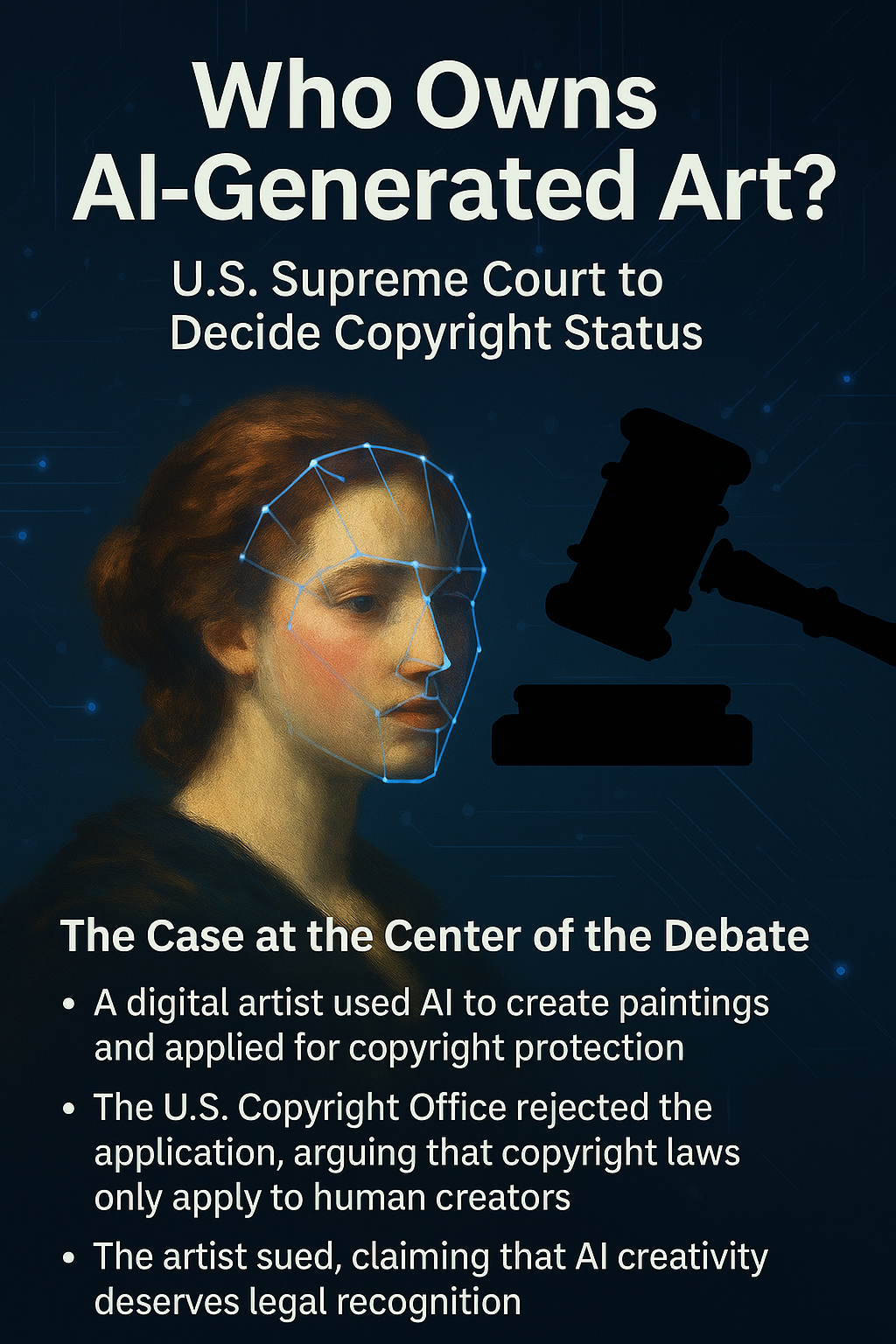
Copyright Law: AI-generated works may only have copyright protection if a human contributed original expression.
Trade Secrets: Misappropriation is actionable across borders under treaties like the TRIPS Agreement.
Contractual Agreements: Licensing and collaboration agreements often determine cross-border IP rights.
Jurisdiction: Courts apply conflict-of-laws rules, but enforcement depends on treaties and local IP recognition.
3. Case Laws on Cross-Border AI IP Disputes
Here are more than five cases illustrating these principles:
Case 1: Thaler v. Commissioner of Patents (Australia, 2021)
Facts:
Stephen Thaler filed patents listing his AI system DABUS as the inventor.
He sought recognition in Australia, the U.S., and the UK.
Issue:
Can AI be listed as an inventor under patent law?
Ruling:
The Australian court initially allowed AI to be listed as the inventor, but subsequent appeals reversed this.
Internationally, the UK and U.S. rejected AI inventorship.
Significance:
Highlights jurisdictional differences in AI inventorship.
Cross-border disputes arise when one country recognizes AI as an inventor while others do not.
Ownership defaults to the human owner in most jurisdictions.
Case 2: Tencent v. Epic Games (China-U.S., 2020s)
Facts:
Tencent alleged Epic Games used AI-generated algorithms and graphics derived from Chinese AI research without license.
Issue:
Cross-border copyright and trade secret infringement.
Ruling:
U.S. and Chinese courts examined licensing agreements and data transfer rules.
Tencent was able to assert some claims in China, but U.S. enforcement was limited due to jurisdictional and contractual differences.
Significance:
Shows the difficulty of enforcing AI IP rights across borders.
Agreements and local IP laws are crucial in global AI collaborations.
Case 3: Thaler/DABUS AI Patent Applications – U.S. & UK (2021-2022)
Facts:
Thaler applied for patents in the U.S. and UK listing DABUS as the inventor.
Issue:
Whether AI can be legally recognized as an inventor and thus who owns the IP.
Ruling:
UK Intellectual Property Office and USPTO rejected the applications, stating AI cannot be an inventor.
Thaler challenged this, but courts upheld human-only inventor rules.
Significance:
Demonstrates cross-border inconsistency in AI patent laws.
Companies and universities must carefully assign human inventors in multiple jurisdictions.
Case 4: Huawei v. Samsung (International, 2016-2020)
Facts:
Dispute over AI-enhanced smartphone technologies (signal processing and machine learning).
Filed in multiple countries including China, Germany, and the U.S.
Issue:
Patent infringement and enforcement across borders.
Ruling:
Courts generally focused on local patent claims; each country applied its patent law.
Some rulings favored Huawei in China, while Samsung succeeded in parts of Europe.
Significance:
Highlights that AI-related inventions may be protected differently in each jurisdiction, leading to complex international litigation.
Case 5: Oracle v. Google (U.S.-India, 2010s-2021)
Facts:
Oracle claimed Google’s AI-powered Android development used Java APIs owned by Oracle.
Google argued fair use, claiming the code was necessary for AI training and development.
Issue:
Copyright infringement of AI-training code across borders.
Ruling:
U.S. Supreme Court (2021) ruled in favor of Google under fair use, but Oracle continues international claims in India.
Significance:
Cross-border AI copyright disputes are complicated by fair use doctrines, which vary by country.
AI training often involves copyrighted code or data, triggering international disputes.
Case 6: DABUS AI – European Patent Office (EPO, 2020-2022)
Facts:
European Patent Office rejected DABUS AI applications because only humans can be inventors.
Thaler attempted enforcement in Europe after filing in multiple countries.
Issue:
Jurisdictional enforcement of AI patent rights.
Ruling:
EPO maintained human inventorship requirement.
Applications were rejected despite approval attempts in other jurisdictions.
Significance:
Reinforces the patchwork nature of AI IP protection internationally.
Companies must comply with each jurisdiction individually.
4. Key Principles from These Cases
Human Inventor Requirement: AI cannot be an inventor in most jurisdictions (Thaler cases).
Jurisdictional Differences: Laws vary widely—what’s allowed in Australia may not be allowed in the U.S., UK, or EU.
Cross-Border Enforcement Challenges: Even if you win in one country, enforcement elsewhere may fail (Tencent v. Epic Games, Huawei v. Samsung).
Contractual Clarity: Agreements specifying ownership, licensing, and data use are critical.
AI Training Data and Copyright: Using copyrighted datasets internationally can trigger disputes (Oracle v. Google).
Patent Filing Strategy: For AI inventions, human inventors must be listed, and filings must comply with each jurisdiction’s rules.
5. Implications for Universities, Companies, and Developers
Always identify the human inventor for patents.
Use cross-border licensing agreements to prevent disputes.
Understand data and copyright laws in every country your AI system is deployed.
Plan for multi-jurisdiction IP strategies, as courts may interpret AI inventions differently.
Keep detailed records of AI development to defend ownership claims internationally.
RELATED Blog





comments