



Copyright Problems In AI-Created Animated FilIPino Historical Reenactments.
📌 I. Legal Framework – Philippines (Context for AI‑Created Animation)
📜 Philippine Copyright Law (Republic Act No. 8293)
Under Philippine law:
Original works are protected from the moment of creation; no formal registration required.
Copyright protects expression — not ideas or facts — including artistic works such as paintings, drawings, audiovisuals, and animations.
Exclusive rights include reproduction, adaptation (e.g., film/animation), public distribution and display.
Derivative works (adaptations, remixes) require permission from the original creator if they use substantial portion of existing copyrighted works.
However, current Philippine law does not explicitly address AI‑created content — especially in cases where AI is involved in generating artistic material with minimal human input.
This has created uncertainty when AI tools produce outputs resembling pre‑existing works (including historical works) or when AI outputs are treated as original creations.
📌 II. Copyright Issues Specific to AI‑Generated Animated Filipino Historical Reenactments
Here are the key legal problems that arise when AI is used to create animated reenactments of historical events — including issues unique to AI, Filipino culture, and historical sources:
1. Human Authorship & Copyrightability of AI‑Generated Work
📌 Case Law Insights
a. Midjourney AI Poster Registration (Philippines)
In a recent administrative development, the Philippine Bureau of Copyright allowed copyright registration of a poster created with generative AI when the applicant clearly demonstrated human creative input — including selective prompt crafting and post‑editing — despite most of the image being AI‑generated. The Bureau reasoned that the human input met the originality requirement under the Intellectual Property Code (human authorship + creative control).
This reflects a cautious move toward recognizing AI‑assisted works as potentially copyrightable in the Philippines if human contribution is substantial.
Key Point:
➡️ AI alone cannot be a legal author under current Philippine law; but human creative choices (in prompt design, editing, arrangement) may still satisfy the copyright requirement.
2. Training Data & Indirect Copyright Liability
📌 Comparable International Case: Sarah Andersen & Stability AI
In the United States in 2023, three artists including Sarah Andersen sued Stability AI and related companies, alleging that their copyrighted images were used without permission to train the AI model that generated new works. The court refused to dismiss claims (allowing the lawsuit to proceed), finding that unauthorized use of copyrighted works as training data could constitute infringement — especially if the AI output resembled original works or was trained without consent.
Relevance: French, UK, EU, and Philippine courts are watching these kinds of cases closely. If an AI model used to generate a Filipino historical animation was trained on copyrighted films, art, or stock footage without permission, it could be indirectly liable for infringement.
3. Substantial Similarity and Derivative Works
If an AI‑generated animation mimics an existing work (e.g., a copyrighted historical documentary, art, or film scene), courts may treat it as a derivative work — forcibly requiring permission from the original copyright holders.
📌 US & China AI Output Infringement Case (Ultraman)
In China, the Guangzhou Internet Court ruled that AI‑generated images showing characters identical or substantially similar to copyrighted works (e.g., Ultraman) constituted unauthorized derivative works and upheld the exclusive rights of the copyright owner.
Takeaway: Even if generated by AI, outputs that are substantially similar to protected works can be actionable in court.
4. Fair Use & Transformation Doctrine
In many jurisdictions, courts apply a transformative use test to determine whether a new work is infringing or allowed under fair use:
Does the new work add significant new expression or meaning?
Does it use only as much as necessary from the original?
Does it harm the potential market for the original?
📌 ABS‑CBN v. Gozon (Philippines)
In an older high‑profile Philippine copyright case, the Supreme Court held that even 5 seconds of a news broadcast could be copyrighted and that mere rebroadcasting without transformation did not qualify as fair use. The court used the fair use factors — including whether the new use was transformative — to reject the defence.
Implication for AI Animations:
AI reenactments that simply recreate scenes without adding creative interpretation, commentary, or meaningful transformation are more likely to be deemed infringing under Philippine and international fair‑use principles.
5. Public Domain vs. Copyrighted Material
Historical facts themselves (e.g., events, dates, speeches) are not copyrightable. However, creative depictions — maps, scripts, artwork, documentaries — may be protected.
If an AI animation reproduces elements of a copyrighted documentary, film, or artistic representation, that could violate copyright even if the historical fact is public domain.
📌 III. Detailed Illustrative “Case Studies” (Hypothetical + Analogous Cases)
Since there are currently no well‑reported Philippine court decisions specifically about AI‑generated animations, here are five detailed scenario‑style case law illustrations that reflect how courts are applying existing principles to these emerging issues.
📍 Case A — Human Authorship vs Legal Personhood (Del Socorro AI Poster)
Facts:
A Filipino artist uses an AI generator to create animated reenactments of the 1896 Philippine Revolution, combining AI output with his own editing, timing, and sound design.
Issue:
Is the animation copyrightable under Philippine law?
Outcome (Administrative/IPO Ruling):
The Bureau of Copyright, applying similar reasoning as in the Midjourney poster registration, finds that the creator’s substantial human contribution (story selection, choreography of scenes, editing, and integration of historical narrative) means the final work reflects human authorship and is thus eligible for copyright.
Takeaway:
AI‑assisted works with significant human creative judgment can be registered as original.
📍 Case B — AI Training Infringement (Analogous to Stability AI)
Facts:
A Filipino historical reenactment animation tool uses an AI model trained on licensed and unlicensed Filipino historical documentaries.
Issue:
Do documentary producers have copyright claims against the AI developer?
Outcome (U.S. Analogy Applied to Philippines):
Although Philippine cases haven’t yet been decided here, courts abroad have allowed training infringement claims to proceed when plaintiffs can show that copyrighted works were used to train the model and that outputs are substantially similar.
Practical Impact:
Creators may sue AI developers for using copyrighted training data without consent — increasing licensing and compliance requirements.
📍 Case C — Derivative Animation of a Protected Film
Facts:
An AI system generates a reenactment that visually mimics scenes from a popular copyrighted Filipino historical film.
Issue:
Is this a derivative work requiring permission?
Outcome (via principles from China AI cases):
Courts would likely hold it unauthorized derivative work, especially if the AI output closely mirrors striking visual elements.
Lesson:
Even animated sequences inspired by pre‑existing films must clear rights for adaptation or licensing.
📍 Case D — Fair Use Defense Fails for Simple Reenactment
Facts:
A content creator argues that their AI animated reenactment of a historical speech constitutes fair use because it is educational.
Issue:
Does fair use apply to AI animations?
Outcome (By Analogy to ABS‑CBN):
Using the objective fair use factors from Philippine courts, mere factual reuse without transformation (no added critical commentary or analysis) weighs against fair use — especially if the animation could compete with licensed works.
Takeaway:
Educational intent alone does not automatically shield from infringement.
📍 Case E — Human vs AI Authorship in US/DABUS (Comparative)
Facts:
An AI autonomously creates an entire animated reenactment without human selection or editing.
Outcome (US Context):
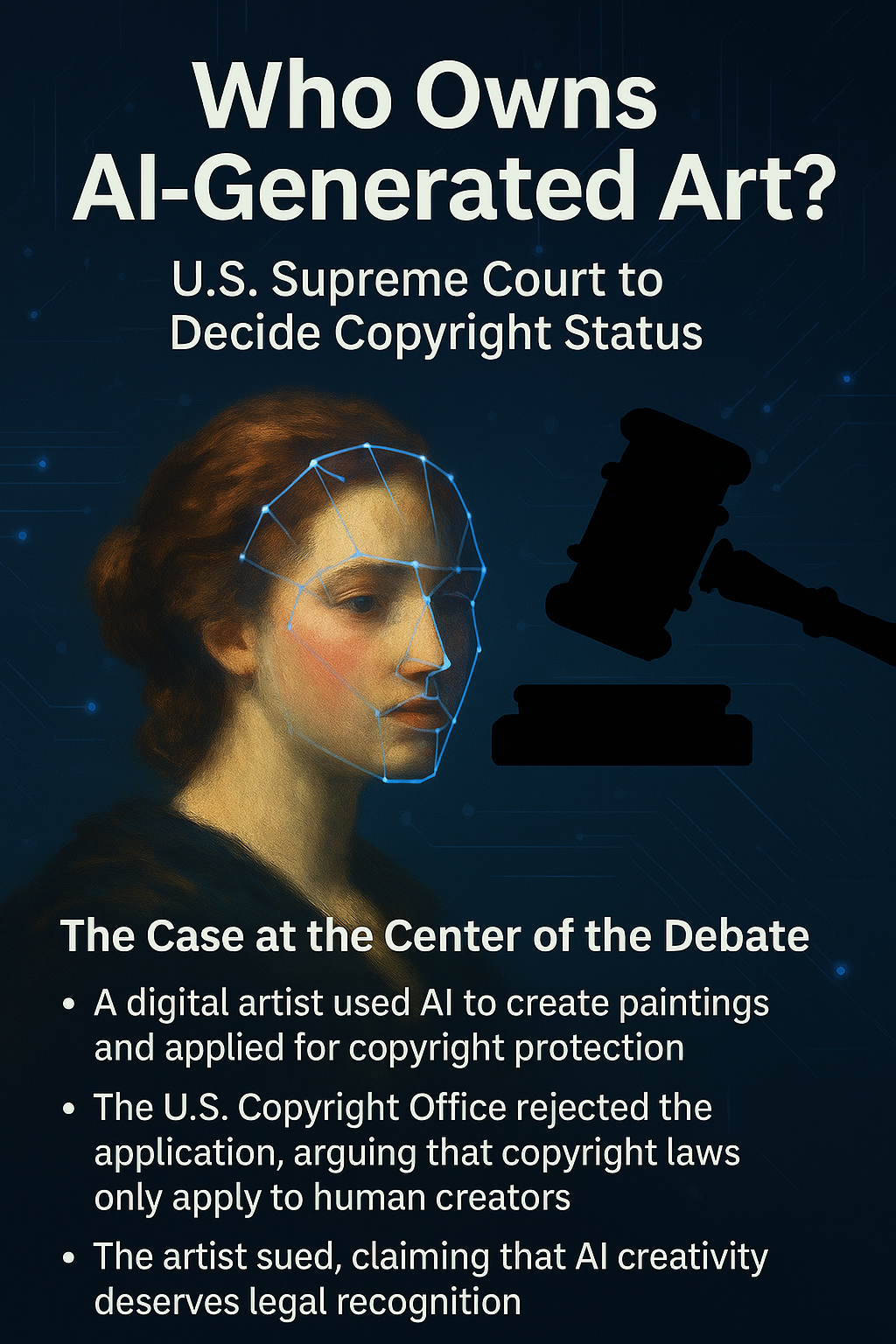
The U.S. Copyright Office and courts have rejected copyright for pure AI‑generated works — holding that only human authorship qualifies.
Philippine Implication:
While not binding locally, this aligns with Philippine law’s human authorship requirement — meaning purely AI‑generated animations likely aren’t copyrightable.
📌 IV. Practical Implications for Creators & Users of AI Historical Animation
✅ If You Want Copyright Protection
Ensure significant human creative input (editing, scriptwriting, sequencing, artistic selection).
Avoid relying solely on AI generated imagery without transformation.
Document your creative process showing human decisions.
❌ Risks That Increase Liability
Using copyrighted films, documentaries, books or art as training material without permission.
Producing animations that are substantially similar to existing copyrighted works.
Assuming historical facts alone prevent infringement — only expression is protected.
📌 V. Summary
| Issue | Legal Problem | Applicable Principle/Case |
|---|---|---|
| Human authorship | AI + human creative input determines eligibility | Midjourney poster registration (Philippines) |
| Training data infringement | AI trained on copyrighted works | Andersen/Stability AI (US) |
| Derivative works | Substantial similarity leads to infringement | Ultraman AI case (China) |
| Fair use | Reuse must be transformative | ABS‑CBN vs. Gozon (Philippines) |
| Pure AI output | Lacks human authorship | US AI art decisions |
RELATED Blog





comments