



Copyright Implications For AI-Generated Artistic Fashion Imagery.
I. Core Legal Question
The main issue is whether AI-generated fashion imagery can be copyrighted. Copyright law generally requires:
Originality – The work must be the product of human creativity.
Authorship – The author must be a human being in most jurisdictions.
Fixation – The work must be fixed in a tangible medium.
AI complicates these principles because it can generate highly creative outputs with minimal human input. Fashion imagery—runway shots, digital garments, editorial visuals—raises practical and legal concerns.
II. Key Case Laws
1. Burrow-Giles Lithographic Co. v. Sarony (1884) – US Supreme Court
Facts: Sarony photographed Oscar Wilde. The defendant reproduced the photo without permission.
Holding: The Supreme Court held that a photograph is copyrightable if it represents the photographer's intellectual conception—choices like pose, lighting, and expression matter.
Relevance:
Human creative input is essential.
For AI-generated fashion imagery, if the designer controls prompts, styling, or editing, they may claim copyright.
Purely autonomous AI outputs without human direction would likely fail this standard.
2. Feist Publications, Inc. v. Rural Telephone Service Co. (1991) – US Supreme Court
Facts: Feist copied a phone directory. Rural claimed copyright.
Holding: Mere effort (“sweat of the brow”) is insufficient; originality requires creativity.
Relevance:
AI-generated fashion imagery must reflect creative human input, not just algorithmic output.
Simple prompt-to-image generation may lack sufficient human originality.
3. Naruto v. Slater (2018) – US Court of Appeals, 9th Circuit
Facts: A monkey took selfies; the question was whether the monkey could hold copyright.
Holding: Only humans can hold copyright.
Relevance:
AI is analogous to a non-human author.
Fully autonomous AI-generated fashion visuals may not be protected under U.S. copyright law.
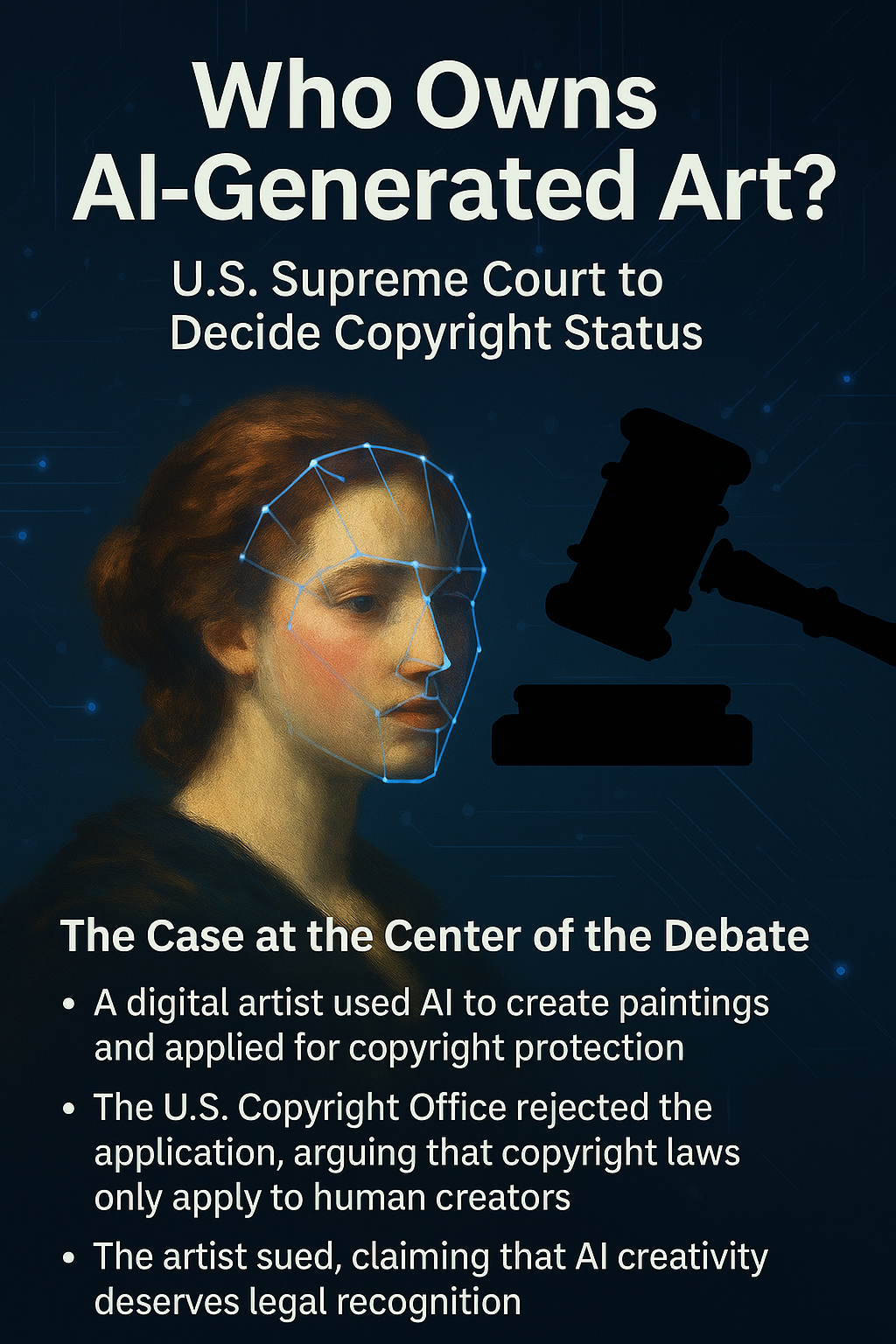
4. Thaler v. Perlmutter (2023) – US District Court, DC
Facts: Stephen Thaler registered copyright for AI-generated works listing the AI as the author.
Holding: Copyright law requires human authorship. AI-generated works without human intervention are not copyrightable.
Significance:
Confirms that U.S. copyright law currently does not recognize AI as an author.
Only works with significant human input (e.g., editing AI outputs, designing prompts) might qualify.
5. Zarya of the Dawn Registration (US Copyright Office 2023)
Facts: The comic book used AI-generated images; the creator sought copyright registration.
Decision: Copyright allowed for textual content and arrangement, but AI-generated images were denied protection.
Relevance:
AI-generated fashion imagery may not be protected, but human-curated content (layout, narrative, sequencing) can be.
Highlights the risk for fashion brands using AI visuals—they may be freely reused by others.
6. Nova Productions Ltd v. Mazooma Games Ltd (UK Court of Appeal 2007)
Facts: Video game graphics and authorship were in question.
Holding: Authorship belongs to the person making creative choices, not the machine executing instructions.
Relevance to UK fashion industry:
The Copyright, Designs and Patents Act 1988 recognizes human authorship even if a computer produces the work.
Designers, art directors, or prompt engineers could be considered authors of AI-generated fashion images.
7. Infopaq International A/S v. Danske Dagblades Forening (CJEU 2009)
Holding: Originality depends on the author's “own intellectual creation.”
Relevance:
EU law focuses on whether a human creator contributes original choices.
AI acting as a tool under human guidance may allow copyright protection.
Fully autonomous AI outputs with minimal human input may not be protected.
8. Beijing Internet Court – Li v. Liu (2023)
Facts: A user generated images via AI and claimed copyright after another party used them without permission.
Holding: The court recognized copyright due to human creative input in prompt design and selection.
Significance:
China is more receptive to protecting AI-assisted works when humans meaningfully control the output.
Fashion brands using AI tools with careful human curation may claim protection in China.
III. Key Legal Issues Beyond Authorship
Training Data Infringement: Using copyrighted fashion photography to train AI can be infringing.
Derivative Works: AI outputs closely resembling copyrighted fashion campaigns could constitute infringement.
Moral Rights: In countries like France or Germany, AI-generated imitations of a living designer’s work could violate moral rights.
Alternative Protection: Fashion images may also be protected via trademarks or design law rather than copyright.
IV. Comparative Overview
| Jurisdiction | Human Authorship Required? | AI Works Protected? | Notes |
|---|---|---|---|
| USA | Yes | Only with human input | Cases: Thaler, Naruto, Zarya |
| UK | Yes, but computer-assisted works recognized | Possible if human directs AI | Nova Productions, CDPA 1988 s.9(3) |
| EU | Yes, “intellectual creation” | Possible with human input | Infopaq, CJEU |
| China | Yes, but flexible | Recognized if human input significant | Li v. Liu 2023 |
V. Practical Implications for Fashion Industry
Document human input: Maintain records of prompts, edits, and creative decisions.
Contracts: Clarify AI output ownership between designers and AI providers.
Legal risk: Fully autonomous AI-generated fashion visuals may not be protected in the U.S., exposing them to free reuse.
Alternative IP: Consider design, trademark, and trade dress protections for AI-created garments or imagery.
VI. Conclusion
The law consistently emphasizes human creativity. AI is considered a tool, not an independent author. Fashion houses using AI-generated imagery must demonstrate substantial human contribution—prompt engineering, editing, styling, or curating—to claim copyright protection. Jurisdictions vary, with the U.S. being strictest, and China and the UK offering more flexibility.
RELATED Blog



comments