


Copyright Implications For AI-Generated Art Restoration Models.
I. Core Legal Issues in AI Art Restoration
1. Authorship
Most copyright regimes require human authorship. If AI autonomously generates restored content, copyright protection may be denied.
2. Derivative Works
Restoring a damaged artwork may constitute a derivative work, which requires authorization if the original is still under copyright.
3. Substantial Similarity & Copying
If the AI reconstruction copies expressive elements, it may infringe unless licensed or justified under fair use.
4. Fair Use / Fair Dealing
Training AI systems and generating restoration outputs may qualify as transformative use under some circumstances.
5. Moral Rights (especially outside U.S.)
Restoration may distort an artist’s intent, raising issues under moral rights doctrines.
II. Major Case Laws
1. Burrow-Giles Lithographic Co. v. Sarony (1884)
Court: U.S. Supreme Court
Key Principle: Human authorship is required for copyright.
Facts:
Napoleon Sarony sued Burrow-Giles Lithographic Co. for reproducing his photograph of Oscar Wilde.
Holding:
The Court held that a photograph is copyrightable because it reflects human creative choices.
Relevance to AI Restoration:
If an AI system autonomously reconstructs missing sections of a painting without meaningful human input, it may fail the human authorship requirement established here.
This case forms the foundation for denying copyright to purely AI-generated restorations.
2. Feist Publications, Inc. v. Rural Telephone Service Co. (1991)
Court: U.S. Supreme Court
Key Principle: Copyright requires originality (modicum of creativity).
Facts:
Feist Publications copied phone listings from Rural Telephone Service Co..
Holding:
Facts are not copyrightable; originality requires minimal creativity.
Relevance to AI Restoration:
If AI restoration merely reconstructs factual historical details (e.g., recreating missing background architecture accurately), there may be insufficient originality to qualify for new copyright.
But if the model invents stylistic elements or fills gaps creatively, originality may exist—though authorship questions remain.
3. Bridgeman Art Library v. Corel Corp. (1999)
Court: U.S. District Court (S.D.N.Y.)
Key Principle: Exact reproductions of public domain works lack originality.
Facts:
Bridgeman Art Library sued Corel Corporation for reproducing photographic copies of public domain paintings.
Holding:
Exact photographic reproductions of public domain paintings lack originality and are not copyrightable.
Relevance to AI Restoration:
If an AI restoration model attempts a faithful reconstruction of a public domain artwork (e.g., restoring a Renaissance fresco), the output likely:
Does not receive new copyright protection
Cannot be monopolized by the restorer
However, if restoration includes creative additions beyond faithful replication, the result may qualify as a derivative work.
This case is central for museums using AI restoration tools.
4. Authors Guild v. Google, Inc. (2015)
Court: U.S. Court of Appeals (2nd Circuit)
Key Principle: Mass digitization for search can be fair use.
Facts:
Authors Guild sued Google over the Google Books scanning project.
Holding:
Google’s scanning was transformative and qualified as fair use.
Relevance to AI Restoration:
AI training datasets often include copyrighted artworks. This case suggests:
Large-scale copying for analysis can be fair use if transformative.
If the restoration model extracts patterns rather than reproducing expressive content, training may be lawful.
However, unlike Google Books (which displayed snippets), AI restoration may generate expressive output resembling originals—making this issue more complex.
5. Andy Warhol Foundation v. Goldsmith (2023)
Court: U.S. Supreme Court
Key Principle: Narrower interpretation of “transformative use.”
Facts:
Andy Warhol Foundation for the Visual Arts licensed a Warhol image based on a photo by Lynn Goldsmith.
Holding:
The commercial licensing competed with the original photograph and was not fair use.
Relevance to AI Restoration:
Even if AI restoration alters or enhances an image, it may not qualify as transformative if:
It serves the same commercial purpose
It substitutes for the original work
This case narrows fair use defenses for AI companies offering restoration services commercially.
6. Naruto v. Slater (2018)
Court: U.S. Court of Appeals (9th Circuit)
Key Principle: Non-humans cannot hold copyright.
Facts:
A monkey named Naruto took a selfie using photographer David Slater’s camera.
Holding:
Animals lack standing to claim copyright.
Relevance to AI Restoration:
By analogy, AI systems cannot be authors. If no human meaningfully directs the restoration, the output may fall into the public domain.
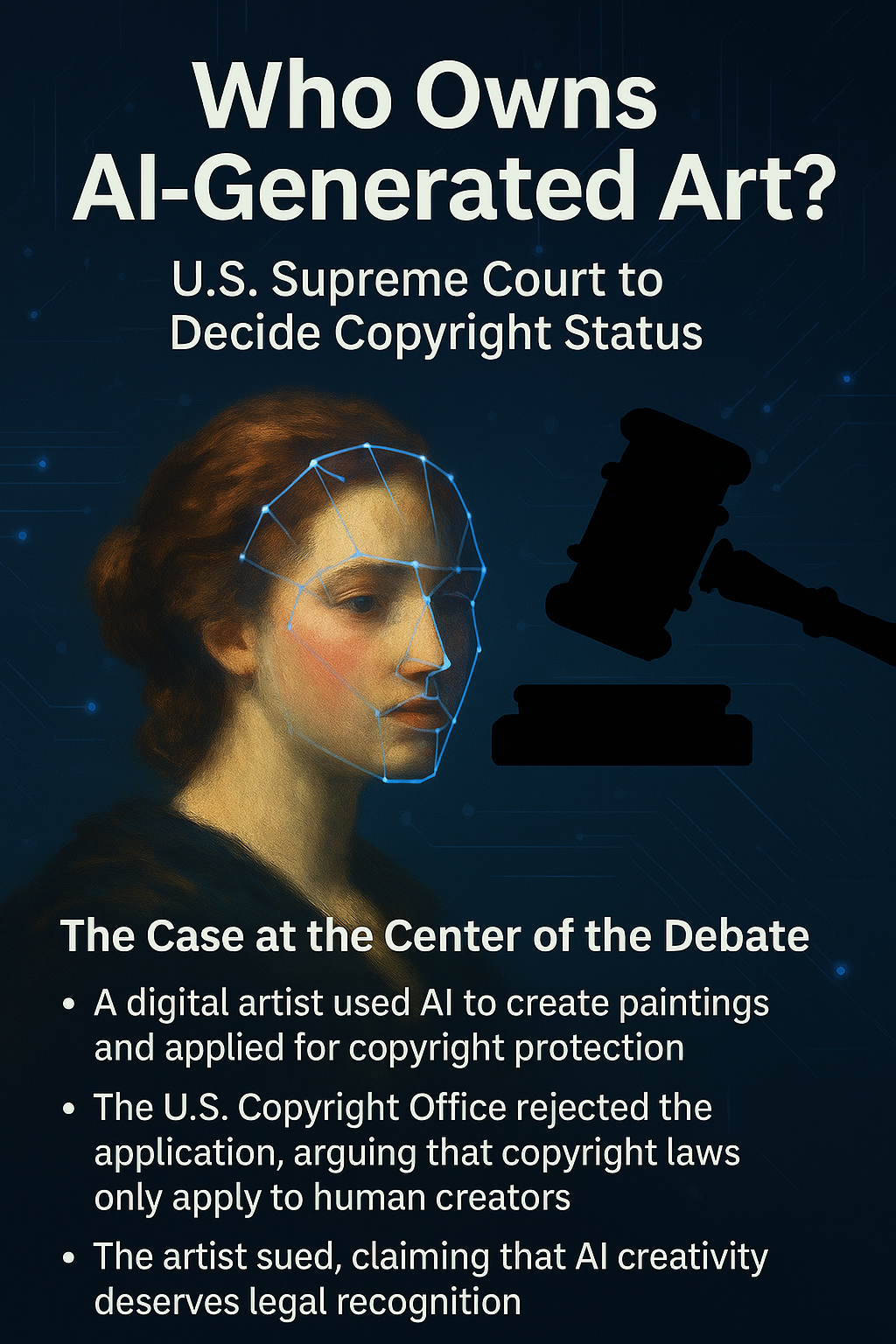
7. Thaler v. Perlmutter (2023)
Court: U.S. District Court (D.C.)
Key Principle: Pure AI-generated works are not copyrightable.
Facts:
Stephen Thaler sought copyright for art generated by his AI system, “Creativity Machine.”
Holding:
The court reaffirmed the human authorship requirement.
Relevance:
If an AI restoration model independently fills missing artwork sections, the output likely lacks copyright protection unless substantial human creative control exists.
8. Gilliam v. American Broadcasting Companies (1976)
Court: U.S. Court of Appeals (2nd Circuit)
Key Principle: Unauthorized alterations can harm artistic integrity.
Facts:
Monty Python sued American Broadcasting Company for heavily edited broadcasts.
Holding:
Distortion of artistic work may violate rights tied to integrity.
Relevance:
AI restoration that significantly modifies tone, color palette, or composition of copyrighted works could be challenged—especially in jurisdictions recognizing moral rights.
9. Visual Artists Rights Act (VARA) – U.S.
Although not a case, VARA grants artists moral rights.
AI restoration that:
Alters meaning,
Changes artistic expression,
Modifies color or structure,
may infringe integrity rights if the artist is living and the work qualifies.
III. International Perspective
European Union
Under the EU InfoSoc Directive and strong moral rights regimes (e.g., France), restoration that modifies artistic intent could violate:
Right of integrity
Right of attribution
United Kingdom
The UK recognizes moral rights and derivative works protections under the Copyright, Designs and Patents Act 1988.
IV. Key Legal Risk Areas for AI Restoration Models
1. Training Data Liability
Potential infringement if training dataset includes copyrighted works.
Fair use analysis required (post-Warhol scrutiny).
2. Output Liability
If restored output is substantially similar to copyrighted originals.
If it competes commercially with licensed reproductions.
3. Ownership Uncertainty
Pure AI restoration → possibly public domain.
Human-directed restoration → potentially protected derivative work.
4. Moral Rights Conflicts
Especially strong in EU jurisdictions.
AI alterations could be seen as distortion.
V. Emerging Legal Questions
Should AI restoration be treated like conservation (technical process)?
Should museums receive protection for digital restorations?
How much human involvement is enough?
Can restoration models claim “transformative use” post-Warhol?
VI. Conclusion
AI-generated art restoration models operate in a legally unsettled space shaped by:
Human authorship doctrine (Burrow-Giles, Thaler)
Originality requirement (Feist)
Public domain reproduction rules (Bridgeman)
Fair use doctrine (Google Books, Warhol)
Moral rights protections (Gilliam, VARA)
The dominant legal trend is:
Pure AI works → no copyright
Faithful reproductions → no new copyright
Creative human-guided restorations → potentially protected derivative works
Commercial AI uses → increasing litigation risk
As generative AI litigation continues worldwide, courts will likely refine how restoration models are treated—particularly regarding training data and commercial exploitation.
RELATED Blog





comments