



Copyright Implications For AI-Generated Animation Short Series.
1. Basic Copyright Principles in Animation and AI Context
Copyright protects original works of authorship fixed in a tangible medium of expression, which includes animations. Key elements include:
Originality: The work must originate from human creativity.
Fixation: It must be recorded or fixed in a tangible medium (e.g., a digital file).
Expression vs Idea: Copyright protects the expression (specific animation sequences, character designs) not the underlying idea.
AI-generated works complicate this because:
AI can autonomously generate content with minimal human input.
There is debate whether AI-generated works qualify as "original works of authorship" under traditional copyright law.
Ownership and infringement issues arise if AI-generated content is trained on copyrighted works.
2. Case Law Illustrating Key Issues
Case 1: Naruto v. Slater (“Monkey Selfie” case, 2018)
Facts: A macaque monkey took a selfie using a photographer’s camera. The question was whether the monkey could hold copyright.
Ruling: U.S. courts ruled that non-humans cannot own copyright.
Implication for AI Animation:
AI cannot hold copyright; human authorship is required.
For AI-generated animation, the copyright usually lies with the human who exercises creative control, such as directing prompts, curating outputs, or editing the final work.
Case 2: Feist Publications, Inc. v. Rural Telephone Service Co., 499 U.S. 340 (1991)
Facts: A telephone directory listing names and numbers was challenged for copyright protection.
Ruling: Mere compilation of facts without originality is not protected.
Implication for AI Animation:
If an AI generates content by merely remixing or compiling existing animations without substantial human creative input, the resulting work may lack originality and thus be unprotected.
Human curation and creative decisions are key to establishing copyright.
Case 3: Naruto v. Slater Principle Applied to AI (Recent U.S. Copyright Office Guidance)
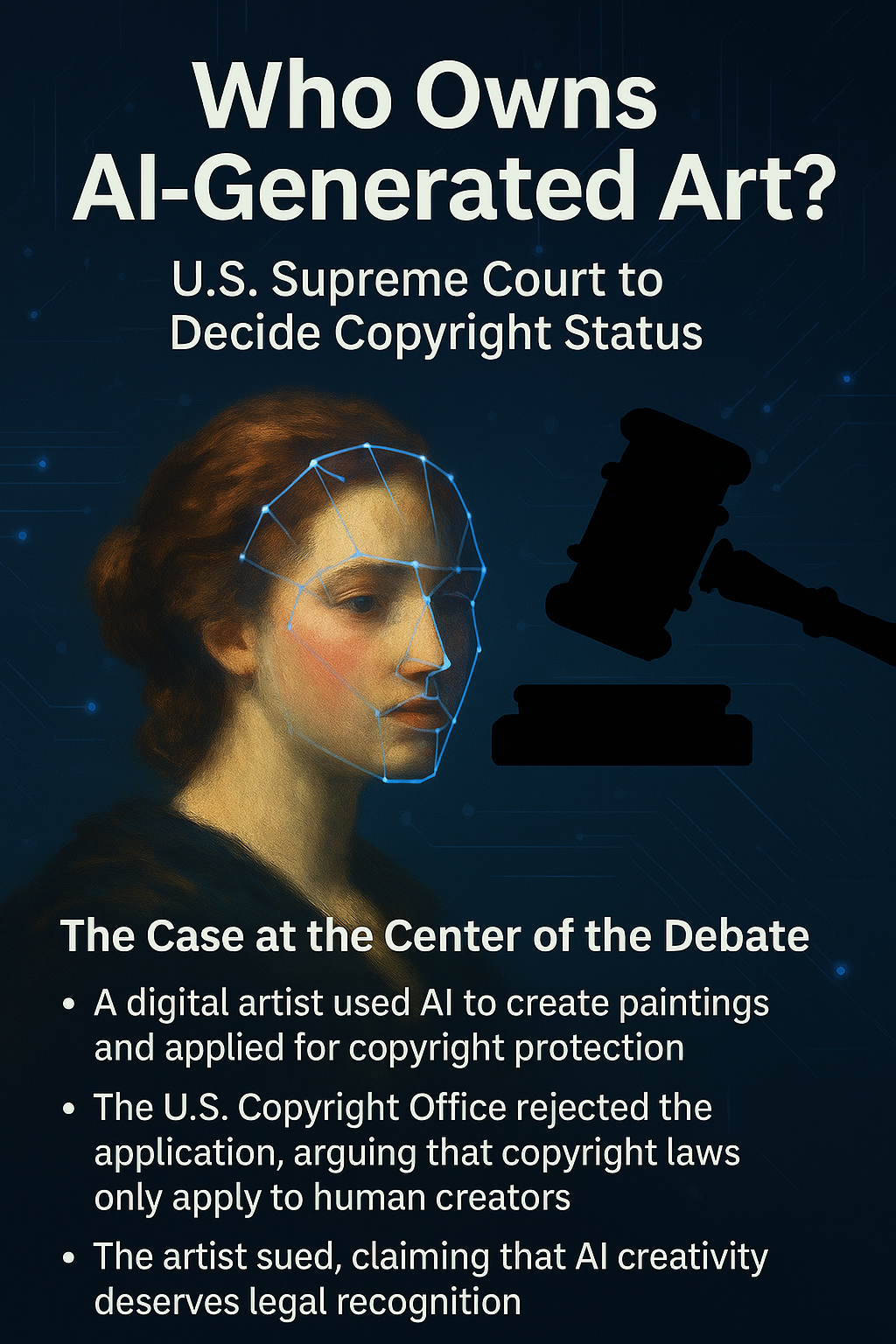
Facts: In recent AI copyright determinations, the U.S. Copyright Office rejected registration of works “created solely by AI without human authorship.”
Implication:
For your animation series, if a human selects prompts, edits frames, or sequences scenes, they can claim copyright.
Fully automated AI outputs may remain in the public domain.
Case 4: Authors Guild v. Google, Inc., 804 F.3d 202 (2nd Cir. 2015)
Facts: Google scanned books and allowed snippets in search results; Authors Guild sued for infringement.
Ruling: The court ruled it was fair use, considering purpose, nature, amount used, and market effect.
Implication for AI Animation:
AI models trained on copyrighted animations may involve copying for transformative purposes.
Using AI to generate a new, transformative animation series may be defensible as fair use, but directly reproducing copyrighted sequences is risky.
Case 5: Andy Warhol Foundation v. Goldsmith, 143 S. Ct. 1258 (2023)
Facts: Warhol used a photograph of a celebrity to create silkscreens. The issue was whether the derivative work was fair use.
Ruling: Courts examined whether the new work transformed the original work with a different purpose.
Implication:
AI-generated animation that transforms copyrighted input significantly can be argued as a new work.
Minimal transformation may lead to infringement liability.
Case 6: Naruto v. Slater’s Logic Applied to AI in Europe (EUIPO)
Facts: EUIPO and EU courts have clarified that copyright requires human creativity, consistent with the Berne Convention.
Implication:
For EU-produced or distributed AI animations, human authorship is mandatory.
Companies often credit prompt engineers, editors, or directors to claim copyright ownership legally.
3. Practical Takeaways for an AI-Generated Animation Short Series
Human Creative Control Matters:
The more you guide, edit, and curate the AI output, the stronger your copyright claim.
Examples: sequencing scenes, designing characters, adding unique dialogue.
Training Data Risks:
Avoid using copyrighted animations as training data without a license.
Cases like Authors Guild v. Google suggest some fair use defense, but it is limited and jurisdiction-dependent.
Derivative Works:
Transformative AI creations are safer than near-identical copies.
Courts assess whether the AI output adds new expression, meaning, or message.
Registration:
In the U.S., the Copyright Office will only register works with human authorship.
Europe follows a similar principle.
Contracts and Licensing:
Document human involvement in creation.
If multiple people operate the AI, define authorship in contracts to prevent disputes.
Summary Table: Key Cases and Their Lessons for AI Animation
| Case | Year | Key Issue | Lesson for AI Animation |
|---|---|---|---|
| Naruto v. Slater | 2018 | Non-human authorship | AI cannot hold copyright alone |
| Feist Publications | 1991 | Originality | Human creative input is essential |
| Authors Guild v. Google | 2015 | Fair use of copyrighted material | Transformative AI use may be fair use |
| Andy Warhol Foundation v. Goldsmith | 2023 | Derivative works & fair use | Significant transformation protects from infringement |
| EUIPO rulings | 2020s | Human authorship requirement | EU law mirrors U.S. – human creativity required |
💡 Bottom Line:
AI-generated animation is copyrightable only when humans meaningfully contribute. Using AI as a tool is fine, but relying on fully autonomous AI output can leave your work unprotected. Always document human creative input and be cautious with copyrighted source material.
RELATED Blog





comments