



Copyright Governance Of AI-Generated Astronomical Visualization And Simulations.
I. FOUNDATIONAL COPYRIGHT PRINCIPLES
Before analyzing case law, it is essential to understand the doctrinal pillars:
Originality requirement – Work must originate from a human author.
Fixation requirement – Must be fixed in a tangible medium.
Idea–expression dichotomy – Facts (like astronomical data) are not protected.
Human authorship doctrine – Copyright requires human creativity.
Astronomical simulations are complex because they combine:
Raw scientific data (facts)
Computational modeling (algorithms)
Artistic visualization (color mapping, perspective, rendering)
The copyright status depends on which layer we examine.
II. KEY CASE LAWS
1. Feist Publications, Inc. v. Rural Telephone Service Co.
Facts
Rural Telephone compiled a phone directory. Feist copied listings.
Legal Principle
The U.S. Supreme Court held:
Facts are not copyrightable.
Compilations require minimal creativity.
Relevance to Astronomical AI Simulations
Astronomical data (star positions, cosmic radiation measurements, telescope outputs) are facts of nature. Therefore:
Raw data from Hubble or James Webb cannot be copyrighted.
AI simulations built purely from factual astronomical coordinates may lack originality unless creative choices are made.
Thus:
✔ Color mapping, framing, interpretive rendering → potentially protectable
✘ Underlying star coordinates → not protectable
Feist establishes that astronomical databases alone are not copyrightable without creative selection or arrangement.
2. Burrow-Giles Lithographic Co. v. Sarony
Facts
Concerned copyrightability of a photograph of Oscar Wilde.
Holding
The Court ruled photographs are copyrightable because:
The photographer makes creative choices (pose, lighting, composition).
Relevance
Astronomical visualization often resembles photography — but enhanced by AI.
If a human:
Selects dataset
Adjusts simulation parameters
Chooses angles, color grading, contrast
Then under Burrow-Giles logic:
The visualization may be copyrightable.
However, if AI autonomously generates the image with minimal human control, authorship becomes questionable.
This case underpins modern recognition of creative input in scientific imaging.
3. Naruto v. Slater (The “Monkey Selfie” Case)
Facts
A monkey took photographs using a photographer’s camera.
Holding
Animals cannot own copyrights.
Only humans can be authors under U.S. law.
Relevance to AI
This case strongly influences AI governance.
If:
A non-human agent (monkey or AI) produces work independently,
There is no human author,
No copyright exists.
Applied to astronomical AI simulations:
If AI autonomously generates cosmic simulations with no human creative control,
→ The output likely falls into the public domain under current U.S. interpretation.
This reasoning has influenced U.S. Copyright Office guidance on AI-generated works.
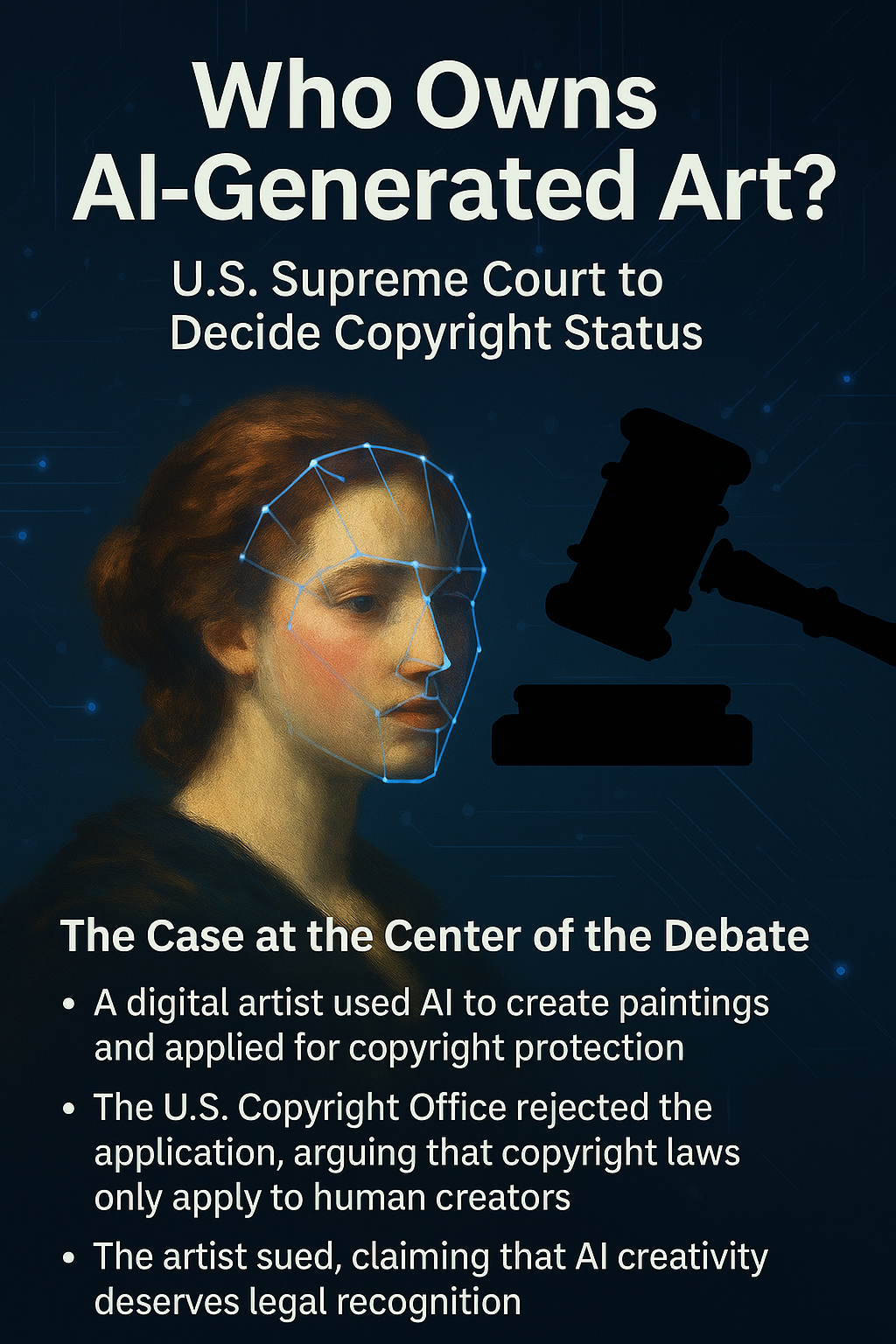
4. Thaler v. Perlmutter
Facts
Stephen Thaler attempted to register artwork created solely by his AI system.
Holding
The court confirmed:
Copyright requires human authorship.
AI-generated work without human involvement is not registrable.
Relevance
This is directly applicable to astronomical AI simulations.
If:
A research institution uses a generative AI to autonomously simulate exoplanet environments,
And no human meaningfully contributes creative choices,
→ No copyright protection attaches.
However:
If humans guide prompts, adjust simulation physics, or curate outputs,
→ Hybrid authorship may exist.
This case is currently central in AI copyright governance.
5. Authors Guild v. Google, Inc.
Facts
Google digitized millions of books for search functionality.
Holding
The Court ruled:
Large-scale copying for transformative use can qualify as fair use.
Relevance to AI Training on Astronomical Data
AI systems trained on:
Scientific publications
Astrophysical datasets
Observatory image archives
May rely on the transformative use doctrine.
If training:
Extracts patterns but does not reproduce original expressive works,
Serves scientific research purposes,
→ Likely defensible under fair use in U.S. law.
This case informs whether AI training on telescope images infringes.
6. Bridgeman Art Library v. Corel Corp.
Facts
Concerned photographic reproductions of public-domain paintings.
Holding
Exact reproductions of public domain works lack originality.
Relevance
If an AI system:
Generates a purely accurate scientific replication of astronomical data
Without creative enhancement
It may lack sufficient originality.
Thus:
Purely technical simulation = likely not copyrightable
Creative interpretive rendering = possibly copyrightable
This case is critical for distinguishing between scientific replication and creative visualization.
7. Andy Warhol Foundation v. Goldsmith
Facts
Concerned whether Warhol’s use of a photograph was transformative.
Holding
The Court narrowed transformative use doctrine.
Relevance
If an AI:
Trains on copyrighted astronomical artwork,
Produces similar visual outputs,
Claiming “transformative use” may not always succeed.
This case signals courts are tightening standards.
III. GOVERNANCE STRUCTURE FOR AI-GENERATED ASTRONOMICAL SIMULATIONS
1. Public Domain Data
Data from:
NASA
European Southern Observatory
Is often public domain (especially U.S. federal data).
However:
European datasets may have database rights under EU law.
2. Human-AI Collaboration
Copyright may exist if:
Humans design simulation parameters
Select physical models
Choose rendering aesthetics
Curate final outputs
Without such contribution → No protection under Thaler.
3. International Differences
United States
Strict human authorship requirement.
United Kingdom
Copyright, Designs and Patents Act 1988 §9(3):
The “person by whom arrangements are undertaken” may be author of computer-generated works.
Thus, UK law may protect AI astronomical simulations more readily than U.S. law.
IV. LEGAL CHALLENGES UNIQUE TO ASTRONOMICAL AI
1. Simulation vs Discovery
If AI predicts unknown cosmic structures:
Is it discovery (fact)?
Or creative expression?
Courts may treat scientifically accurate outputs as factual, limiting protection.
2. Deep-Space Visualization as Art
If stylized (e.g., colorized nebula art),
Likely protected as artistic expression.
3. Open Science Policies
Space agencies encourage open dissemination, reducing proprietary claims.
V. SUMMARY OF LEGAL POSITION
| Legal Question | Current Legal Position |
|---|---|
| Are raw astronomical datasets copyrightable? | No (Feist) |
| Are purely AI-generated simulations protected? | No (Thaler, Naruto) |
| Are human-guided AI simulations protected? | Possibly (Burrow-Giles logic) |
| Is AI training on datasets infringement? | Often defensible under fair use (Authors Guild) |
| Are exact scientific reproductions protected? | No (Bridgeman) |
VI. CONCLUSION
Copyright governance of AI-generated astronomical visualizations depends on:
Human creative involvement
Nature of underlying data (fact vs expression)
Jurisdiction
Purpose of AI use (research vs commercial art)
Under current jurisprudence, fully autonomous AI-generated cosmic simulations likely fall into the public domain in the United States. However, hybrid human–AI works may qualify for protection where meaningful creative control exists.
As AI advances in astrophysics — particularly in exoplanet modeling, dark matter simulations, and cosmic microwave background visualization — legislatures may eventually introduce sui generis AI authorship rules. Until then, courts rely heavily on traditional doctrines established in the cases above.
RELATED Blog



comments