



Copyright Challenges In Polish AI-Curated Digital Galleries.
Copyright Challenges in Polish AI‑Curated Digital Galleries
With Detailed Case Law and Legal Reasoning
(Currently, *Poland doesn’t yet have specific court rulings on AI content itself, so relevant case law includes key EU and related decisions that shape the Polish landscape)
📌 1. Can AI‑Generated Works Be Copyrighted?
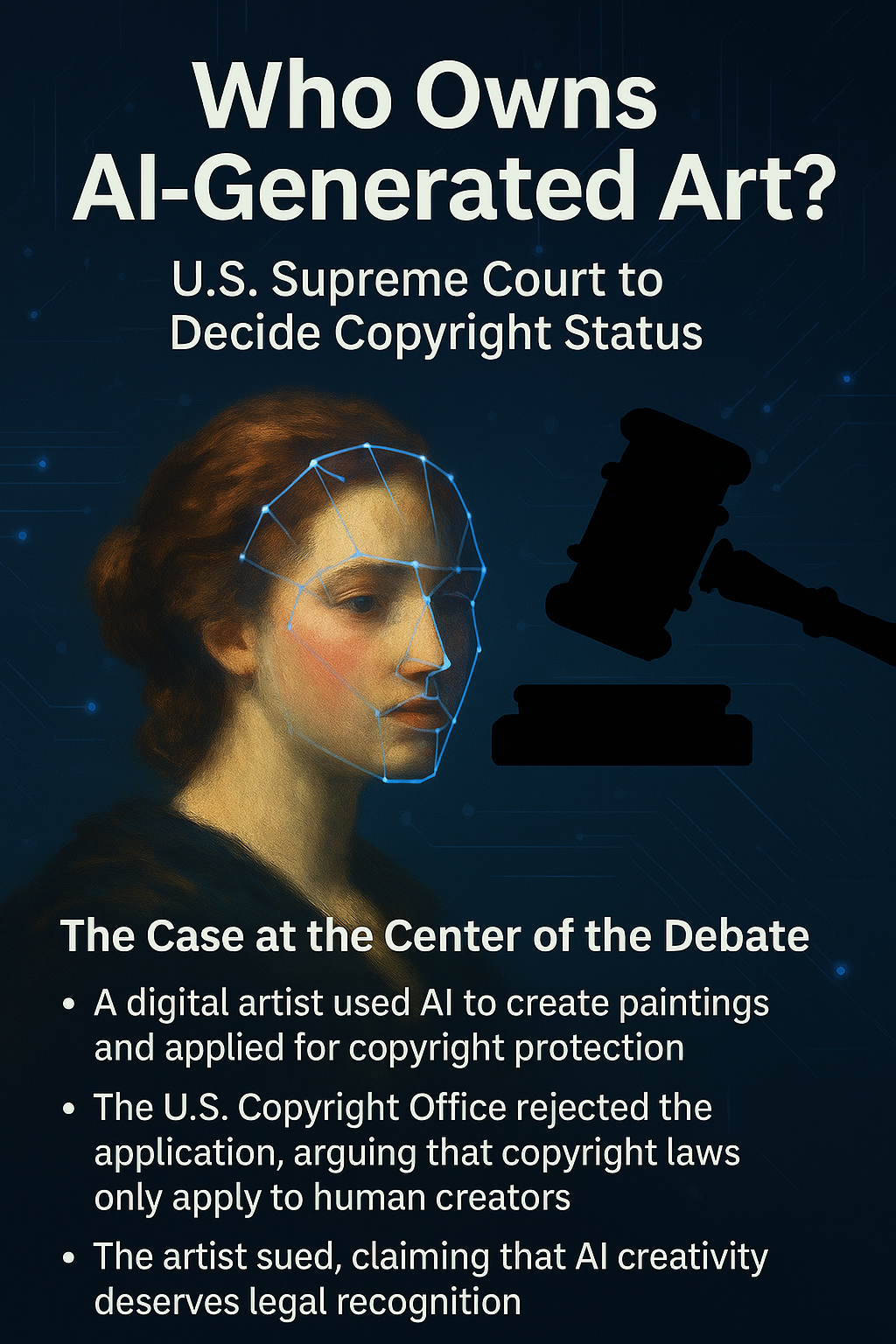
This is the most fundamental question: if an AI system generates a work featured in a digital gallery, does copyright protect it? Under Polish Copyright Law, a work must be the result of human creative activity by a natural person. There is no specific Polish precedent yet, but European and comparative jurisprudence make the contours clearer.
Case 1 — Prague Municipal Court (Czech Republic): First European Ruling on AI‑Generated Work (2024)
Facts:
A person generated an image using the AI tool DALL‑E and displayed it on their website. A local law firm copied it and posted it on their own site. The claimant sued for copyright infringement.
Issue:
Is an AI‑generated image eligible for copyright protection?
Can the person who entered the prompt be considered the author?
Holding:
The court ruled that the work was not protected by copyright because:
AI cannot be an author — only a natural person can be an author under EU copyright law principles.
The claimant failed to sufficiently prove they personally created the image or provided the decisive creative input.
Even the prompt was deemed an idea — not a protectable original work.
Legal Impact:
This decision — one of the first in Europe — suggests that AI‑generated content lacking clear human creative decisions will not be copyrightable. It also highlights the evidentiary burden on users to show actual creative control.
Why This Matters to Polish AI Galleries
Poland, as an EU member, implements unified EU copyright principles. If an AI‑generated artwork appears in a Polish digital gallery, rights cannot be automatically assumed. Without human creative authorship, no copyright exists to enforce — meaning:
The gallery cannot claim rights.
Third parties may copy the work freely, as no exclusive rights are enforceable.
This undermines any strategy of licensing or royalties for AI‑generated artworks without significant human involvement.
📌 2. Training Data for AI and Copyright Infringement
AI models behind digital galleries typically require huge datasets of images, texts, and metadata. Using this material without permission can itself violate copyrights, even if the output is different. This issue is currently one of the most litigated topics worldwide.
Case 2 — EU Text and Data Mining Directive Implementation Debate (Poland)
Not a court decision, but a major regulatory legal dispute with case‑law potential.
Context:
Under EU Directive 2019/790 (DSM Directive), rights holders may opt out of having their works used for text and data mining (TDM) including machine learning. In Poland’s draft implementation, the government considered excluding training generative AI models from TDM exceptions.
Legal Consequence:
If training generative AI models on copyrighted works is excluded from TDM exceptions, every copyrighted work used for such training would require a licence from the copyright holder, creating enormous legal and practical barriers.
This ongoing legal restructuring illustrates the tension between:
Developers wanting to use copyrighted works to train models
Rightsholders wanting compensation and control
Case 3 — ZAiKS (Polish Society of Authors) Reservation Against TDM
ZAiKS, Poland’s leading collective rights organisation, has issued a legal reservation of rights that expressly states that any TDM (including AI training) involving works it represents is an infringement unless licensed. Rightsholders argue that none of their repertoire may be mined without consent.
Legal Importance:
This is not a court decision yet — but functions like an enforceable contractual position under Polish law.
It forces AI galleries using Polish‑authored content to obtain licences or face liability.
📌 3. Who Owns Rights When Human Inputs and AI Mix?
Many Polish AI galleries incorporate AI outputs further modified by curators. What is the copyright status then?
Case 4 — Draft EU Policy and National Law Interpretation
Under EU and Polish law, a purely AI output without human creative contribution lacks copyright. But if substantial human creative decisions are added, new protections may arise for the human contribution.
Polish courts haven’t ruled on this yet. But European principles suggest:
Partial human creative input (editing, selection, contextual arrangement) could generate protectable works.
License agreements and contracts must carefully distinguish what portion of creative work is “human” versus “algorithmic”.
This is a growing area of litigation and likely to generate future Polish precedents.
📌 4. Infringement by Galleries vs. Original Copyright Owners
Even if AI galleries curate legal content, they may inadvertently distribute infringing material if:
They use unlicensed copyrighted works in galleries
They redistribute high‑fidelity reproductions of copyrighted works
Case 5 — EU Commission and CDSM Enforcement Precedents
The EU’s DSM Directive requires Member States to protect rights holders’ interests. Implementations of Article 4(3) require that generic access provisions respect rights holders’ reservations.
When AI galleries make potentially infringing copies without consent, they:
Could be liable for civil damages
May face injunctions to remove galleries or disable access
Poland must implement these provisions in its national laws, so galleries must comply — or risk enforcement actions based on EU copyright law.
📌 5. Derivative Works, Similarity, and Copyright
AI models trained on copyrighted images might generate images or galleries that are too similar to protected works.
While no Polish case directly exists, international jurisprudence suggests:
Even if AI output is not directly copied, if it’s substantially similar to a copyrighted work, liability can attach.
This depends on how much of the original’s expressive content is reproduced.
This is a major legal thread that will soon see cases in EU courts.
Summary of Key Legal Challenges
| Challenge | Legal Principle | Case/Example Support |
|---|---|---|
| AI content has no copyright if purely machine‑generated | Human authorship required | Prague Municipal Court AI ruling |
| Training AI on copyrighted works may infringe if no licence | DSM Directive & Polish implementation debate | Polish TDM implementation controversy |
| Rights holders reserve against TDM use of their works | Opt‑out mechanisms | ZAiKS reservation against TDM |
| Human creative input may create new copyright rights | Human creative threshold | EU analysis of originality requirements |
| Derivative & substantially similar AI outputs could infringe existing works | Substantial similarity tests | Legal commentary and DSM Directive context |
Conclusion
Copyright challenges for AI‑curated digital galleries in Poland hinge on two core conflicts:
🧠 1. Who owns the rights?
AI itself is not a legal person and cannot be a copyright holder. Unless significant human creative decisions are involved, AI outputs typically lack copyright protection.
📚 2. What rights are infringed?
Even if a gallery displays AI outputs, it may still infringe the rights of original creators — especially in training datasets or if it features works that imitate pre‑existing copyrighted works without authorization.
Determining these issues requires:
Careful legal analysis
Licensing strategies
Clear documentation of human creative inputs
RELATED Blog



comments