



Ai Licensing Frameworks For Cloud Services.
AI cloud services are becoming central to modern IT infrastructure, enabling businesses to deploy machine learning models, predictive analytics, and AI-powered applications without managing physical infrastructure. Licensing AI in cloud environments involves intellectual property (IP), data rights, user agreements, and compliance with software licenses.
1. Key Concepts
(a) AI in Cloud Services
Delivered via SaaS, PaaS, or IaaS models.
Key components:
AI algorithms
Pre-trained models
Training datasets
APIs and SDKs
Examples:
Google Cloud AI
Microsoft Azure Cognitive Services
AWS AI/ML services
(b) Licensing Frameworks
Proprietary Licensing
Users pay to access AI software hosted on the cloud.
License defines usage rights, restrictions, and liability.
Open Source Components
Cloud providers may include open source AI libraries, triggering compliance requirements (e.g., TensorFlow, PyTorch).
Data Licensing
Training data used to develop AI models may be licensed or subject to privacy restrictions.
Includes third-party datasets, user data, or proprietary datasets.
Usage Restrictions
Licenses often restrict:
Commercial use
Model redistribution
Re-training on proprietary datasets
2. Legal Issues in AI Cloud Licensing
IP Ownership
Who owns models trained on cloud platforms? User, provider, or shared?
Derivative Works
Models trained using cloud-hosted AI may constitute derivative works.
Open Source Compliance
Using open source libraries in cloud AI services can trigger GPL/AGPL obligations.
Data Rights
Compliance with privacy laws (HIPAA, GDPR) for datasets used in AI training.
Liability
Errors in AI predictions or services may raise contractual or tort liability.
3. Landmark Case Laws
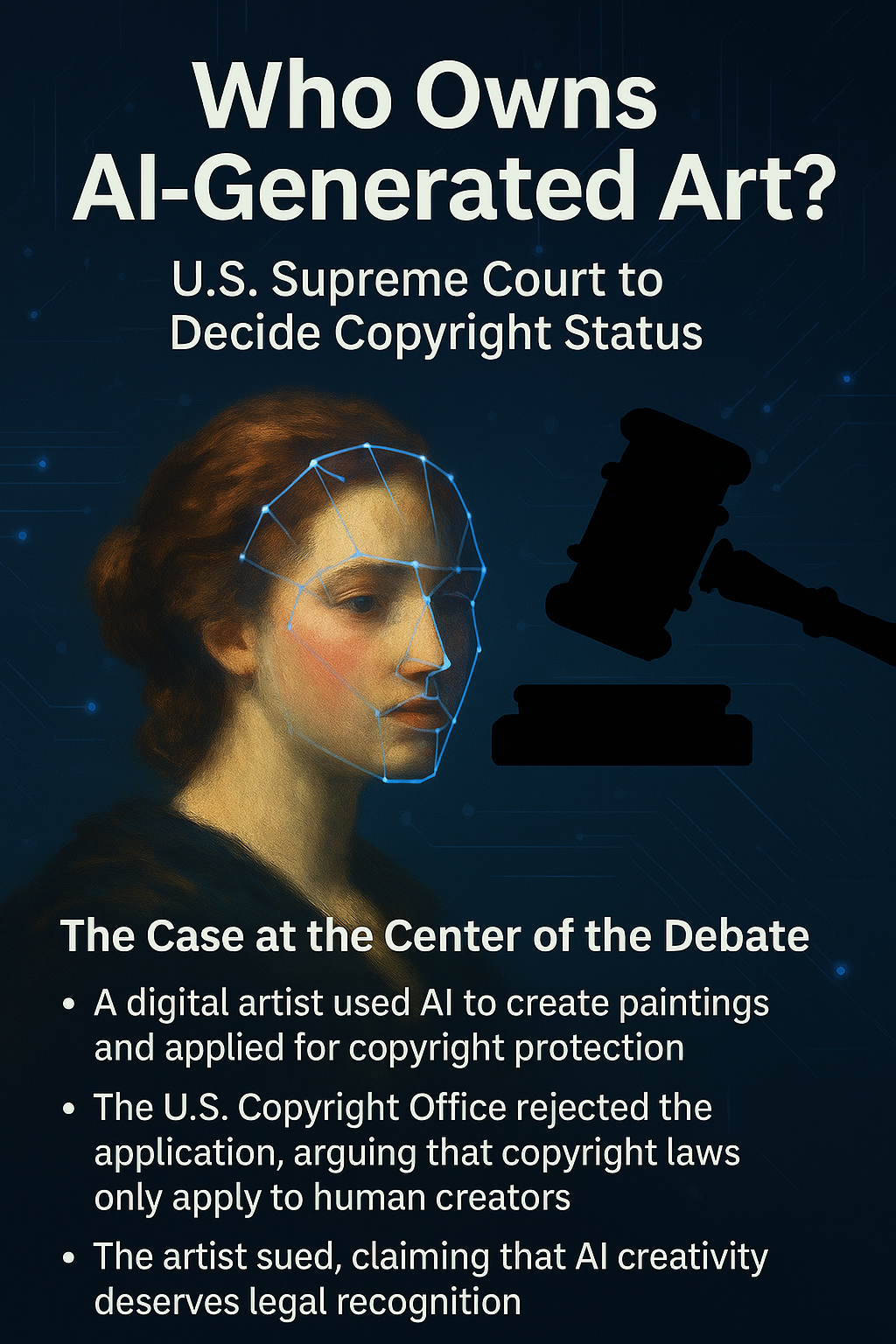
CASE 1: Thaler v. USPTO (DABUS AI) (2020-2023)
Facts
AI DABUS generated inventions, potentially deployable via cloud services.
USPTO rejected patent applications because AI cannot be an inventor.
Holding
Only humans can hold IP rights for AI-generated inventions.
Implications
Cloud-based AI platforms must assign IP ownership to human developers or organizations.
Licensing agreements must clearly define ownership of AI-generated output.
CASE 2: Oracle v. Google (2010-2021)
Facts
Google used Java APIs in Android, some delivered through cloud-based services.
Oracle claimed copyright infringement of APIs.
Holding
Supreme Court ruled Google’s use constituted fair use for interoperability, but highlighted IP issues with software services.
Implications
Cloud AI services using APIs must ensure proper licensing or interoperability defenses.
Licensing frameworks must clarify API usage, redistribution, and derivative rights.
CASE 3: Artifex Software, Inc. v. Hancom, Inc. (2016)
Facts
Artifex distributed Ghostscript under GPLv3; Hancom embedded the software in commercial products without source code disclosure.
Holding
GPL obligations apply to derivative works, even if distributed via cloud-enabled products.
Implications
Cloud providers hosting AI services that include GPL components must ensure compliance with license terms.
SaaS delivery does not always escape copyleft obligations (AGPL may apply).
CASE 4: SAS Institute Inc. v. World Programming Ltd. (UK, 2012)
Facts
SAS sued WPL for replicating SAS software functionality in a cloud-deployed product without licensing SAS’s proprietary software.
Holding
Courts allowed functionality replication but protected software code under copyright.
Implications
Cloud AI services can implement functional equivalents, but licensing must respect IP in original code.
SaaS AI providers must ensure proprietary code is not illegally reproduced.
CASE 5: BusyBox Litigation in Embedded Cloud Services (2007-2013)
Facts
BusyBox (GPL software) embedded in cloud-based devices and IoT platforms.
GPL violations occurred due to lack of source code release.
Holding
Courts ruled that GPL applies even in network-accessed cloud/embedded environments, particularly under AGPL terms.
Implications
Cloud AI providers using open source must release code or comply with license obligations.
Licenses for cloud AI must clarify derivative works and source code responsibilities.
CASE 6: IBM Watson Health Controversy (2018)
Facts
IBM Watson AI provided cloud-based diagnostic recommendations.
Concerns arose about accuracy and data ownership.
IP/Regulatory Implications
Licensing agreements addressed:
Ownership of models trained on client data
Liability for AI predictions
Confidentiality of medical datasets
Implications
Cloud AI licensing frameworks must explicitly address client data and output ownership.
Contracts often include indemnity, compliance, and service-level guarantees.
CASE 7: Microsoft v. TomTom (2009)
Facts
TomTom used Linux-based navigation software with Microsoft patents in cloud-connected services.
Microsoft claimed patent infringement.
Holding
Settlement required patent licensing for embedded and cloud-connected devices.
Implications
Cloud AI licensing must consider third-party patents for software and algorithms.
IP due diligence is critical before offering cloud-based AI services.
4. Observations
Cloud Licensing Requires Clarity
Must define who owns models, training datasets, and derivative outputs.
Open Source Compliance
GPL, AGPL, and other OSS licenses must be carefully managed in cloud deployments.
Data Rights and Privacy
Licenses should define usage, storage, retention, and rights to train models on user data.
Liability and Risk Management
AI cloud contracts often include:
Warranty disclaimers
Indemnification clauses
Data compliance guarantees
Global Considerations
Licensing frameworks must address cross-border data and IP laws, especially for cloud AI accessible worldwide.
5. Key Principles for AI Cloud Licensing
| Principle | Application |
|---|---|
| Ownership of AI Outputs | Specify if user or provider owns trained models or predictions |
| Open Source Compliance | Ensure OSS components comply with licenses (GPL/AGPL/MIT) |
| Data Licensing | Define rights for training, storage, and derivative datasets |
| Liability & Indemnification | Clarify responsibilities for errors or IP infringement |
| Cross-Border Enforcement | Address IP and data laws in multiple jurisdictions |
6. Conclusion
AI licensing for cloud services sits at the intersection of IP law, software licensing, and contractual frameworks:
AI-generated outputs must have clearly defined ownership (Thaler).
Using APIs and software components in cloud environments requires compliance with licensing and interoperability laws (Oracle v. Google, SAS v. WPL).
Open source AI libraries in the cloud require careful management of copyleft obligations (Artifex, BusyBox).
Cloud contracts must clearly handle data rights, liability, and IP enforcement.
Global cloud deployment introduces cross-border IP and regulatory challenges.

RELATED Blog



comments